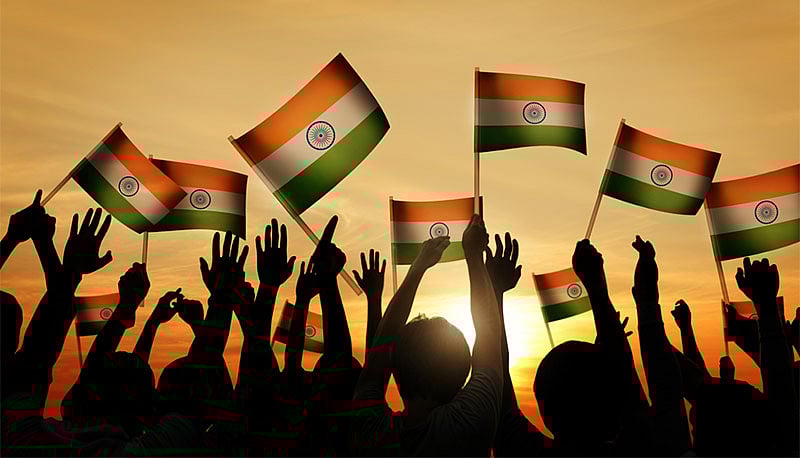
Some twenty years ago when Dr. Amartya Sen published his ‘The Argumentative Indian’ he perhaps did not foresee that soon his India would really take each and every issue and debate about it. No wonder a national song ‘Vande Mataram’ [Mother, I bow to you] that inspired generations of freedom fighters, violent and non-violent alike, would be a hotly debate issue in 2025! That is exactly what India has become these days.
Monday, the first day of winter session of Parliament witnessed heated discussion on this song written by Bankim Chandra and was published in the year 1882 as part of his novel ‘Anandmath’ which was written in Bengali. This song was originally written in Sanskit and which was officially adopted by the Indian National Congress in 1905. Those days the nationalist movement was it its peak and Congress adopted it to further the pan-Indian feelings among the patriot Indians. Same song was adopted as ‘national song’ in the Republic India on 26th January 1950, ‘Jan Man Gan’ became the national anthem. 2025 marks the 150th year anniversary of the song.
As the history has it, the song was partly composed in Sanskit and partly in Bengali in the year 1875. It was included in Bankim Chandra’s novel which, as per the fashion of that era, was serialized in the magazine Bangadarshan. In the year 1896 Rabindranath Tagore not only composed its tune but also sang it for the first time at the Congress session. When the Bengal Partition was announced in 1905 by Lord Curzon, song was on everybody’s leaps. Despite the language barriers, it spread to the every nook and cranny of the country.
Now to understand the true import of the song, let us quickly understand the central theme of the novel ‘Anandmath’ which narrates the story of Hindu sanyasi rebellion of 1776 against the Muslim rulers who ruled Bengal province for a long time. Understand the main thrust of the novel: it was a Hindu rebellion against the Muslim rulers. Consequently some stanzas of the song had direct references to unjust rule of the Muslims and an appeal to rebel. No wonder when the song became extremely popular during the 1920s and 1930s, it also divided the Congress as the Muslim leaders objected to Vande Maratam. As note the song had strong invocations to Hindu goddess against the Muslims rulers. Congress, with its secular outlook had to take cognizance of these objections. Pandit Nehru was the Congress president then and appointed a committee of Tagore to study these objections. It is interesting to note that Subhash Chandra Bose wanted all eight stanzas of the poem to be adopted by the Congress. The Tagore committee accepted that out of eight stanzas, six had direct references to Hindu gods and they should be dropped. This suggestion was accepted and accordingly only two stanzas were adopted by the Congress. The six stanzas of Vande Mataram, which were dropped, described the motherland in explicit Hindu terms. It invoked Hindu deities like goddess Durga and celebrated Hindu monks fighting against the Muslim rulers in Bengal province.
Tagore committee further observed that it was easy to separate first two stanzas from the remaining six stanzas. The gentle devotion and celebration of this land’s beauty and blessings described in these two stanzas held a unique charm. "I freely concede that the whole of Bankim's Vande Mataram poem, read together with its context, is liable to be interpreted in ways that might wound Moslem's susceptibility, but a national song, though derived from it, which has spontaneously come to consist only of the first two stanzas of the original poem, need not remind us every time of the whole of it, much less of the story with which it was accidentally associated. It has acquired a separate individuality and an inspiring significance of its own in which I see nothing to offend any sect or community," Tagore wrote back to Nehru in October 1937. The Congress Working Committee [CWC] met in Calcutta later that month with Gandhi, Nehru, Patel, Bose, Azad and Prasad in attendance. The CWC decided that ‘whenever and wherever Vande mataram is sung, only the first two stanzas should be sung, with perfect freedom to the organisers to sing any other song of unobjectionable character in addition to, or in the place of, Vande mataram song," Gandhi declared at the Calcutta session in 1937.
The issue did not stop there and after Independence, the Constituent Assembly [CA] adopted the song as National Song alongside Jan Gana Mana as the National Anthem. Consequently in Republic India, the first two stanzas are regularly sung in schools, at events and in stadia. The new version by A R Rahman is hugely popular.
Now in its 150 anniversary the truncated version of the original song is precisely is the main attack of Prime Minister Modi in Parliament on Monday. He said that the crucial verses of Vande Mataram removed and commented that this partition of the song sowed the seeds of the country’s eventual partition. Tuesday similar discussion will be held in Rajyasabha. That apart, has not time come that we keep some issues and songs beyond political debate? Must every issue be politicized?
Prof. Dr. Avinash Kolhe.

