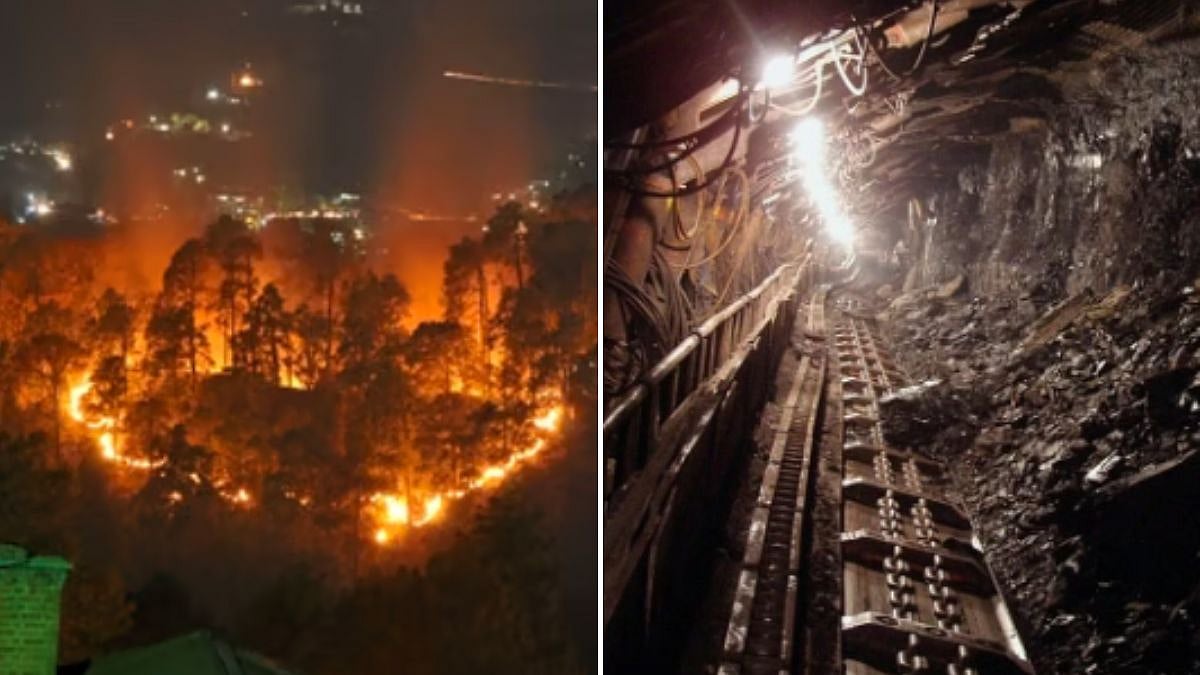
The new year has not started well for our Himalayan forests, which are engulfed by unseasonal fires that have spread across Uttarakhand, Himachal Pradesh, and Kashmir. There has been little snow or rain this winter, and these dry conditions have left our forests highly combustible. This has provided the timber mafia a golden opportunity to acquire these shrivelled logs to be auctioned for a good price. And once the forests are cleared, the land mafia can step in to make a killing.
According to the World Wide Fund for Nature, we are losing 130,000 square km of forest across the globe on a daily basis. If this loss of vegetation continues unabated, we will have lost forests covering the size of India in the next two decades.
This should be a matter of tremendous concern because over a billion people worldwide are dependent on forests for their livelihood. In India, 275 million, largely tribals (one-fifth of our population), are dependent on these shrinking forests for food and livelihood.
During the last three decades, the focus of successive governments has been on development. Government statistics show that 14,000 square kilometres of forests have been cleared to accommodate 23,716 industrial projects in this period.
Key forests presently under threat include global biodiversity hotspots, such as the Western Ghats, the central Indian forests of Hasdeo Arand and Mahan, the forests of the Himalayas, and the mangrove forests of the Sundarbans, to cite a few examples. The problem is that coal blocks and minerals are located below these forests. With large-scale mining leases having been distributed to industrial houses to start coal mining operations, vast swathes of forests are facing the chopping block.
To cite an example, we are presently in danger of losing the Hasdeo Arand forest. Spread over 1.70 lakh hectares in Chhattisgarh, this is the last contiguous stretch of dense forest in central India. Not only is this forest the ‘lung of central India’, but it also plays a key role in regulating the climate, apart from being home to 640 floral species, 128 medicinal plants, 92 bird species, and numerous endangered animals.
Worse, mining in the catchment area of the Hasdeo river will disrupt the water supply for both agriculture and industry, jeopardise the future of the Bango dam, and adversely affect the livelihoods of five million people who are dependent on the dam’s water supply.
Densely packed below the surface of this forest are ‘black diamonds’—an estimated five billion tonnes of coal deposits. Unlike most coal blocks, these are said to be closer to the surface, hence easier to mine and lighter on initial overheads, making Hasdeo Arand an attractive proposition for the coal mining lobby.
The problem is the government needs coal, and there is pressure on the Ministry of Coal to increase coal production. According to ministry estimates, coal production rose to 784.41 million tonnes between February and April 2023, an increase of over 15 per cent. Their target was to touch 1.31 billion tonnes by 2024-25. To achieve this goal, 141 new coal blocks have been auctioned.
Odisha Chief Minister Mohan Charan Majhi is also under pressure to increase coal and mineral production. A few weeks into Majhi's chief ministership, his Deputy Chief Minister Vijay Kumar Sinha submitted a memorandum urging Majhi to expedite the transfer of forest and private land in Naini block to the Singareni Collieries Company Ltd, insisting they had received all environmental and forest clearances, which was not the case.
In neighbouring Madhya Pradesh, one of the first decisions taken by the BJP leader, Mohan Yadav, after becoming chief minister was to approve the setting up of 13 coal mines within a period of six months. Yadav also okayed the setting up of 5,895 mines for minor minerals.
The problem with this increased mining activity is that it is meeting stiff resistance from the local tribal population, who warn that not only will mining adversely affect their water security but will also endanger the entire ecosystem from which they draw sustenance. For these tribals, these ancient trees are gods. Their forests fall under the Fifth Schedule, where no decision can be taken without the consent of the tribal population. But the tribal leaders claim falsified gram sabha records are being presented before the administration. They are demanding court-monitored referendums to ensure their lands are not taken away from them.
Odisha-based Dalit activist Lingaraj Azad, who has been part of the anti-mining protests for the last two decades, said they have told the “state government that excessive amounts of mining threaten our water security and ecosystems.”
The original inhabitants of Hasdeo, who include the Gond and Oraon tribes, have been protesting the expansion and have been protesting since last year. Alok Shukla, winner of the 2024 Goldman Environmental Prize, has been organising the pushback under the banner of the Hasdeo Aranya Bachao Sangarsh Samiti for the past decade.

Shukla says, “People’s lives and livelihoods are at stake. We want the Surjuga forest in Ambikapur district (where the extension is being sought to start yet another coal mine) to remain undivided and unfragmented, and we want to highlight just how much suffering such a move will cause.”
Striking a balance between protecting the environment and ‘development’ is not an easy task. The government needs to remember that forests help in maintaining the water balance of nature by storing water during the monsoons and making this water available during the long summer months. It must not forget that we are a water deficit nation, and as far back as 2019, the Niti Aayog had sent out a stern warning that 600 million Indians are facing extreme water stress.
Prior to general elections, Modi had assured Adivasis that their jal, jangal, and zameen (water, forests, and land) would not be threatened. Following the formation of the three BJP state governments in Madhya Pradesh, Odisha and Chattisgarh, the reverse is taking place. Surely some via media must be arrived at. Must the price of development be paid by our last remaining virgin forests and indigenous communities, who will end up losing their land, livelihood, and way of life?
Rashme Sehgal is an author and an independent journalist.

