It is no secret that traffic rules are followed mostly in the breach in India, and the physical infrastructure in cities and towns is not conducive to orderly vehicular movement. What is also true is that fine challans are ignored by motorists, since there are no serious consequences.
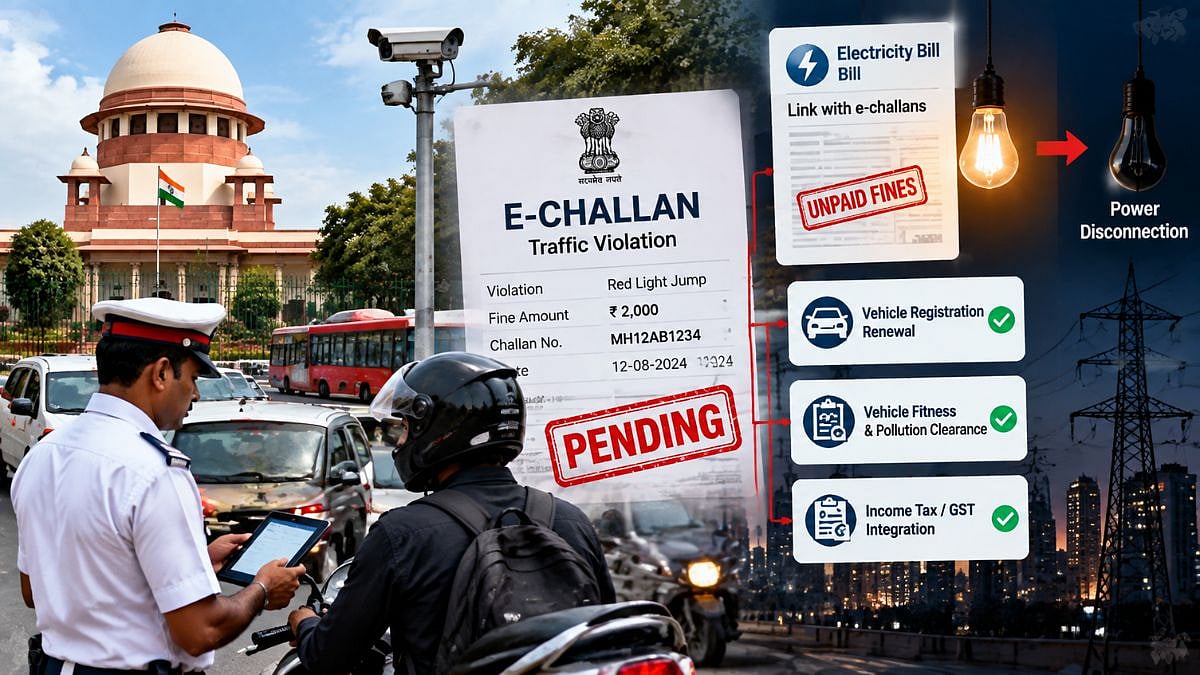
The Supreme Court has now come up with suggestions on how governments can realise the accumulated unpaid fines of about Rs 20,000 crore from e-challans totalling Rs 45,000 crore. Reviewing the 14-year-old writ petition in the road safety case filed by Tamil Nadu orthopaedician S. Rajaseekaran, the court asked the government to consider linking e-challans with electricity bills to ensure that failure to pay would lead to power disconnection.
Besides this viable recommendation, Justices J.B. Pardiwala and K.V. Viswanathan called upon the government to consider linking the challans to the renewal and transfer of the Registration Certificate, vehicle fitness, and pollution control clearances.
These are potentially efficacious remedies to the problem of unpaid traffic fines and can be easily implemented using databases for motor vehicles and electricity connections. Other possibilities too exist, such as linking the challans to income tax, GST, and immigration databases, the latter already in vogue in some countries.
However, the court must ensure that, other than due process in hearing challenges to challans, discretionary cancellation should be removed to ensure equity. Given the strong influence of VIP culture in India, the high and mighty usually avoid penalties that the average citizen cannot escape.
Court Emphasis On Accountability
The emphasis of the court on reviewing the implementation of its various directions in Rajaseekaran vs. Union of India is to be welcomed, since the evidence on the ground points to governmental indifference towards the orders for more than a decade.
Arguably, the biggest lapse is in failing to constitute a technically competent National Road Safety Board and choosing to form a weak one with advisory functions.
Many cities are reeling under the impact of haphazard building, lack of paved roads, total absence of usable footpaths, an indulgent acceptance of free street parking of cars and stunted district-level trauma handling capabilities.
Road Safety Needs Strict Enforcement
The Union and state administrations have been taking the unconscionable loss of life—1.77 lakh deaths in 2024—and lakhs of severe injuries in their stride, unmindful of global derision and ridicule.
It is essential, therefore, for the court to fix similar accountability for the administration for patent disregard for road safety through fines imposed on officials responsible for bad roads, poor enforcement, dysfunctional infrastructure, and lack of trauma care facilities.
Realising penalties from the wages of the officials, starting with the highest levels of the civil services, would have a salutary effect. Fortunately, citizen monitoring of rogue behaviour on roads is growing with the wide availability of smartphones and vehicle and helmet cameras. Strict enforcement is the biggest missing piece.

