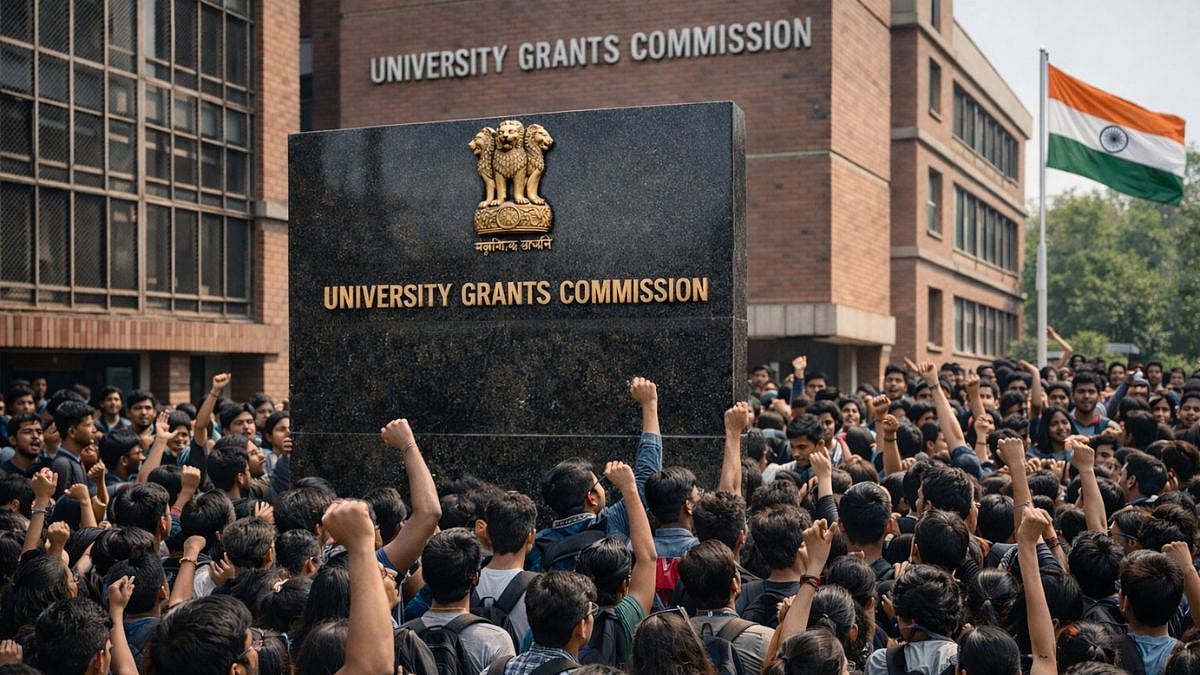
One persistent and normalised aspect of Indian society at all levels is its caste hierarchy and the graded respect and humiliation that it forces people to accept down the hierarchy. Not surprisingly, our higher education institutions (HEIs) are also not immune from these practices on their campuses.
UGC regulations to address discrimination
To deal with caste-based and other similar harassment of students from marginalised backgrounds, for the first time, the UGC issued the Promotion of Equity In Higher Educational Institutions Regulations in 2012.
The regulations defined discrimination in a wide-ranging manner: any distinction, exclusion, limitation or preference which has the purpose or effect of nullifying or impairing equality of treatment in education in particular, depriving a student or a group of students on the basis of caste, creed, religion, language, ethnicity, gender or disability of access to education of any type or at any level.
The regulations prohibited discrimination against students from marginalised groups in admission and unfair evaluation and their harassment on campus. It barred labelling of students by caste/community, their segregation in hostels and other facilities, and publicising names of reserved category students.
Further, HEIs were required to set up an equal opportunity cell to ensure equal access and opportunities for all students. All complaints of harassment and discrimination were required to be resolved within 60 days. These regulations applied to all HEIs in India.
Limitations of the 2012 framework
However, these regulations lacked two key provisions: no penalties for non-compliance and a much weaker mechanism to implement these regulations compared to those governing ragging and sexual harassment complaints. As a result, the 2012 regulations were largely ignored by colleges and universities under the UGC.
Petition in Supreme Court seeking stronger enforcement
In 2019, two mothers—Radhika Vemula, mother of Rohith Vemula (a PhD student who had committed suicide in January 2016 at the University of Hyderabad after facing months of harassment from the administration for protesting against caste-based discrimination on the campus), and Abeda, mother of Payal Tadvi (a post-graduate student and junior resident at the BYL Nair Hospital, Mumbai, who was found hanging by the ceiling fan in her hostel room in May 2019 on account of persistent caste-based harassment and humiliation by her seniors)—filed a petition in the Supreme Court, asking the Court to intervene and strengthen the mechanism for the strict implementation of the Regulations, 2012. In January 2025, the Supreme Court directed the UGC to prepare a more rigorous institutional framework against caste-based discrimination to ensure accountability.
New UGC regulations introduced in 2026
On January 13 this year, the University Grants Commission issued the landmark “Promotion of Equity in Higher Education Institutions Regulations, 2026”, replacing the Regulations, 2012. The 2026 regulations mandate strict, time-bound measures to eliminate caste-based discrimination in Indian Higher Education Institutions (HEIs). According to these regulations, each HEI must establish an Equal Opportunity Centre and an Equity Committee with representation from the SCs, STs, OBCs, minorities, women and persons with disabilities to monitor and report incidents of any identity-based discrimination. Further, the HEIs must appoint equity ambassadors and equity squads to patrol ‘vulnerable spots’ on the campus and to ensure that students from disadvantaged groups are not harassed or excluded from academic and extracurricular activities.
All complaints must be acknowledged within 24 hours and must be resolved within 15 working days. The HEIs are required to submit an annual report to the UGC, giving details of complaints received and actions taken during the period. Those failing to comply with these regulations will face penalties, including the loss of accreditation, and will be debarred from offering degrees and denied participation in UGC schemes. These regulations would govern all central, state, private and deemed universities.
Concerns and criticisms over the new rules
Though these regulations are an important step forward, they are also flawed. While these regulations make it compulsory that the 10-member equity committee must have representation from marginalised groups of students, it does not clarify either the mechanism of representation or the number of representatives. Similarly, Regulations, 2026, fail to clearly define caste-based discrimination, which was, in fact, clearly spelt out in the Regulations, 2012.
Also, the regulations exclude several technical and medical institutions, such as the IITs, the IIMs and the All India Institutes of Medical Sciences. In fact, these prestigious institutions of national importance are places where caste-based and other discriminations are practised quite intensely by both the students and the staff. These regulations also don’t provide any framework to hold the faculty and the administration accountable for numerous forms of discrimination practised by them, especially for the hiring and promotion of faculty from the SC, ST and OBC groups.
Protests and legal challenge
However, in a stark reflection of the complex caste dynamics of the country and its HEIs, as the details of the UGC Regulations, 2026, spread, protests by upper-caste students and groups swiftly erupted in several districts of Uttar Pradesh, who demanded an immediate rollback of these regulations. They also began a sustained online campaign against them. They also filed a petition in the Supreme Court against these regulations, claiming that the caste-based hostility on campuses is not unidirectional and that general category students also face ‘discrimination’. Further, the petitioner claimed that the regulations could be used to frame general category students under false charges.
On January 29, the Supreme Court bench led by CJI Surya Kant stayed the Regulations, 2026, asking the UGC to continue with the Regulations, 2012, till further orders and directing the UGC to get the Regulations, 2026, re-examined by a committee of experts. We have to wait and watch how the case unfolds in the Supreme Court.
Vrijendra taught in a Mumbai college for more than 30 years and has been associated with democratic rights groups in the city.

