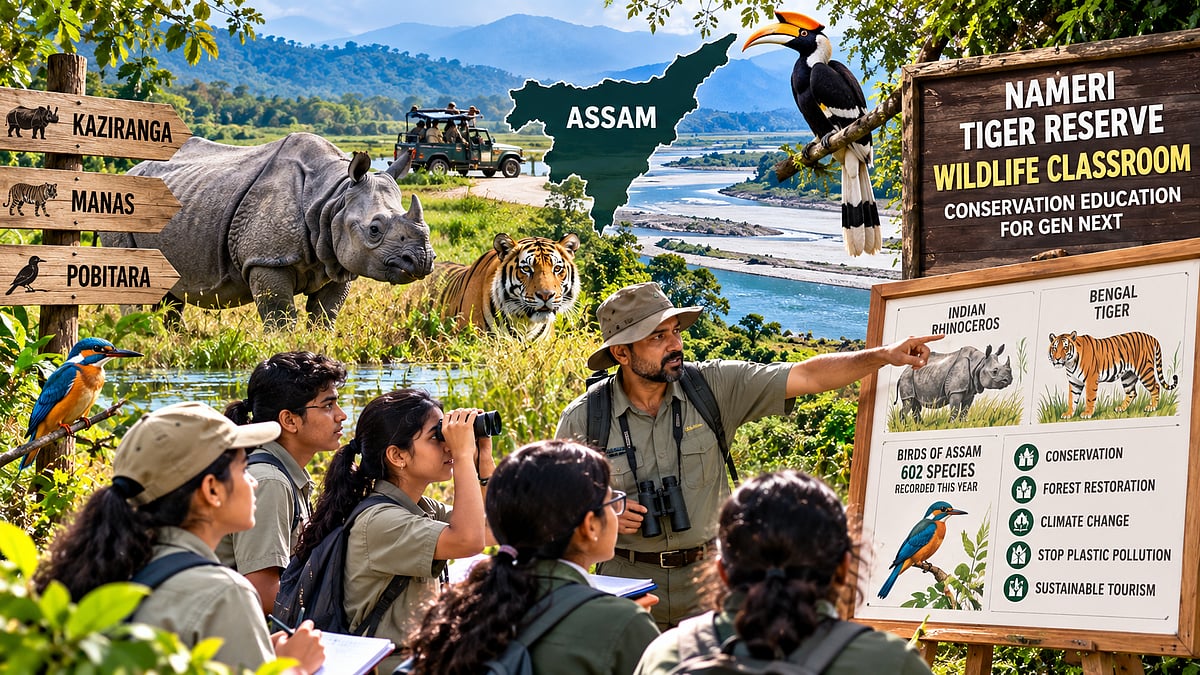
Famed as a wildlife haven hosting one of the best-run sanctuaries in the country, Assam is a living laboratory of good conservation practices. Kaziranga, the crown jewel with its rare mix of large animals led by the Indian rhinoceros and the tiger, sits at the top of a state also known as a birdwatcher’s paradise. Yet, conservation is challenging in a century of growing population, climate change, loss of natural forests, and the threat of local extinctions. The Assam government apparently hopes to prepare for the future by making Gen Next aware of its natural heritage. Its conservation education is led by a new set of wildlife classrooms in Nameri, where students beyond Class 8 can experience nature in the openness of a tiger reserve. That should be thrilling for youth, who can, additionally, take to birdwatching and learn about no less than 602 winged species that have so far been reported this year by private individuals on the Cornell Lab of Ornithology’s eBird database.
Historically, Assam is credited with providing habitats for some 738 bird species, a trove that includes Eurasian and other east Asian species. Kaziranga has also estimated a rise in its tiger population, from 104 in 2022 to 148 adult cats in the last census of 2024. What students will find fascinating is the return of the one-horned rhinoceros in Assam from near-extermination during the British era and the earliest conservation actions of JC Arbuthnott, the officiating commissioner of the Assam Valley districts, and Major Gurdon, whose recommendations in 1902 led to the formation of a protected reserve forest in the era of shikar. In 2020, a population rise of rhinos to about 2,900 was attributed to the Indian Rhino Vision 2020 plan launched in 2005.
Evidently, the success of conservation in Assam must be viewed in perspective. As any diligent student will quickly realise, there are severe problems confronting Assam’s ecology—notably the annual flood and erosion due to the swelling of the Brahmaputra and its tributaries—affecting as much as 31 lakh hectares, the failed initiatives to prevent solid waste and heavy metal pollution in waterbodies, such as Deepor beel, the impacts of oil exploration, resource extraction, and unrelenting climate change. Every wildlife club member is potentially an activist against environmental degradation caused by plastic and urban waste pollution, and building a dedicated community at Nameri could encourage similar efforts elsewhere. The student club members are also wildlifers in the making, who could give a boost to the restoration of degraded forests and rewild good sites to encourage sustainable wildlife tourism. Besides Kaziranga, where similar wildlife clubs could attract devoted youth, Pobitara and Manas are the focus of conservation initiatives. Creating an ecological consciousness among Gen Next can produce right-minded custodians of natural heritage.

