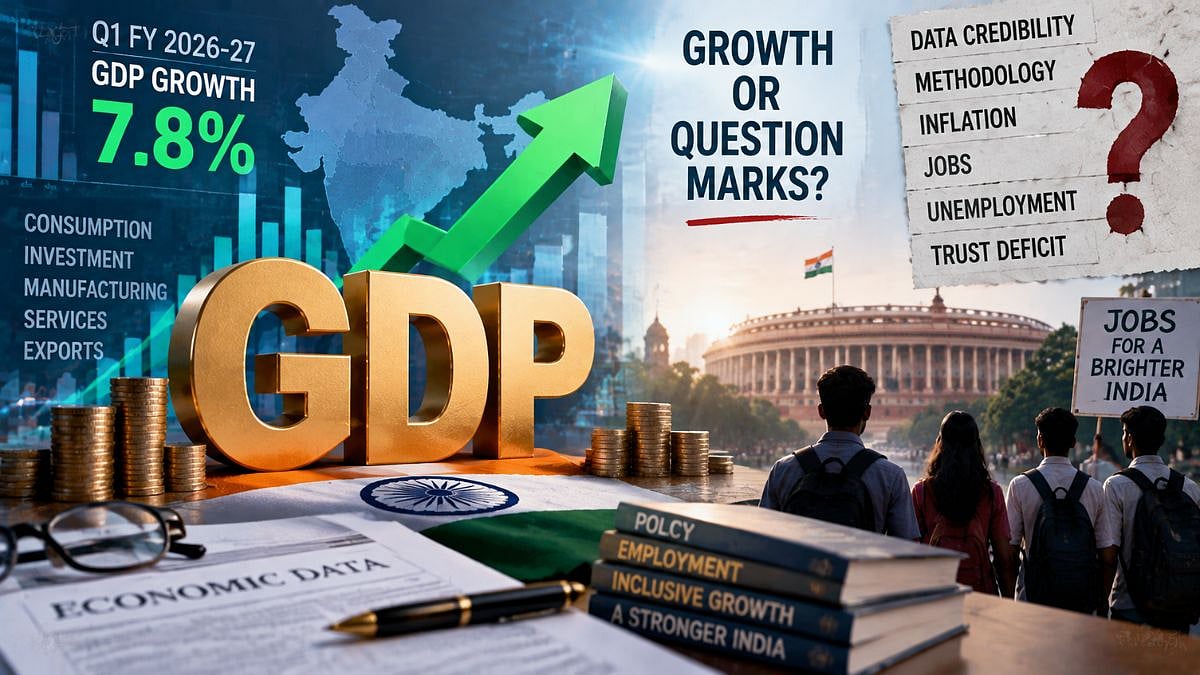
The GDP data for Q1 of FY 2026-27, released a fortnight ago, showed India's economy grew at 7.8 per cent. This came as a big surprise to many because the number exceeded everyone’s expectations. The impressive headline number was a shot in the arm for Prime Minister Narendra Modi and his government, which recently faced scathing student anger at Jantar Mantar and is still struggling to deal with the youth’s longstanding concerns and disappointment with the government’s administrative failure, rising unemployment, and an economic model that many believe no longer delivers on its promise.
The glowing GDP growth suggests that the government may have deftly handled the Middle East oil shock and geopolitical uncertainty. But it also sparked a major controversy over its credibility. One strand of criticism has been that the strength suggested by the GDP does not match how the economy feels. Those who have questions agree on a more fundamental problem—a lack of transparency and statistical credibility in the government’s economic data. The Congress described the GDP numbers as "statistical gymnastics" to “hide India’s bleak economic reality.” So, what explains the lack of consensus?
Questions Over Data Credibility
Over the past decade, critics say the government has “compromised” the integrity of its own data infrastructure, weaponising economic data for political gain and creating a trust deficit. Methodologies have been changed, crucial surveys and datasets have faced long delays, and inconvenient findings have been sought to suppress. What has added to the scepticism is the government’s alleged systematic efforts to hide the truth by changing methodology for many crucial datasets, which include employment numbers, poverty numbers, health data, and consumption data, raising questions about their quality and accuracy.
Not long ago, India’s statistical infrastructure and process commanded a lot of respect, and the government data on economic and social indicators was considered rigorous and satisfactory. At times, there were disagreements on the quality of the estimates, but their independence was widely accepted and found adequate. Critics say this has changed after 2014, raising questions about the robustness and integrity of government data, be it the GDP numbers or claims over outcomes in poverty reduction, hunger, malnutrition, and unemployment.
Nominal And Real GDP Gap
One of the discrepancies Congress leader Jairam Ramesh pointed out in the GDP data relates to the gap between nominal and real GDP, meant to reflect inflation, which, according to the government, is only 2.3 per cent, though in the same quarter the wholesale inflation was more than 9 per cent. This discrepancy "manufactured" by the government, according to Ramesh, by changing the methodology of calculating the GDP twice this year and moving away from the wholesale price index to the producer price index just in time for estimating the latest round of GDP figures has helped “inflate” the aggregate GDP number.
Former finance secretary Subahsh Chandra Garg, who was the first to raise the concern over the data, said economic growth analysis is done in terms of current prices and that the government had drastically revised the GDP at current prices for the first quarter of last fiscal. He contends that it’s because of a massive reduction in the base year’s Q1 GDP at current prices—from Rs 86 lakh crore to 80 lakh crore—that the nominal growth in Q1 of current fiscal is 10.30 per cent, which, after deflating inflation, comes at 7.8 per cent in real terms. If you take the numbers which were put out last year as the GDP at current prices, Garg said, the nominal growth would be around 2.5 per cent for the latest quarter, and the real growth would be close to zero.
Government Defends GDP Revision
The government’s defence has been that last year’s GDP was revised as part of the revision in base year, incorporating new data sources and methodologies. It also rejected the suggestion that the lower base has artificially inflated this year’s first quarter growth. However, the point the former finance secretary has stressed on is that while the revision of earlier GDP numbers is routine and the change in base year takes place periodically, the impact on past numbers is never so significant. The important question he has raised is, how did Rs 6 lakh crore GDP disappear from last year’s nominal Q1 GDP?
Garg’s claim has struck a chord among many Indians faced with day-to-day realities of inflation, living expenses outpacing wages, and scarce job opportunities. Critics argue that the data relies too heavily on formal sector proxies for India’s large informal economy, while economists aligned with the government, like V Anantha Nageswaran, chief economic advisor to the government, and Neelkanth Mishra, India’s executive director at the World Bank, reject claims of political manipulation or data exaggeration. Mishra says it is difficult to keep economics and politics very far apart, a reality that, in his view, explains the controversy around the GDP number.
Debate Over Revised Estimates
Keeping aside political undercurrents to the GDP debate, critics have said that a change in methodology does not explain “what went out of the production to bring down the value of last year’s GDP by Rs 6 trillion”. Garg has claimed that in the last four years, downward revision of earlier GDP numbers has been a recurrent practice, making the year-on-year numbers look impressive. That helps the government create a hype around the Indian economy’s performance. The Congress party has backed Garg's claim, saying that the GDP over the past four years has been “revised down by 43 lakh crore”, which implies that an excess of goods and services was added to the GDP and the same has now been removed.
Nobody is saying that the 7.8 per cent growth is just froth. The percentage of growth can be debated, but beyond statistical disagreement, former RBI governor Raghuram Rajan’s question is equally relevant: if the growth indeed was so rapid, why was India not creating more jobs or attracting more foreign direct investment? Complicating the debate is the reality of many Indians: almost 40 per cent of graduates under 25, a study by Azim Premji University revealed, are unemployed. More damning is a recent report by a government think tank—an estimated 8.7 crore Indians aged between 15 and 29 are neither studying, working, nor doing skill training.
GDP Data Muddies Economic Picture
Clearly, the GDP controversy has muddied the picture for the government, which might have hoped the numbers would help it counter growing criticism about the uneven and unequal nature of India’s progress and growth trajectory.
The writer is a senior independent Mumbai-based journalist. He tweets at @ali_chougule

