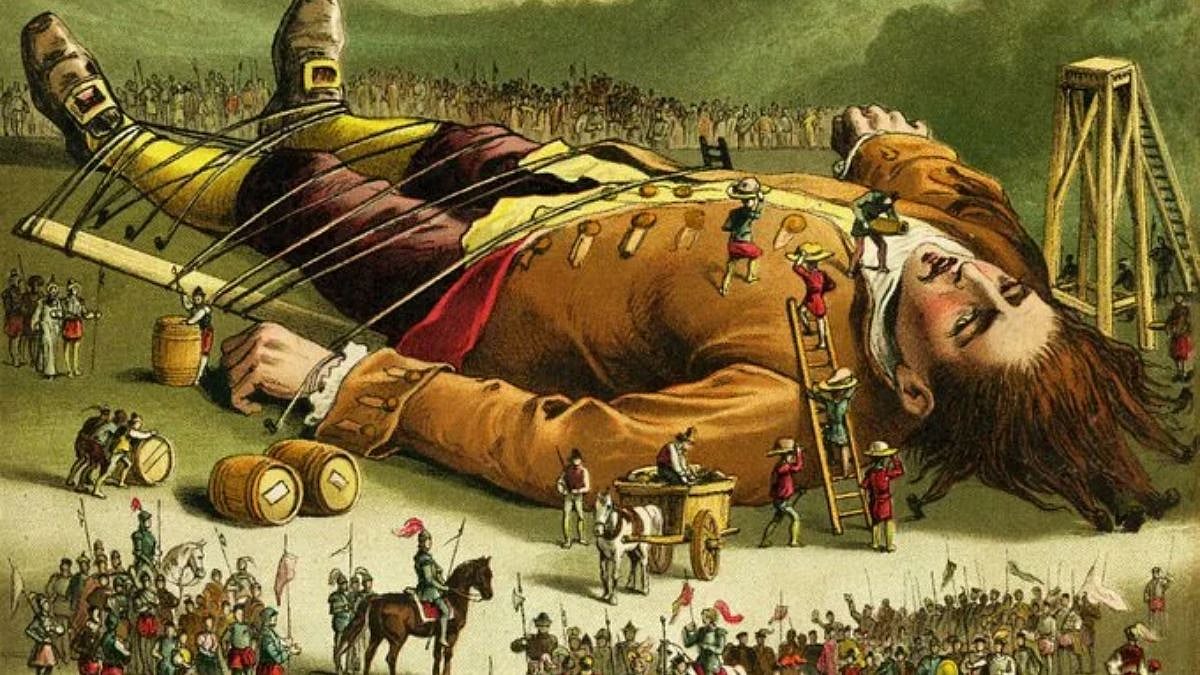
Three hundred years is a long time in the life of a civilisation. Empires have fallen, monarchies have given way to democracies, and technology has transformed life. Yet, as the world marks the tercentenary of Jonathan Swift’s Gulliver’s Travels this year, one wonders how a book written three centuries ago continues to speak to modern anxieties. Perhaps the answer lies in an uncomfortable truth: humanity has changed considerably in material achievements, but far less in its moral and intellectual disposition.
Published in 1726, Gulliver’s Travels appeared to be an adventure through distant lands and fantastical worlds. Beneath its imaginative surface lay a sharp examination of human vanity, political opportunism, religious intolerance, intellectual arrogance, and the absurdities of power. Swift was not merely taking readers on an imaginary journey; he was holding a mirror to society.
Lilliput And Political Absurdity
The first voyage to Lilliput, where six-inch-tall inhabitants engage in bitter political rivalries and wage wars over which end of an egg should be broken, is more than a comic illustration of human pettiness. It comments on the disproportion between the importance people attach to disagreements and their actual significance. As political polarisation, ideological divisions and religious animosities fracture societies, Swift’s miniature kingdom looks familiar. The scale has changed, but the appetite for turning differences into existential battles has not. The Lilliputians remind us that political absurdity is a recurring feature of human nature.
Brobdingnag And The Arrogance Of Power
The second voyage, to Brobdingnag, offers another lesson. Gulliver, a giant among the Lilliputians, becomes a miniature creature among giants. This reversal exposes the arrogance with which individuals and nations regard themselves as superior. When the king of Brobdingnag hears Gulliver’s account of European civilisation, he is appalled by its violence, corruption, and political intrigue. The episode invites readers to question powerful nations’ claims of superiority. Broadening your worldview starts with stepping outside your comfort zone.
Laputa And The Limits Of Knowledge
Perhaps the most contemporary of Swift’s imaginary worlds is Laputa, the flying island inhabited by intellectuals and scientists whose theoretical pursuits are disconnected from practical realities. Their experiments, including attempts to extract sunbeams from cucumbers, expose the absurdity of knowledge pursued without purpose. Today, as artificial intelligence, biotechnology, and digital innovation transform human existence, Laputa acquires fresh significance. Scientific advancement cannot automatically be equated with human progress. The crucial question is whether knowledge improves human life or merely feeds the vanity of those who possess it. The distinction between what we can and ought to accomplish deserves consideration.
Houyhnhnms And Human Nature
Swift’s most unsettling criticism of humanity emerges in his final voyage, when Gulliver encounters the Houyhnhnms, rational horses, and the Yahoos, brutish creatures resembling human beings. Disillusioned by the cruelty, dishonesty, and irrationality he associates with his species, Gulliver develops an almost pathological admiration for the horses. His inability to reconcile himself with ordinary human society makes the conclusion disturbing. Swift leaves readers confronting the possibility that human beings, despite their claims to civilisation, remain capable of barbarity. Contemporary wars, environmental destruction, exploitation, and normalised cruelty make this reflection difficult to dismiss. Yet, Gulliver’s revulsion towards humanity raises another question: can the pursuit of perfection make us intolerant of ordinary human weaknesses?
Power, Domination And Civilisation
The book’s critique of power extends beyond eighteenth-century European politics. Swift exposes how powerful societies justify domination through claims of superiority and civilisation. As economic inequality, territorial ambitions, and colonial legacies continue to shape international relations, his satire remains incisive. It reminds us that the language of progress can conceal the exercise of power.
Ultimately, the achievement of Gulliver’s Travels lies in its refusal to let readers regard human folly as somebody else’s problem. Swift’s satire targets not merely kings, politicians, scientists, or religious institutions, but also the prejudices, vanities, and self-deceptions that make such follies possible. The reader, too, is implicated. It is a warning against confusing influence, wealth, and technological sophistication with wisdom.
Three centuries after its publication, we have travelled beyond the skies, mapped the oceans, connected continents, and created technologies that would have seemed magical in Swift’s lifetime. But have we become wiser, more compassionate or less susceptible to vanity? That remains an open question. Perhaps the greatest tribute we can pay Swift is not simply to celebrate his masterpiece’s literary brilliance but also to confront the uncomfortable truths about human nature that it continues to expose. The world may no longer be populated by Lilliputians and Yahoos, but the impulses that animated them have hardly disappeared.
The writer is a Delhi-based journalist.
To get details on exclusive and budget-friendly property deals in Mumbai & surrounding regions, do visit: https://budgetproperties.in/

