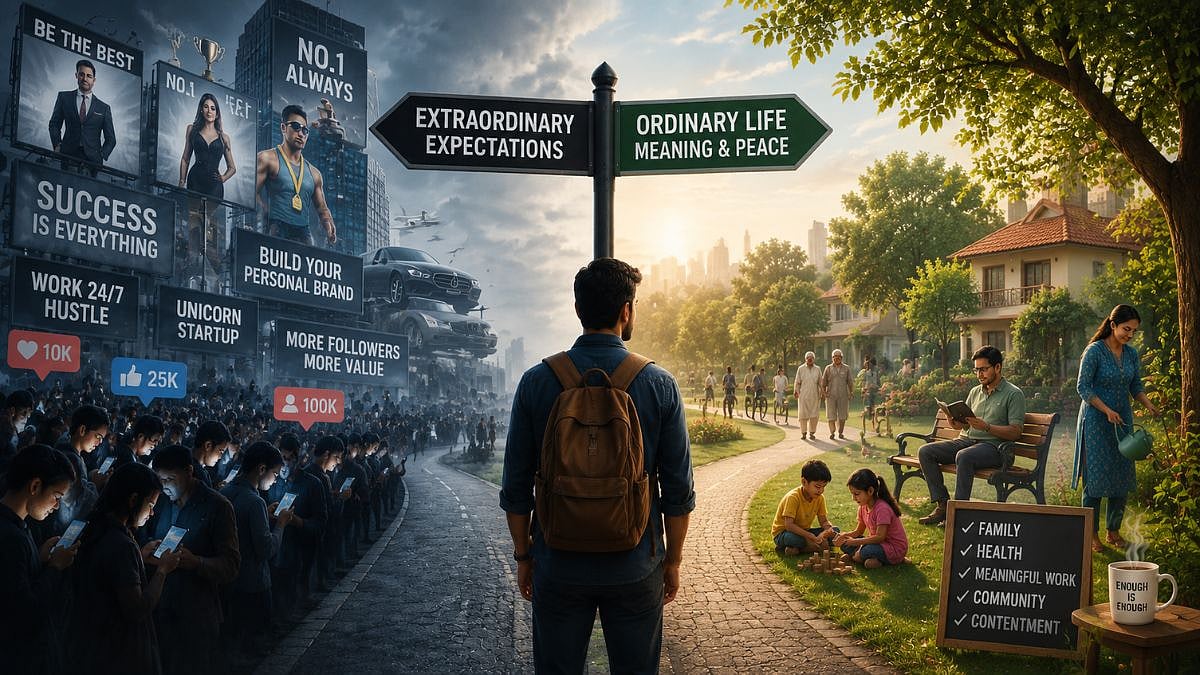
Once, people aspired to raise decent families, do honest work, educate their children and, perhaps, leave behind a little more than they inherited. Few felt compelled to become remarkable. The extraordinary existed, but it stood out precisely because society considered ordinary lives honourable.
Somewhere along the way, that balance changed.
Today, being exceptional no longer appears to be an aspiration. It often feels like a requirement.
Children are expected to excel not merely in academics, but also in sports, music, coding and communication. Young professionals are encouraged to become thought leaders before they have had the chance to become thoughtful people. Entrepreneurs are urged to build unicorns rather than durable businesses. Employees are advised to cultivate personal brands. Retirees are told that ageing itself must become a project. Even hobbies seem incomplete unless they evolve into side hustles or content channels.
Without any public debate or formal announcement, society has quietly raised the minimum standard for feeling successful.
The Burden Of Exceptionalism
The consequences are visible everywhere. Despite unprecedented prosperity, opportunities and technological convenience, many people carry a lingering sense that they are somehow falling behind. Achievement has become increasingly accompanied by anxiety. Satisfaction appears strangely elusive. There is always another benchmark, another comparison and another expectation waiting around the corner.
Previous generations compared themselves with neighbours and colleagues. Their reference points were local and finite. The modern citizen inhabits an entirely different world. Through screens that never sleep, people compare themselves with billionaires, influencers, celebrities, founders and carefully curated lives assembled for public consumption. It is difficult to feel adequate when one's competition consists not of reality but of highlight reels.
The pressure begins early. Parents worry whether their children, even infants, are doing enough. Children absorb anxieties they do not yet understand. By the time adulthood arrives, many individuals have internalised the belief that average is synonymous with failure.
Language itself offers clues about this shift.
People increasingly describe themselves with a curious apology. They speak of being “just an employee”, “just middle class”, “just a teacher” and “just a homemaker”. The word “just” carries an unintended confession. It reveals a culture that has come to associate worth with visibility, scale and distinction.
The Value Of Ordinary Lives
Yet, societies are sustained not by exceptional individuals alone. They are held together by millions of ordinary citizens whose names rarely appear in headlines—teachers who shape minds; nurses who comfort strangers; shopkeepers who know their customers; public servants who perform thankless tasks; parents who sacrifice without the expectation of recognition; and people whose greatest achievements may never attract applause, but whose contributions quietly keep communities functioning.
Civilisations have always depended upon these invisible foundations.
Perhaps this explains why so many people feel exhausted. The burden is no longer merely to succeed; it is to stand out. Modern life encourages individuals to optimise every dimension of existence. Careers must provide wealth and purpose. Friendships must be meaningful. Vacations must become experiences. Meals must become photographs. Personal interests must become businesses. Happiness itself must become evidence.
The result is not necessarily greater fulfilment. Often, it is relentless self-surveillance.
Redefining Success
What makes this cultural shift particularly significant is that institutions increasingly mirror the same expectations. Schools celebrate toppers more visibly than perseverance. Companies reward visibility as much as substance. Cities compete to become world-class. Universities chase rankings. Nations aspire to become superpowers. In almost every sphere, the language of greatness has begun to overshadow the virtues of steadiness and continuity.
Lost in this pursuit is an appreciation for the ordinary disciplines upon which enduring success has always rested. Families thrive because of routines rather than grand gestures. Businesses survive because of execution more than inspiration. Democracies depend less on moments of heroism and more on citizens performing unglamorous duties with consistency. Even trust itself is built gradually through repeated acts of reliability.
Perhaps societies, like individuals, occasionally confuse prominence with importance. History celebrates spectacular achievements, but everyday life is sustained by quieter virtues, such as patience, responsibility, decency and commitment. They rarely attract admiration, yet they remain civilisation's invisible infrastructure.
Ironically, many of history's most admired figures did not begin their journeys seeking fame or influence. They pursued excellence in their chosen paths. Recognition arrived later, sometimes accidentally. The obsession with extraordinariness is a distinctly modern phenomenon. Earlier generations understood something contemporary culture occasionally forgets—significance and visibility are not alike.
The Meaning Of Enough
Perhaps the real luxury in the twenty-first century is not excess, but enough.
Enough achievement without constant comparison. Enough prosperity without endless appetite. Enough ambition without permanent dissatisfaction.
Contentment has become strangely unfashionable. Ambition receives admiration, while satisfaction is mistaken for complacency. Yet, human beings were never designed to live in a perpetual state of inadequacy. A society that cannot respect ordinary lives risks creating extraordinary levels of anxiety.
There is dignity in competence. There is grace in consistency. There is honour in responsibilities fulfilled without fanfare.
Most human happiness has never resided in fame, followers or fortune. It has lived around dinner tables, in neighbourhoods, friendships, shared memories and lives that rarely make history books.
For centuries, extraordinary people stood out because ordinary lives were considered worthy of respect. If exceptionalism becomes compulsory, its meaning eventually disappears. In trying to create a world filled with stars, society risks forgetting the importance of the sky that holds them together.
Perhaps the future does not require people to dream smaller; it may simply require society to remember that a life need not be extraordinary to be meaningful. Sometimes, enough is not a compromise. Sometimes, enough is civilisation's greatest achievement.
Dr Srinath Sridharan is a policy researcher and corporate adviser. X: @ssmumbai

