It is a telling irony that, as Parliament began this week, the Prime Minister embraced the “limitless capabilities and aspirations of Indian youth” even as his security forces were pummelling tens of thousands of young people in the heart of the capital, Delhi, for peacefully demanding his government do precisely that.
Modi’s sentiments were clearly at odds with the brutality with which the Delhi Police and paratroopers, wearing multi-coloured camouflage gear but no name tags, lashed out with batons and fired tear gas at the peaceful students’ protest march from Jantar Mantar to Parliament House.
Their only fault was to ask for the resignation of Education Minister Dharmendra Pradhan as a first step towards accountability over the recent scandal involving leaked medical examination papers and faulty school-leaving marksheets. This vast chasm between the inflated flaunts by the current regime and ground realities may well prove to be its undoing.
Growing Student Discontent
While it is far too early to predict where the vast, popular upsurge of mostly young students worried about their education and job prospects will ultimately go, it does have a clear portent for the central government.
Clearly, there is growing disgruntlement among students, both in high school and in medical and engineering educational institutes, about falling teaching standards, leaked examination question papers and flawed marking, among a host of other issues, underlining a rapidly deteriorating system over the past several decades and successive governments.
Most importantly, the education on offer in India today in an overwhelming majority of schools, colleges and technical institutes no longer guarantees gainful employment, particularly now with the spectre of artificial intelligence (AI) threatening to take away jobs.
Unfortunately, the ruling party has been sleeping on the job despite its promise to reinvigorate the education system from top to bottom when it first swept to a full majority 12 years ago. Both school and collegiate education in various fields have further deteriorated over the past decade.
An added complication has been the increasing involvement of the Rashtriya Swayamsevak Sangh (RSS), most particularly its students’ wing, the Akhil Bharatiya Vidyarthi Parishad (ABVP), whose active and former leaders have been involved in directing education policy, including key administrative and academic appointments in educational institutions.
Since Education Minister Pradhan is an RSS member and former ABVP leader, it is unsurprising that the government is so opposed to him stepping down, the immediate demand of the protesting students.
Government Response Under Scrutiny
Moreover, the Prime Minister and his close aides not only instinctively recoil from admitting mistakes but have also, because of the BJP’s phenomenal political success for more than a decade, developed a kind of hubris that brooks no public dissidence, even if it relates to relevant issues and is articulated in a peaceful manner.
Much like in Trump’s America, even mild criticism of the government is immediately deemed “anti-national”. Thousands of the Supreme Leader’s devotees and millions of paid cheerleaders trumpet adverse comments, interrogating the background of those daring to question the government.
This is in stark contrast to both the earlier BJP government led by the accommodative Atal Bihari Vajpayee and its successor Congress administration led by the scholarly Dr Manmohan Singh.
The only precedent of public dissent and peaceful protest being completely snuffed out was the 19-month nightmare unleashed by Indira Gandhi’s Emergency regime.
It is interesting to note that two years ago, when the previous NEET examination paper leak scandal erupted into a public controversy, Prime Minister Modi publicly promised, “I will tell every student of the country, every youth of the country, that the government is very serious about preventing such incidents, and we are taking one step after another to fulfil our responsibilities on a war footing. Those who play with the future of the youth will not be spared at all.”
However, he observed radio silence when, in the middle of May this year, yet another NEET paper scandal, along with glaring marking discrepancies in the Grade 12 Central Board of Secondary Education (CBSE) examination marksheets, hit the headlines.
It has taken the Prime Minister more than two months even to respond to the raging public controversy. Finally, the day after the police unleashed unprovoked violence on peaceful protesters in the streets of Delhi, Modi broke his silence. He termed the paper leak a “grave sin”, emphasising that the issue was a "national concern" rather than a matter for partisan politics.
Political Fallout
Education Minister Pradhan’s behaviour in dealing with the controversy has also been most curious. A month after the NEET leak was established, he reacted strongly, describing the officials and teachers responsible as “protectors turned predators”. The minister also held himself morally accountable for the distress caused to students.
However, instead of conceding to the students’ demands, Pradhan has clung to his post, accusing opposition leaders, particularly Rahul Gandhi, of creating fear and panic in the minds of students instead of trusting the country's examination systems.
In his latest post about education on X, the minister replied to students agitating for his resignation with a spiritual message and video, saying the “Guru’s image, feet, words, and grace are the foundations of meditation, worship, mantra, and liberation.”
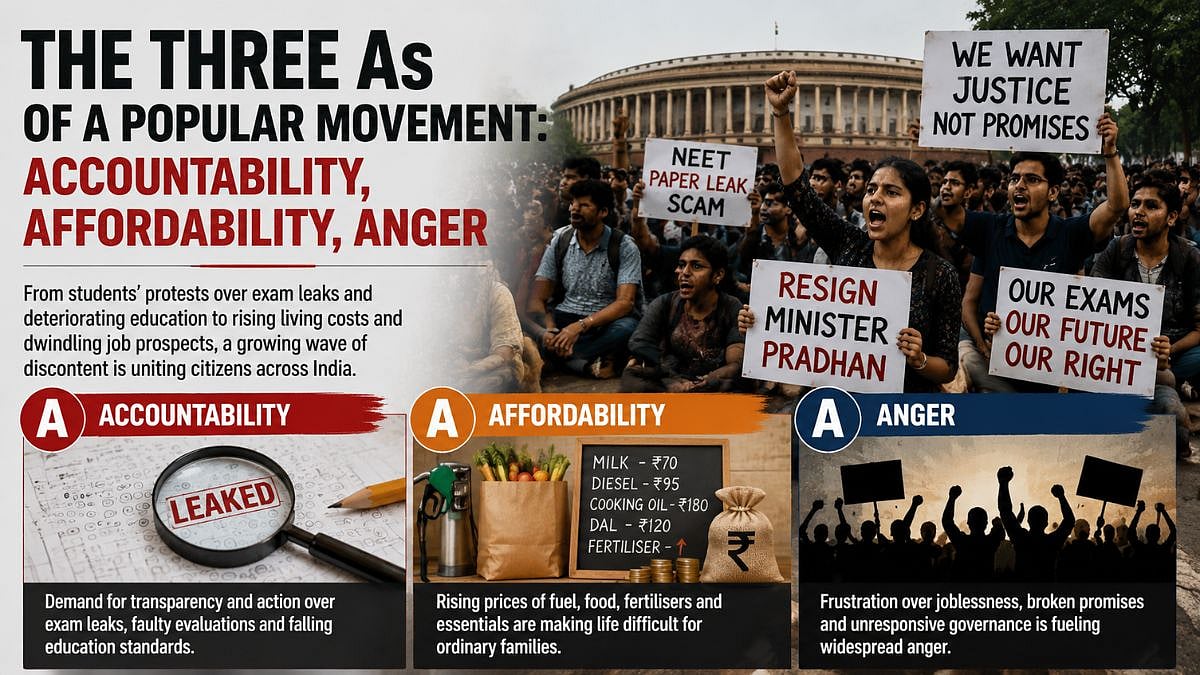
The government has needlessly painted itself into a corner on a controversy that shows no signs of abating. Instead, it is growing into a larger agitation centred on the perennial three As of popular movements—accountability, affordability and anger.
There are several issues other than education that are causing grave distress to a vast majority of people, except the super-rich, cutting across class, caste and religion. They include the price and quality of fertilisers and petrol, mounting costs of living, shrinking job prospects and rapid deforestation, to name just a few.
Comment Sparks Wider Debate
Interestingly, it all started with an off-the-cuff comment by Chief Justice Surya Kant: "There are youngsters like cockroaches who don't get any employment and don't have any place in the profession. Some of them become media, some of them become social media, some of them become RTI activists, some of them become other activists, and they start attacking everyone."
The compliant mainstream media swallowed the insult, but the youth of the country are far feistier. The establishment may have bitten off more than it can chew.
The writer is a senior journalist.

