An election can survive a political defeat. An Election Commission can survive political criticism. What neither can easily survive is a sustained loss of public trust.
That is why the controversy over Form 6 is becoming far more consequential than a dispute over a piece of electoral paperwork. At its heart is a simple democratic question: who decides the conditions under which an eligible citizen gets onto the electoral roll, and under what authority?
The answer must never be clouded by ambiguity.
A Small Form, A Big Question: Form 6 controversy
During SIR, the online Form 6 was supplemented by a declaration asking new applicants to establish whether their own name, or that of a parent or grandparent, appeared in an earlier SIR electoral roll, with details such as the relevant constituency, polling station and serial number. This was particularly problematic for first-time voters and those whose names had been deleted during SIR. The Election Commission later removed the additional declaration in states and UTs where SIR had been completed and restored the statutory Form 6. The Supreme Court has now made it clear that it had not approved the modified Form 6 and has sought the records to establish who authorised the change.
Fallout: deletions, West Bengal and 22 states
The larger issue is the scale of the SIR deletions. More than 13 crore names were deleted from draft electoral rolls across the states and Union Territories covered by the exercise, according to figures reported during the controversy. In West Bengal, where the SIR exercise has generated particularly intense political and legal scrutiny, deleted voters have had to seek restoration through the claims-and-objections process. Thus, removing the extra Form 6 declaration is not equivalent to restoring deleted names; it merely removes an additional hurdle for subsequent enrolment. The real fallout across West Bengal and the other 22 states/UTs is whether genuine voters excluded during SIR can be efficiently restored before the electoral rolls are finally settled.
But constitutional questions cannot be settled by terminology.
If an additional requirement is imposed on a citizen seeking registration, the crucial issue is whether it has proper legal authority and whether it can make voter registration more difficult.
The controversy would probably have remained technical had the Supreme Court not now made a crucial clarification.
The BJP’s Defence
The BJP has rejected the Opposition's allegations and argues that the Supreme Court has not declared Form 6 illegal. It is right on that limited point.
A judicial observation that the court did not approve the modification is not the same as a judicial finding that the Election Commission acted illegally.
But the BJP is trying to answer for the Election Commission.
The question before the poll panel is not whether the Congress is exaggerating, nor whether Rahul Gandhi is using the issue politically. The question is whether the Commission can provide a clear documentary explanation of who authorised the additional declaration, when it was authorised and on what legal basis.?
Political defence cannot substitute for institutional transparency.
The Supreme Court’s Red Line
The Supreme Court has made it clear that it did not approve any modification to Form 6 and has indicated that it will examine who made the changes.
That observation changes the political and institutional equation.
It does not mean that the court has declared the modified Form 6 illegal. Nor does it establish that the Election Commission deliberately violated the law. Those conclusions must await examination of the records.
But one question can no longer be brushed aside: why was the Supreme Court's earlier judgment on SIR cited as approval for something the court now says it did not approve?
This is no longer a Congress-versus-BJP argument. It is a question for the Election Commission itself.
When Dissent Comes from Within
The controversy becomes still more serious because the two other Election Commissioners reportedly raised objections on several occasions concerning decisions and orders that they believed had been issued without their knowledge.
Their concerns included Form 6 and new voter registration.
This is the point at which a political controversy becomes an institutional one.
Differences within a constitutional body are not inherently unhealthy. In fact, dissent can be a sign of institutional strength. Three Election Commissioners need not think alike.
But repeated objections over decisions affecting the electoral process raise a different question: was the Commission functioning collectively, or were important decisions effectively being driven from one end of the institution?
The answer matters enormously because the Election Commission is not another government department. Its authority rests substantially on the confidence of political parties and voters that its decisions are impartial.
The SIR Problem
The Special Intensive Revision itself has a perfectly legitimate objective.
India needs clean electoral rolls. Dead voters, duplicate entries, bogus names and ineligible voters cannot be allowed to distort elections. No serious democracy can object to a rigorous verification exercise.
But cleansing the electoral roll and excluding a genuine voter are two entirely different things.
The greater the scale of a revision, the greater must be the safeguards against wrongful exclusion. The process must be simple enough for an ordinary citizen to understand and robust enough to withstand political scrutiny.
That is where the controversy over Form 6 becomes important.
A requirement that appears minor to an administrator may become a formidable hurdle for a young first-time voter, a migrant, a poor citizen or someone whose family records are incomplete.
The principle should therefore be simple: verification must protect the vote, not make the vote harder to obtain.
Opposition’s Opportunity—and Its Risk
The Opposition has seized the controversy with considerable political force.
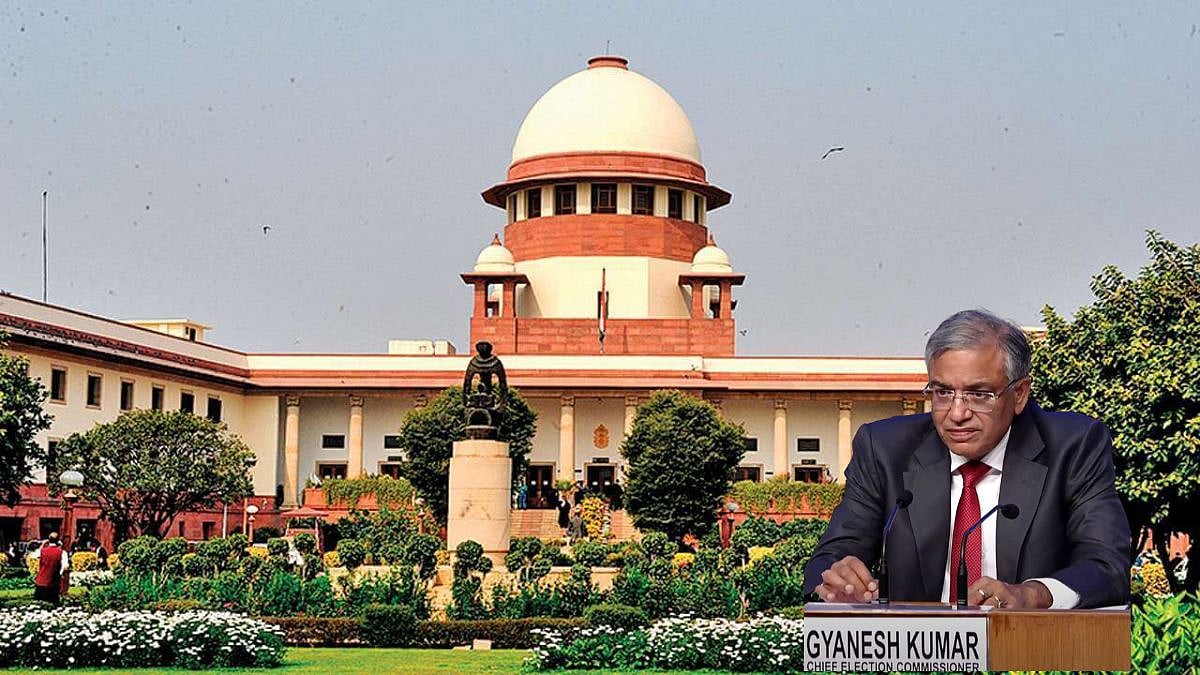
Rahul Gandhi and other INDIA bloc leaders have escalated their campaign against Chief Election Commissioner Gyanesh Kumar, accusing the poll panel of compromising electoral integrity and demanding his resignation. The protests have moved from Parliament to the streets.
Politically, this gives the Opposition a powerful issue.
But it also carries a risk.
The phrase “vote chori” may be an effective political slogan, but slogans cannot establish an institutional charge. The Opposition has tried to produce evidence, identifying specific irregularities to demonstrate the alleged exclusions represent isolated errors or a systematic pattern.
A legitimate campaign for electoral transparency could degenerate into another partisan confrontation.
The Credibility Gap
The most dangerous feature of the controversy is the widening gap between what the Election Commission says and what sections of the political class and civil society believe.
Once an electoral institution enters a credibility crisis, every subsequent decision is viewed through a partisan lens.
That is deeply damaging.
If the Commission removes names, one side suspects manipulation. If it adds names, another side suspects favouritism. If it changes a procedure, political parties question its motive. Even a legitimate administrative correction can then be interpreted as evidence of conspiracy.
The only antidote is radical transparency.
The Commission Must Open the Record
The Election Commission should therefore welcome the Supreme Court's scrutiny rather than regard it as an institutional affront.
The complete decision-making record relating to the Form 6 declaration should be placed beyond doubt. The role of the three Election Commissioners should be clear. The legal basis for the additional requirement should be explained. And the precise relationship between the SIR judgment and the subsequent Form 6 procedure should be established.
If the Commission is right, transparency will strengthen its position.
If mistakes were made, acknowledging and correcting them will ultimately strengthen the institution even more.
What cannot work is silence, defensiveness or the suggestion that criticism itself is an attack on democracy.
The Election Commission Cannot Afford Ambiguity
India's electoral system is too important to become a battlefield of competing narratives.
The Opposition must not undermine the Election Commission merely because it dislikes a particular decision. The BJP must not defend every decision of the Commission merely because criticism happens to come from the opposition.
And the Election Commission must understand that constitutional independence does not mean immunity from scrutiny.
Its independence is protected precisely so that it can withstand political pressure. But independence also carries a corresponding obligation of transparency.
The Form 6 controversy has therefore presented the Commission with a difficult but necessary test.
It must demonstrate not merely that it has the power to revise electoral rolls, but that it exercises that power through a process that is lawful, collective, transparent and fair. The Supreme Court should also ponder over the plight of those lakhs of voters who were otherwise eligible but could not exercise their franchise because the Election Commission proceeded with the completion of the electoral process. Why is the Supreme Court not acting on its own observation that, if the number of deleted voters exceeds the margin of victory, it could reconsider the ambiguity surrounding their deletion?
Because the real issue is not Form 6.
It is whether an Indian voter can look at the electoral system and still believe that his or her vote is beyond manipulation.
That confidence is the foundation of democracy. Once it begins to crack, no electoral victory can repair it.
(Writer is a strategic affairs columnist and senior political analyst based in Shimla. He is also Contributing Editor with The South Asian times from New York)

