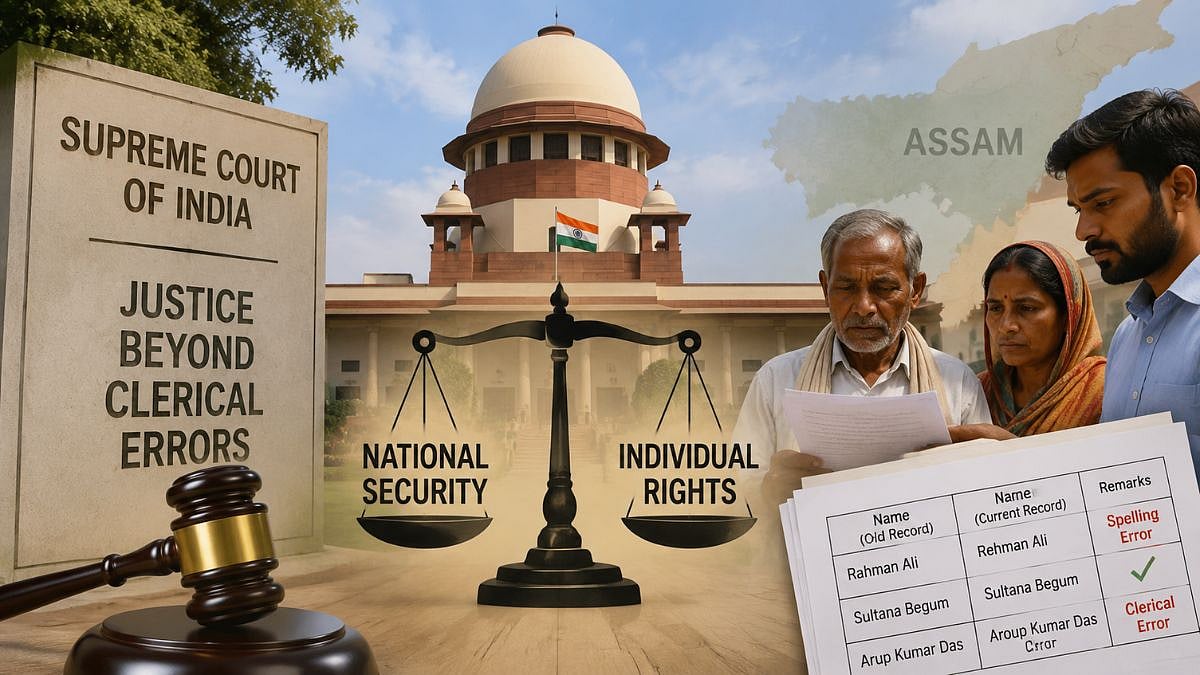
No sovereign nation can be denied the right to identify illegal immigrants living within its borders. Equally, no democracy governed by the rule of law can deny any individual a fair opportunity to establish his citizenship. The Supreme Court’s decision to set aside 27 judgements of the Gauhati High Court concerning alleged foreigners in Assam is a timely reminder that national security and individual rights are not mutually exclusive. They must coexist.
The Central government is well within its constitutional authority to detect those who entered India illegally, managed to secure their names on electoral rolls, and even obtained passports. Such persons, if found to be foreigners after due process, can be deported in accordance with the law.
Questions involving their children and grandchildren born in India may involve legal complexities, but they too must be resolved within the framework of the Constitution and the Citizenship Act.
Due Process Must Prevail
What the apex court has rejected is not the government’s authority but the manner in which that authority was exercised. It found that the Foreigners Tribunals and the Gauhati High Court had failed to uphold the minimum standards of procedural fairness.
Many cases were decided ex parte, with the affected persons being denied an opportunity to present evidence in their defence. The court has, therefore, ordered fresh adjudication by independent Tribunals within six months and barred any coercive action, including detention or deportation, until the proceedings are completed.
The judgement exposes the dangers of bureaucratic indifference. In several cases, individuals failed to establish their identity because of spelling mistakes in their names. These were not errors of their making but clerical mistakes committed by officials decades ago while entering records. Yet such trivial discrepancies became the basis for branding them foreigners.
Citizenship Cannot Be Arbitrary
The consequences can be devastating. One of the most striking instances was that of an Assamese army officer who fought in the Kargil War, only to find himself declared a foreigner because official records failed to match. Such cases shake public confidence in the justice delivery system.
The ruling also carries an important message, as the Special Intensive Revision of electoral rolls is underway in some states. Millions of voters may discover inconsistencies between present records and earlier electoral rolls, particularly those of 2002, the benchmark year for the exercise. Even prominent citizens have suffered. A well-known editor in Kolkata reportedly faced denial of passport renewal after his name disappeared from the revised electoral roll.
Citizenship is too precious to be determined by clerical errors or administrative shortcuts. The state must be vigilant against illegal immigration, but that vigilance must be matched by scrupulous fairness. A democracy proves its strength not merely by protecting its borders but also by ensuring that justice is never sacrificed at the altar of expediency.

