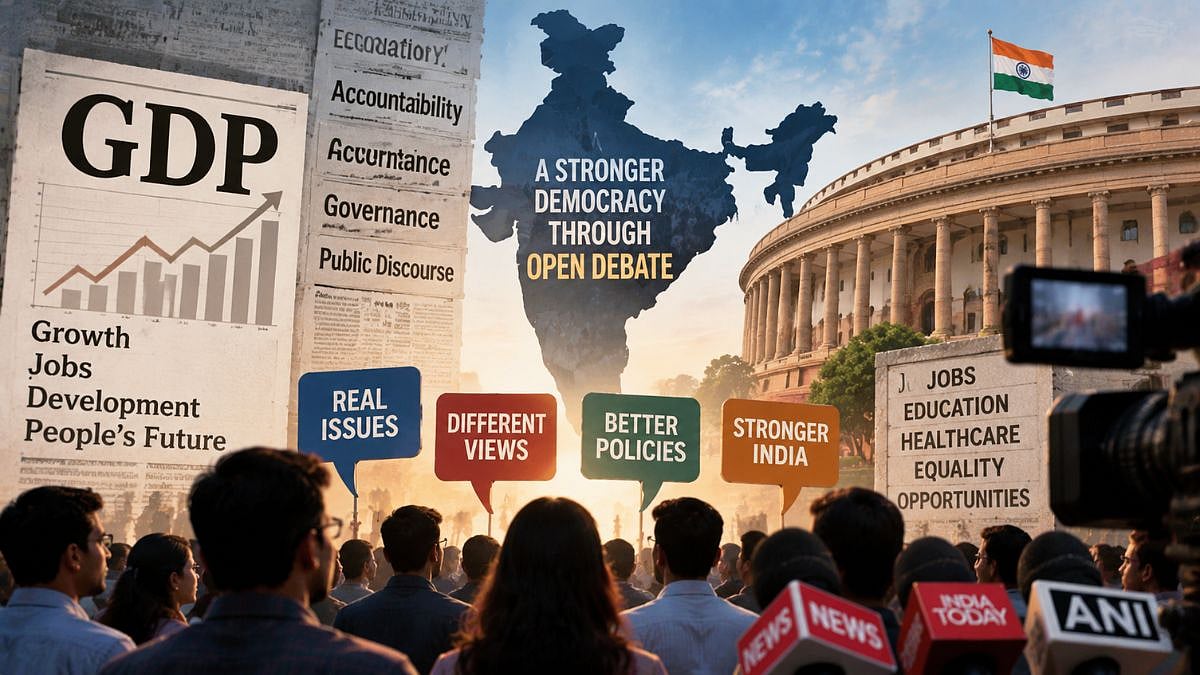
India is witnessing a pleasant change in its public discourse, including the media, and the credit for it should go partly to former finance secretary Subhash Chandra Garg. The debate was about whether the GDP data provided by the central government was genuine. The government has proudly announced that the GDP growth in the April-June quarter was 7.8%. On the face of it, this looks impressive and hints at robust economic growth. But before the government could celebrate, Garg, while speaking on TV channels, announced that the figure of 7.8% is misleading. He claimed that if one carefully processes the government’s own data, then the number is much lower. He, in fact, claimed that, based on government data, the real GDP could be zero and the nominal GDP as low as 2.6%. Both numbers were shocking.
Obviously, the government was livid. Commerce and industry minister Piyush Goel called him an unemployed person who joins TV debates to weaken the government. But Garg was unstoppable. While talking to me on SatyaHindi, he said that this was the problem in the country; instead of countering and rubbishing his argument, he was being attacked. He said that he was quoting government data, not something he had invented, and if their data guided him to this particular conclusion, then why should he be faulted? Instead of attacking him, he said, they should take care of their data.
I can understand his pain and anguish. Having been the former finance secretary, who had worked with the Modi government before taking a VRS, he knows a thing or two about the subject and understands how the government works. No wonder his words became viral. He became the talk of the town. Former chief economic adviser and eminent economist Kaushik Basu and ex-RBI chief Raghuram Rajan nodded in agreement with him. Obviously, the government issued a clarification, and several other economists jumped into the debate and tried to prove Garg wrong. I am not an economist, and I have no claim to understanding economics well enough to either support Garg or prove him wrong, but I was ecstatic about the entire controversy, and for good reason.
Debates About Real Issues
First and foremost, debates like this should be welcomed, as they are about real issues. In a country of 140 crore people, the question should be asked whether the economy's health is good. Because a good economy means the life standard of the common people is getting better. If the economy is growing at a rate of 7.8%, then everyone needs to feel happy. It gives hope to the poor and middle class that after finishing their studies, their children will get employment, their talent will be recognised and they will be suitably placed in the job market, and the combined income of the family will go up. And if the economy is not growing, then the common people should be worried about their future. Either way, this provides an opportunity to critically evaluate the performance of the government they voted for in the hope that their lives will be better. The GDP debate helped people form opinions about the regime's functioning. It does not matter if their opinion is good, bad or ugly.
I can understand that the Prime Minister is not happy with the debate. He is upset that the good work his government has done has not been recognised. But he should be pleased that, if the GDP data is genuine, voters will not be misled and will surely vote for him.
Emotional Issues In Politics
Secondly, this country has long been misled by false narratives. Debates over communal and religious issues and mobilisation along caste lines have gone too far. Politicians deliberately lay a trap around such emotional issues, as it distracts people from issues that affect their lives. Emotions create a delusional world that blinds people to the failures of the government in power and the opposition. In a functioning and healthy democracy, people should have the opportunity to form a considered opinion about whom to choose to lead and whom to reject. The country has seen the naked dance of the Hindu-Muslim binary in the recent past. The propaganda around Islamophobia has turned our world upside down. It has made us bitter, angry, restless, and incapable of judging the achievements and failures of political parties, leaders, and governments.
Shift Towards Rational Debate
Unfortunately, we live in an age in which manufacturing consent has become a flourishing industry. The use of technology and global interconnectedness, the explosion of information or misinformation, and the torrential rain of news and fake news are not only confusing people but also making them schizophrenic and paranoid. We are members of a global society in which too much information should have made citizens’ lives easy; instead, it has turned them into zombies. But thanks to Cockroaches, the debate seems to be shifting from emotional to rational. The CJP brought to the fore the issue of education. Paper leaks were happening for many years, but no serious thought was given to them, and no accountability was ever enforced. The education minister’s resignation, in any case, is a significant milestone in Indian democracy, which has long refused to hold our rulers accountable. The government was also forced to establish a commission and introduce a bill to stop regular leaks. But its greater contribution was to draw the country's attention to the condition of schools. A raging debate took place, and I hope this will continue. The debate around the GDP is an extension of that change. I am not sure my optimism will last long, but at least I can rejoice and enjoy the moment.
The writer is Co-Founder, SatyaHindi.com, and author of Hindu Rashtra. He tweets at @ashutosh83B

