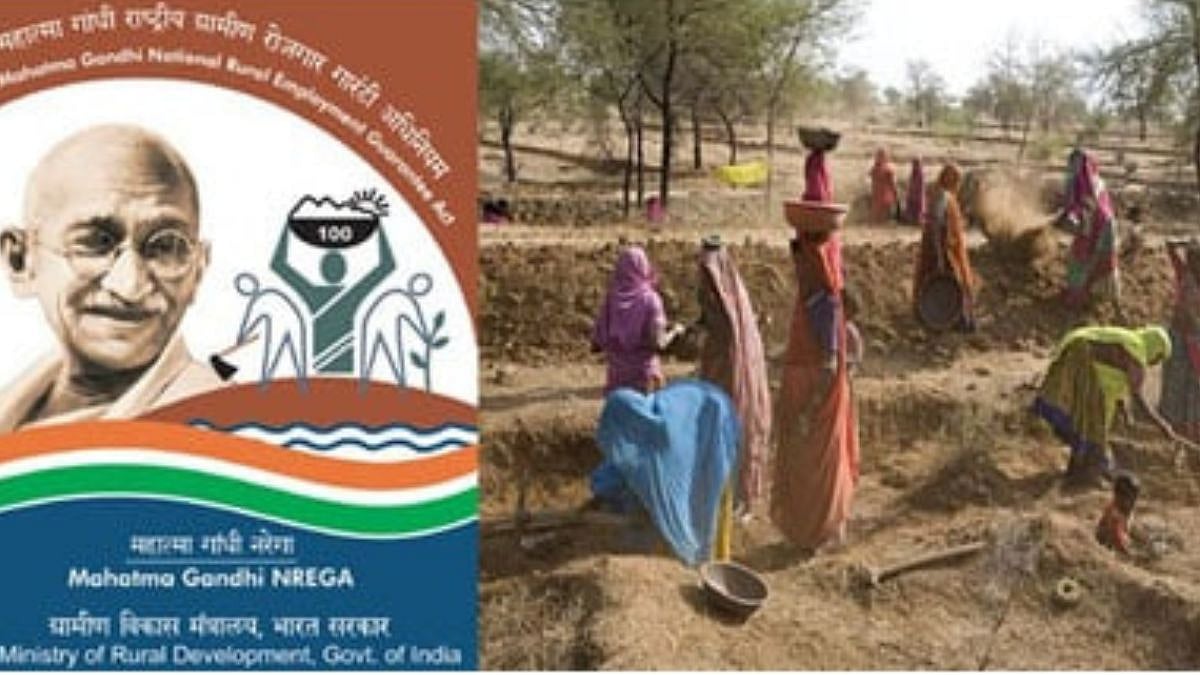
The passage of the Viksit Bharat Guarantee for Rozgar and Ajeevika Mission (Gramin) Bill, 2025, called the VB-G RAM G Bill, marks a decisive break from one of India’s most consequential pieces of social legislation. It replaced the landmark National Rural Employment Guarantee Act (NREGA) of 2005, which was later named after Mahatma Gandhi. While the government insists that the new law is a reform that raises the ceiling of guaranteed work from 100 to 125 days, this claim does not survive even cursory scrutiny. What the new Bill does, in substance, is far more troubling: it dismantles the justiciable right to work, recentralises control, shifts the fiscal burden to states, and weakens labour’s bargaining power in rural India.
The NREGA was never just another welfare scheme. It was a legal innovation that translated Article 41 of the Constitution—the state’s obligation to secure the right to work—into an enforceable entitlement. If work was not provided within 15 days of demand, the state was legally bound to pay an unemployment allowance. Under the NREGA, employment was demand-driven and universal, and the right was justiciable. The NREGA was a proxy for genuine unemployment insurance, a social security measure which is still a distant dream despite the new labour codes. The VB-G RAM G Bill replaces this rights-based, demand-led framework with a supply-driven, budget-capped scheme whose guarantees are conditional on central allocations and administrative discretion.
The forgotten legacy of Maharashtra’s EGS: Recall that the roots of the NREGA were in Maharashtra’s Employment Guarantee Scheme (EGS). Born out of the devastating droughts of the early 1970s, the EGS was financed through a dedicated tax on urban workers and backed by a statutory guarantee of rural employment. Its genius lay in its simplicity: work on demand, locally determined public works, and wages paid as a matter of right. For over three decades, the EGS acted as an unemployment insurance programme for rural Maharashtra. It became the intellectual and institutional template for the NREGA. The design of the EGS itself was inspired by pilot projects implemented in the early 1960s, under the leadership of VS Page, a dhoti-clad Gandhian, who was the speaker of Maharashtra’s Legislative Council for a record eighteen years.
The EGS also revealed a political truth that remains relevant today. By setting a floor on wages and offering workers an exit option, it reduced labour’s dependence on landlords and contractors. Unsurprisingly, it faced resistance from the landed elite, who complained about “labour shortages” and rising wages. That resistance never disappeared; it merely went underground. The new Bill’s provision, allowing a 60-day pause in employment during peak agricultural seasons—ostensibly to “facilitate labour availability”—reads less like neutral policy design and more like a concession to agrarian power structures that have long resented the NREGA’s impact on rural labour markets. Even at its peak, the NREGA has provided a tiny fraction of total person-days of employment in rural areas. So, its distortionary impact on the labour market is overstated.
The illusion of 125 days: The centrepiece of the government’s defence is the increase in guaranteed employment from 100 to 125 days. But this is largely symbolic. Even under the NREGA, only a small fraction of households actually received the full 100 days of work in most years. Raising the ceiling without ensuring an enforceable demand-based provision is like promising a taller ladder while quietly removing the ground beneath it.
More importantly, the new Bill caps total expenditure through “state-wise normative allocations” determined by the centre. Any spending beyond this ceiling must be borne by the states, following procedures prescribed by the centre itself. A right that depends on fiscal discretion is not a right; it is a favour. By embedding budget caps in the statute, the Bill converts a legal guarantee into a centrally rationed programme.
Setback for Cooperative Federalism: The NREGA, for all its flaws, embodied a workable form of cooperative federalism. The centre bore the full wage cost and most of the material cost, recognising that poorer states with higher unemployment also have weaker fiscal capacity. The VB-G RAM G Bill overturns this logic. The proposed 60:40 cost-sharing pattern shifts a significant additional burden onto the states—estimated at over Rs 50,000 crore annually—at a time when the fiscal autonomy of the states has already been eroded by the GST and borrowing constraints.
This is not merely a fiscal issue; it is a constitutional one. Employment and public works fall squarely within the state list and the domain of local self-government under the Eleventh Schedule. The new Bill exemplifies what scholars have called the centre’s “seventh schedule creep”: expanding central control over subjects constitutionally assigned to states, while leaving states to carry the financial and political costs of implementation.
Defenders of the Bill argue that the NREGA was inefficient, corruption-prone, and administratively rigid. But these were problems of implementation, not of design. The response to delayed payments, biometric failures, and exclusion errors should have been institutional repair, not legal dilution. Furthermore, by introducing centralised AI-based dashboards for project and work selection, the crucial autonomy of the local government and community, which was a feature of the NREGA, has been taken away.
From demand-driven to discretion-driven: The NREGA’s most radical feature was its universality. It did not rely on poverty lines, beneficiary lists or targeting errors. Anyone willing to do unskilled manual work could demand employment. This self-targeting design minimised exclusion and leakage, a point repeatedly affirmed by empirical research. The VB-G RAM G Bill departs from this principle by allowing the centre to notify specific rural areas where employment will be provided. A guarantee that applies only where the centre chooses to apply it is a contradiction in terms.
During the COVID-19 shock, the NREGA acted as a shock absorber, sustaining rural demand and preventing mass destitution. It has also raised the labour force participation of women, improved bargaining power for the poorest workers, and reduced distress migration. These were not side effects; they were central to its design. A programme that modestly improves the bargaining power of labour in one of the most unequal labour markets in the world should be celebrated, not dismantled.
A procedural failure too: Equally disturbing is the manner in which the VB-G RAM G Bill was introduced and passed—without reference to a parliamentary standing committee and without serious consultation with states, workers’ organisations or civil society. For a law that alters the balance between the citizen and the state so fundamentally, this procedural haste does not fit into democratic norms.
Final Word: The rights-based framework means that the state owes its citizens work with dignity as a matter of right, not charity. Maharashtra’s EGS demonstrated this half a century ago. The NREGA nationalised that moral insight. The new Bill retreats from it.
A nation aspiring to be “Viksit Bharat” by 2047 should be expanding the scope of social citizenship and social security, not shrinking it. Reforming the NREGA was both necessary and desirable. Replacing a justiciable right with a discretionary scheme is neither reform nor progress. It is a constitutional, economic and moral step backward.
Dr Ajit Ranade is a noted Pune-based economist. Syndicate: The Billion Press (email: editor@thebillionpress.org)

