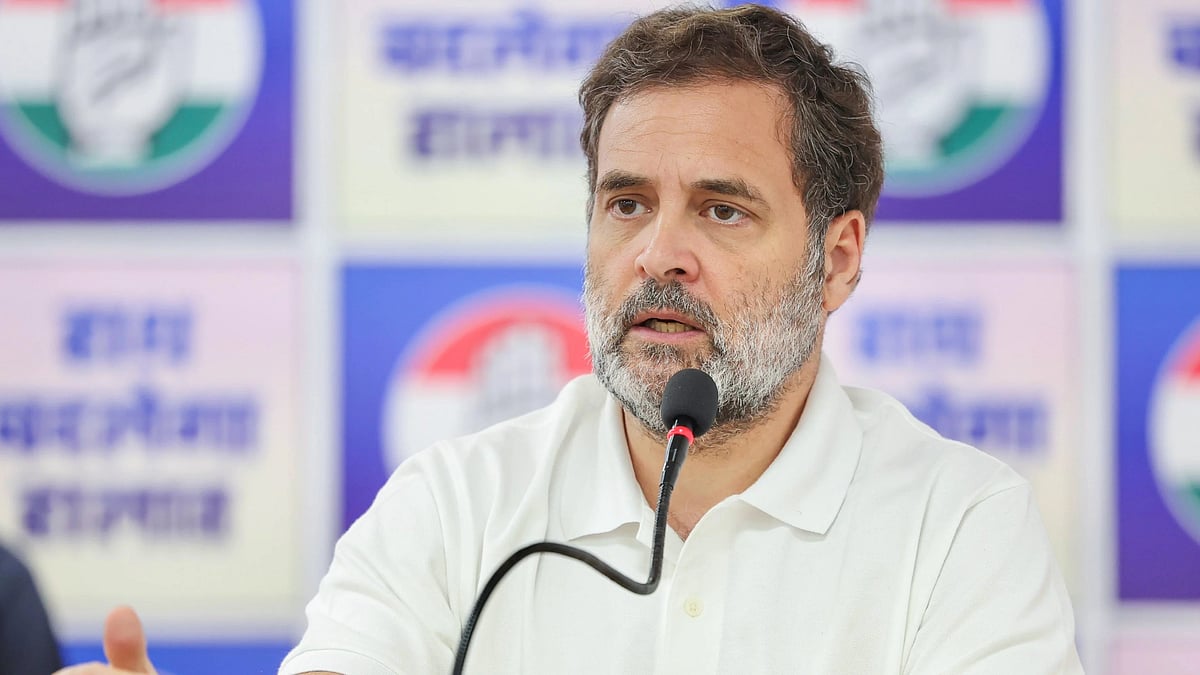
Rahul Gandhi has increasingly shown a willingness to go where politicians traditionally fear to tread—speaking his mind even at the risk of controversy. He does not unravel in the face of criticism; he retains his sangfroid and frames his response with reasoned conviction. His decision to back Indian Youth Congress members, who staged a protest at a high-profile AI venue in New Delhi last month against India’s deal with the United States, may have angered many leaders even in the Opposition, but by describing the young protesters as “babbar shers”, he did not merely endorse their dissent; he validated it.
For the ruling establishment led by Narendra Modi, this posture is more than routine opposition politics. It is an irritant that refuses to fade. The BJP has long sought to pigeonhole Rahul Gandhi through reductive stereotyping, portraying him as inconsistent and politically immature. Yet, what once appeared as hesitation now looks increasingly like stubborn conviction. In publicly accusing the Prime Minister of being “compromised” over the tariff deal with the United States, Rahul signalled that he would not dilute his critique for the sake of diplomatic politeness or political convenience.
The significance of his stance lies not merely in the content of his criticism but in the manner of its delivery. Indian politics has long favoured measured speech over impulsive candour. Leaders often leave themselves room to retreat, recalibrate, or reinterpret. Rahul Gandhi, by contrast, has shown a growing tendency to dig in his heels. The more the BJP pushes back, the more emphatically he appears to restate his position. This refusal to yield under pressure has begun to redefine him—not as an accidental Leader of the Opposition, but as one prepared to shoulder dissent like a cross.
Critics argue that this confrontational approach has contributed to the decline of India’s grand old party. Electoral setbacks over the past decade have frequently been laid at Rahul’s doorstep. Within political circles, he has been accused of failing to provide strategic clarity or organisational revival. Yet, adversity often reshapes leaders. The Rahul Gandhi of today appears less burdened by the weight of expectations and more willing to articulate ideological differences sharply and without apology.
His endorsement of protests at an elite AI venue is symbolically important. Technology summits and international platforms are typically insulated from street politics. By defending the Youth Congress’s decision to register protest at such a venue, Rahul underscored a broader principle—that democratic expression cannot be confined to designated spaces. To supporters, this signals courage. To detractors, it suggests recklessness.
For the BJP, this presents a dilemma. A predictable opposition can be managed through rebuttal and narrative control. An opposition leader who refuses to play by established scripts is harder to contain. Senior BJP leaders’ responses to Rahul often serve to elevate his prominence. Even when his statements are dismissed as irresponsible, they achieve visibility. In a political ecosystem driven by perception, staying visible is itself a form of power.
There is also a generational undercurrent to his politics. By hailing young protesters as “babbar shers”, Rahul aligns himself with a vocabulary of defiance that resonates with youth activism. In an era when younger voters often value authenticity over polish, his bluntness may carry greater appeal than carefully hedged statements. He appears increasingly comfortable embracing the role of combative challenger.
Yet, the question remains whether rhetoric alone can alter political arithmetic. Electoral politics demands organisation, alliances, and a persuasive economic narrative. On these fronts, the Congress continues to face formidable challenges. However, leadership tone shapes morale. By refusing to be politically correct when he believes larger principles are at stake, Rahul Gandhi offers party workers a sense of ideological clarity. He projects the message that defeat need not mean silence.
Has he, then, come of age? In many ways, yes. Maturity in politics is not always about moderation; sometimes it is about steadiness under fire. Rahul’s critics may question his methods, but few can deny that, despite repeated electoral defeats and sustained personal attacks, he has remained in the arena, persistently raising issues he considers vital.
Ultimately, Rahul Gandhi’s evolution reflects a broader truth about democratic politics: dissent is rarely comfortable, and those who practise it are considered a burr under the saddle. By choosing confrontation over caution, Rahul ensures that he keeps the government under constant scrutiny. In refusing to temper his rhetoric, he has embraced a role that is less about consensus and more about challenge.
The writer is a Delhi-based journalist.

