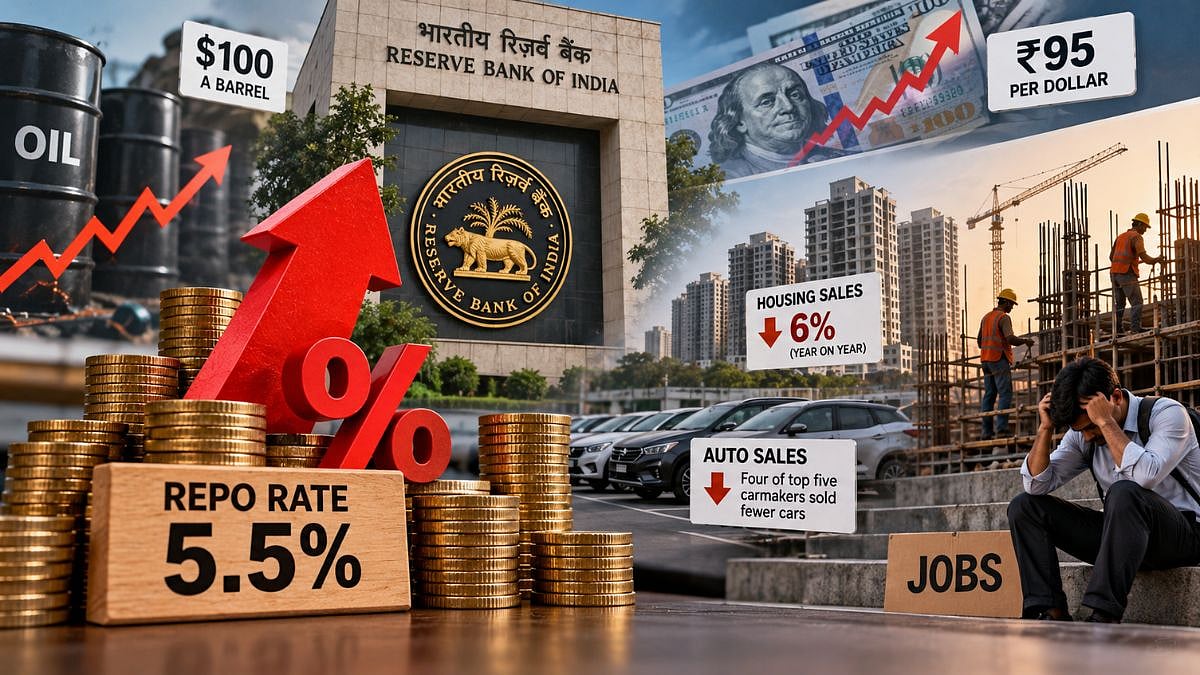
Early this week, the Reserve Bank of India carried out what it has been hinting at for some time. It raised the repo rate (the rate at which it lends money to commercial banks) to 5.5%, saying the decision reflected challenging geopolitical developments and growing inflation concerns. If the concern is more about controlling inflation, the hike is unlikely to do that. Because the price pressure comes from oil. Crude is hovering around $100 a barrel due to the Hormuz crisis, while the rupee has slipped past 95 per dollar. Both impact fuel and imported goods, whatever Indians choose to spend.
Rate Hike Targets Demand
Basic economics tells us that if banks pass on the repo rate hike to customers, their ability to spend more is restricted. In turn, it impacts everything one consumes, ranging from buying a house to buying a vehicle. Therefore, the repo rate hike targets demand more than the cause.
One of its biggest impacts will be on the housing sector, which is already weakening. Home sales in the nine largest cities fell 6 per cent year on year in July to September, to over 1 lakh units, according to reports. Data shows developers are already trimming launches. Fewer launches mean fewer construction sites, and construction employs many urban and migrant workers. Auto sales haven’t been doing well either. Four of the top five carmakers sold fewer cars in September than in August. Most car loans are fixed-rate, so the new buyers will bear the impact, and they are also the only source of sales.
Higher Costs Threaten Jobs
The repo rate hike also comes at a time when the festive season is around the corner, and rising loan costs will put almost all sectors’ best quarter at risk. The repo rate is only half the squeeze. In September, the RBI sold ₹1 lakh crore of bonds to drain cash from the banking system. This means there is less money in the market already, and, combined with a higher repo rate, it raises banks' cost of funds and, in turn, the cost for small businesses, most of which borrow at floating rates. This hurts the job market most. National unemployment was 5% in August, but in urban areas, it is as high as 6.8% and is only edging up. Urban India is where construction, car dealerships, and small manufacturers are concentrated.
Oil Prices Hold The Key
If oil prices remain high, inflation will stay above the RBI's target regardless of what it does with the repo rate. However, the cost will be felt by housing, automobile purchases, and small businesses through higher borrowing costs. If oil prices fall, inflation will ease anyway, without the need for higher rates.
That leaves the RBI with a difficult question: what exactly is the rate hike trying to fix?

