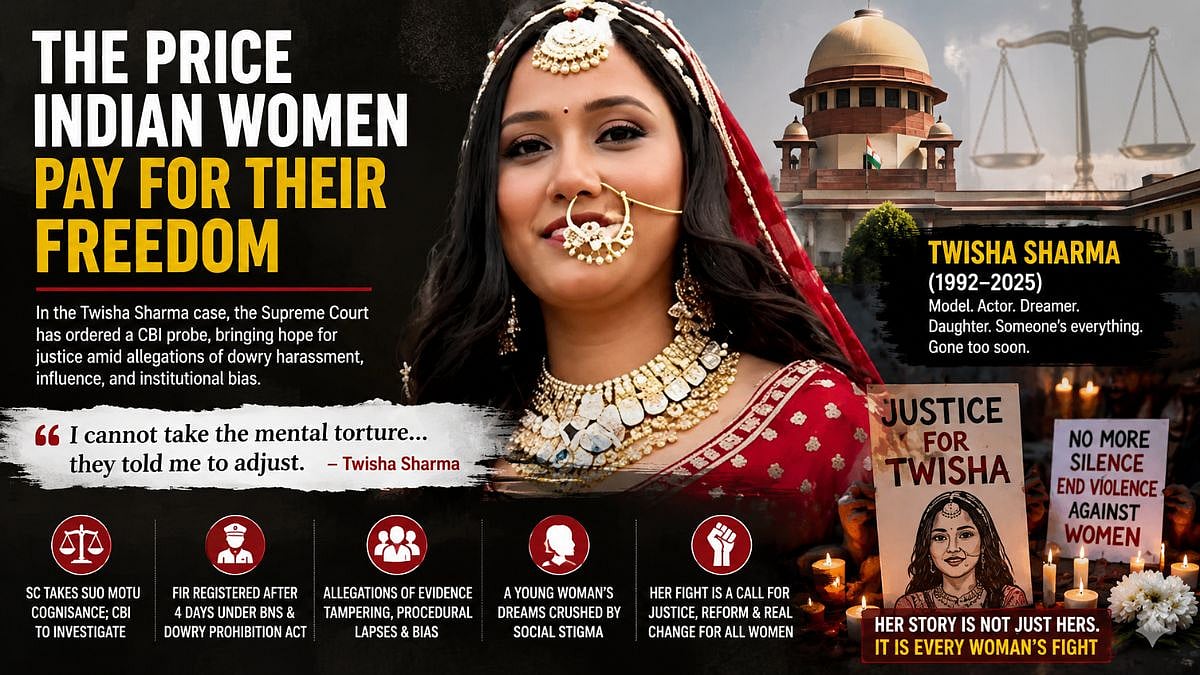
On Monday, as the Supreme Court took suo motu notice of the Twisha Sharma case and directed the Central Bureau of Investigation (CBI) to take charge of the investigation in Bhopal, the spotlight was not merely on the reprise of the dowry-and-daughter-in-law issue in the national headlines but equally on the imbalance of influence and power in such cases.
In barely five months, 33-year-old Twisha Sharma’s life went from a dream wedding with Insta-worthy photographs to a horrific death, contested autopsies, delayed cremation, and character assassination by her mother-in-law, Giribala Singh, and advocate husband, Samarth Singh. The model-turned-actor was found hanging in her marital home in Bhopal’s Katara Hills on May 12.
It took four days and repeated allegations by the Sharmas for the police to even register an FIR under Sections 80(2), 85, and 3(5) of the Bharatiya Nyaya Sanhita, along with sections of the Dowry Prohibition Act, naming the mother-son duo. However, the mother-in-law, a former district judge, was vocal on every possible channel and platform, denigrating Twisha’s character, habits, and choices to suggest that it was a death by suicide by a mentally ill person.
The available facts contested this and raised serious questions. This, coupled with the allegations that the police had committed procedural lapses, tampered with evidence, and displayed institutional bias, perhaps prompted the SC to step in. Its assurance that the investigation will be “fair, independent, and impartial” holds out a sliver of hope for justice for Twisha and closure for her natal family.
Questions of influence and institutional bias
The trajectory in this case is not different from similar cases of sexual harassment or suspicious deaths of many young women in the homes or premises of powerful people, but Giribala Singh’s visible influence—she produced her own call data records—and constant vilification of her dead daughter-in-law must not have passed the SC’s bar.
Among other damaging statements, Singh said Twisha “never watered plants, never prayed, didn't want to become a mother, and was too liberal”, pointing to the serious social dimensions of this case.
The burden of adjustment
That a beautiful young woman with an independent mind, work record, and relationships showed bodily autonomy was unacceptable to the former judge, presumably a learned person herself, pointing to the continuing social stigma that plagues women’s agency and the detrimental role older women themselves play in this process. Twisha had appealed to her parents that she could not take the mental torture, but they too asked her to “adjust”.
The word has claimed many a young woman’s life in her marital home. Twisha Sharma’s case has proved, once again, that women’s education and independence do not ensure autonomy; equally, there is much work to be done to ensure that young brides have the social and emotional support they need in times of crisis in their married homes.
