Parsis who arrived in India between the 8th and 10th centuries to escape persecution after the Arab-Islamic invasion of their land, Persia, settled in Diu before striking roots in Sanjan, Navsari, and Udvada in Gujarat. It was an existential crisis in every sense of the word.
The first generation of migrants found their mojo in Bombay, as the British developed it into a port and trade city. Later generations did business as well as philanthropy remembered even today.
As centuries passed, they adopted Gujarati as their mother tongue but lived in cohesive settlements or baugs, kept their traditions, and remained ethnically whole by disallowing marriages outside the community and not admitting children of mixed marriages into their fold. This has, clearly, led to another existential crisis — too few of them around and declining fast.
Parsi population decline raises concerns
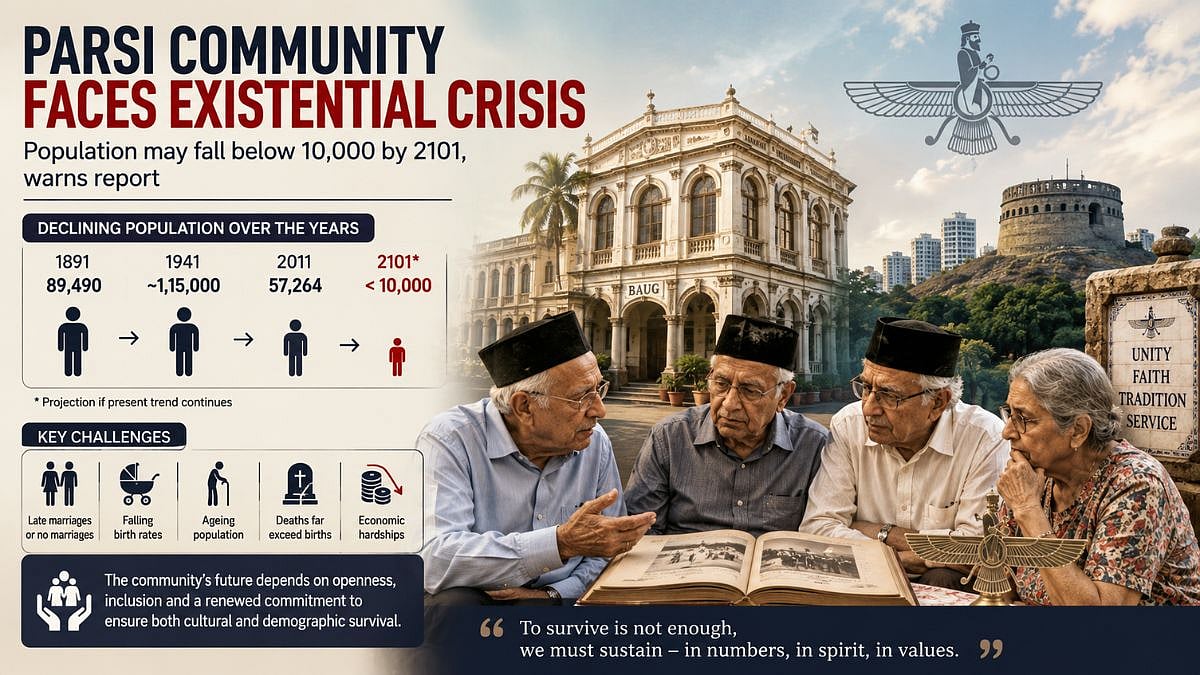
A report released over the weekend, at a National Commission on Minorities conference attended by Union Minister Kiren Rijiju, among others, stated that should the present trend continue, the Parsi population in India could decline to fewer than 10,000 by 2101.
Back in 1891, they were 89,490; the last Census of 2011 counted 57,264, just about half the population in 1941. Indeed, the demographic decline of the community has been alarming.
Late marriages or no marriages, falling birth rates, and infertility have taken their toll. In 2010 alone, Mumbai recorded 210 births against 933 deaths.
To arrest the decline and reverse the trend, the Government of India launched the Jiyo Parsi programme in 2013-14. However, despite the advocacy and financial support, an average of 50-55 children were born every year; between 2020-21 and 2024-25, only 232 babies were born under the programme.
Economic and social challenges deepen crisis
Incentivising births has not been able to address the core socio-economic issues of the community, which now include an ageing population and a death rate far exceeding the birth rate.
The cascading impact has been on the economic well-being of the community. The report showed that economically weaker Parsis faced hardship, and the once most-wealthy community now counted some of its own among the poor. Another layer of existential crisis.
The community trust and wealthy philanthropists do their bit, but that is not enough. Clearly, the ethnic insulation and isolation did not help keep the community vibrant and thriving.
On the contrary, it may have brought the community face-to-face with an inter-generational crisis that its ancestors faced in Persia: not merely how to survive but how to sustain demographically and socially.
Need for balance between identity and openness
Sociologists aver that societies and languages endure when they have offspring and assimilate just enough to preserve their core but open a window to the world.
The Parsi population has been shrinking. And the windows in their quaint baugs — community colonies mostly in Mumbai — have remained shuttered.
