Decades ago, political scientist James C. Scott wrote Seeing Like a State, a book that should be mandatory reading for anyone currently obsessed with "Smart Forestry". In it, he describes how 18th-century Prussian foresters grew tired of the unruly, unmappable chaos of the woods. They wanted a forest they could count and tax from a desk in Berlin. So, they cleared the ancient, tangled undergrowth and replaced it with the normal “baum” — neat, standardised, taxable rows of identical trees.
They created a "scientific" forest that looked perfect on a spreadsheet but eventually collapsed into “Waldsterben” (forest death). It died because it lacked a soul — and, more importantly, because it lacked the ecological complexity that only "messiness" can provide.
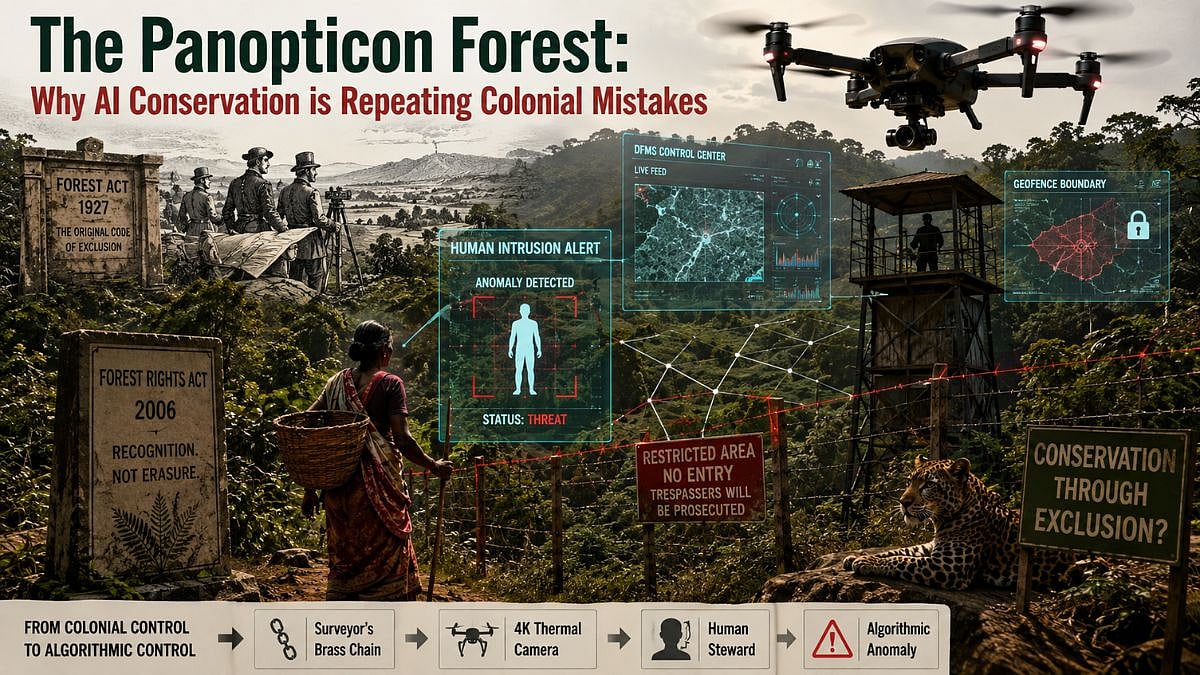
Walk into the deciduous heartlands of Central India this May and you’ll hear a sound that suggests we’ve learnt nothing from the Prussians. It’s a flat, electric whine — the dry hum of a drone battery cutting through the humid air of the Sal canopy. As the nationwide Digital Forest Management System (DFMS) completes its rollout this month, we aren't just straightening the trees anymore. We are digitising the very act of exclusion. We have traded the surveyor’s brass chain for a 4K thermal camera, and the ghost of the 1927 Forest Act is now a permanent ghost in the machine.
The Algorithm’s Invisible Wall
The DFMS is pitched to the public as a high-tech shield for the Panthera tigris. It is a seductive narrative: AI-driven drones and thermal sensors protecting our national animal from the "threat" of intrusion. But on the ground in the Nilgiris or the scrublands of Simlipal, "Smart Forestry" looks less like conservation and more like a paramilitary operation.
The system relies on "geofencing" — a clean, corporate-sounding word for an invisible cage. These are digital boundaries drawn by bureaucrats on satellite maps, cordoning off the very lands that Adivasi communities have managed for millennia. When a woman steps across one of these invisible lines to gather mahua flowers or dry kindling, she isn't seen as a neighbour or a steward. To the algorithm, she is an "anomaly". She is a "human-intrusion alert".
The drone doesn't know about the Forest Rights Act of 2006. It doesn't see a grandmother searching for medicinal roots; it sees a heat signature breaching a polygon. This is the ultimate irony of "Surveillance Ecology": it treats the people who have lived in a symbiotic dance with the tiger for centuries as "noise" to be filtered out of the data. To the state, the forest is finally becoming "legible", but only by making its inhabitants invisible.
The Security-Industrial Complex
This isn't just about trees; it’s about who holds the remote control. The architects of these "Smart Forests" aren't local ecologists with mud on their boots. They are tech-defence contractors — the same firms that build surveillance grids for international borders and high-security prisons.
When you hand the keys of the forest to the security-industrial complex, you get a "fortress mentality". To a contractor, the jungle is just a perimeter. There is no room for the messy, human negotiation of the Gram Sabha when a black-box algorithm in a distant command centre has already flagged a settlement for "habitat fragmentation".
By automating the monitoring of these lands, we are stripping away the human mediation that has historically mitigated conflict. When a drone identifies a "threat", the response is immediate and paramilitary. We are witnessing the birth of a high-tech land grab, where "data optimisation" is used to justify the eviction of the most vulnerable.
The Myth Of The Empty Forest
At the core of this high-tech push is a deep intellectual laziness — the Western myth of the "pristine wilderness". It’s the idea that nature is only healthy if humans aren't touching it.
But India’s forests are not "untouched" wilds; they are cultural landscapes. The very biodiversity we are so desperate to protect was shaped by Adivasi stewardship — by their controlled fires, selective harvesting and sacred groves. By using AI to clear these people out, we aren't just violating human rights; we are sabotaging ecology itself.
When you remove the human "eyes on the ground" and replace them with a drone, you don't get a safer forest. You get a fragile, unmonitored grid that is ripe for the kind of large-scale industrial mining that the drones always seem to "miss" until the first excavator arrives. We are trading a living, breathing community for a digital map that shows us everything and understands nothing.
Signal Vs. Noise
Technology doesn't have to be a weapon. In a world that actually valued "Smart Forestry", these drones would be in the hands of Adivasi youth. They would be used by the Gram Sabhas to map their own ancestral Community Forest Resource (CFR) claims, to catch illegal industrial loggers or to document the success of community-led conservation.
In that world, technology would be a tool for sovereignty. In our current world — the world of the DFMS — it is a tool for erasure.
As the sun sets over the deciduous canopy this week, the red blinking lights of the drones are the only things left watching. We need to stop pretending this is just about "efficiency". If we continue to let algorithms define the boundaries of nature, we will protect the tiger only by destroying the soul of the place it calls home.
Down on the ground, where the soil meets the sensor, the Adivasi is not the "noise" to be deleted. They are the only signal that actually matters. It’s time we stopped watching them and started listening.
Nishant Sahdev is a physicist at the University of North Carolina at Chapel Hill, United States, and a global columnist on AI, infrastructure and global systems.

