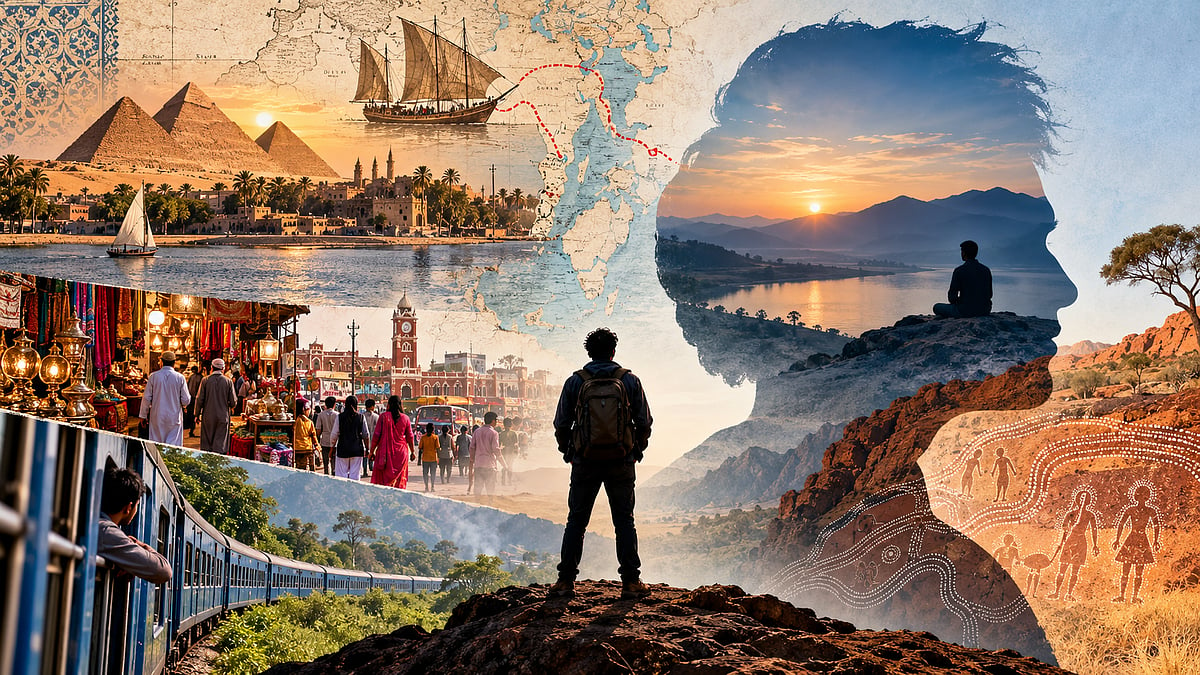
Travel is often imagined as an encounter with the unfamiliar: a distant landscape, an alien culture, a bustling marketplace or a road disappearing into the mountains. Yet, the most enduring travel writing takes us somewhere more intimate. It uses the outer world to illuminate the inner one, revealing our fears, prejudices, desires, memories, and contradictions. In the works of Amitav Ghosh, Pico Iyer, Pankaj Mishra, Paul Theroux, and Bruce Chatwin, travel becomes not merely a geographical exercise but also an exploration of human interiority.
What makes these writers compelling is their understanding that a journey does not necessarily end when the traveller reaches a destination. Sometimes, the more consequential journey begins when the traveller turns inward and attempts to understand what the encounter has stirred within.
In ‘In an Antique Land’, Amitav Ghosh travels to Egypt, but his journey extends far beyond the physical landscape. Moving between his experiences in an Egyptian village and the history of a mediaeval Indian Ocean merchant, Ghosh reconstructs connections that conventional histories and modern national boundaries tend to obscure. His encounters with ordinary people reveal how intimacy, hospitality, suspicion, and belonging shape human relationships across cultures. His travelogue suggests that to know another culture is also to recognise the limitations of one's own perspective.
Pico Iyer approaches this inward journey through a different doorway: stillness. In an age that equates travel with movement, speed, and the accumulation of experiences, Iyer asks what happens when we pause long enough to absorb them. In ‘The Art of Stillness: Adventures in Going Nowhere’, he explores the possibility that physical movement acquires meaning only when accompanied by reflection. He has observed, “You’re travelling in order to be moved.” The distinction is significant. A traveller may cross continents without being transformed, while a brief encounter with a stranger may alter the way one sees oneself. For Iyer, the inner landscape is as vast and unpredictable as the external world.
If Ghosh explores the historical imagination and Iyer the contemplative self, Pankaj Mishra examines the psychological and social aspirations that animate a changing India. In ‘Butter Chicken in Ludhiana’, his journeys through small-town India reveal a society negotiating the promises and anxieties of modernity. Beauty-pageant ambitions, consumer desires, popular culture, and the urge for upward mobility become more than colourful details of local life. They disclose the restless inner world of a society attempting to redefine itself. Mishra’s travel writing demonstrates that the psychology of a place cannot be separated from its economic ambitions, cultural hierarchies, and historical circumstances.
Paul Theroux, meanwhile, treats the road as an instrument of self-discovery. His travelogues are attentive to the unvarnished realities of places encountered away from the familiar routes of tourism. Local trains, roadside conversations, uncomfortable journeys, and chance meetings become occasions for observing both strangers and oneself. In ‘The Tao of Travel’, Theroux recalls his youthful desire to discover “a new self in a distant place”. The phrase captures a fundamental impulse behind travel: the hope that distance might loosen the identities imposed by habit and circumstance. Yet, the road offers no guarantee of revelation. Encounters may unsettle rather than reassure, forcing travellers to confront their impatience, loneliness, and preconceived notions.
Bruce Chatwin’s ‘The Songlines’ takes this inquiry into the relationship between movement, memory, and belonging. Inspired by Indigenous Australian traditions connecting landscape, ancestral stories, and song, Chatwin explores the possibility that movement is deeply embedded in the human imagination. His interest in nomadism raises questions about our need for rootedness and our simultaneous longing to escape confinement. The landscape, in his account, is not merely scenery; it can carry stories through which communities understand their existence and place in the world.
Read together, these writers suggest that travel is an encounter between two geographies: the world outside and the world within. A foreign street may reveal a prejudice; a conversation may expose a loneliness; a landscape may awaken a forgotten memory. The destination supplies the occasion, but the traveller’s consciousness determines what the encounter comes to mean. Perhaps this is why the finest travelogues endure long after the details of itineraries have faded. They remind us that the greatest distance is not always the distance between two countries; it may be the distance between what we believe about ourselves and what experience compels us to recognise. To travel deeply is not merely to discover the world but also to discover the self through the world, for sometimes the most meaningful journey is the one that brings us closer to understanding who we are.
The writer is a Delhi-based journalist.

