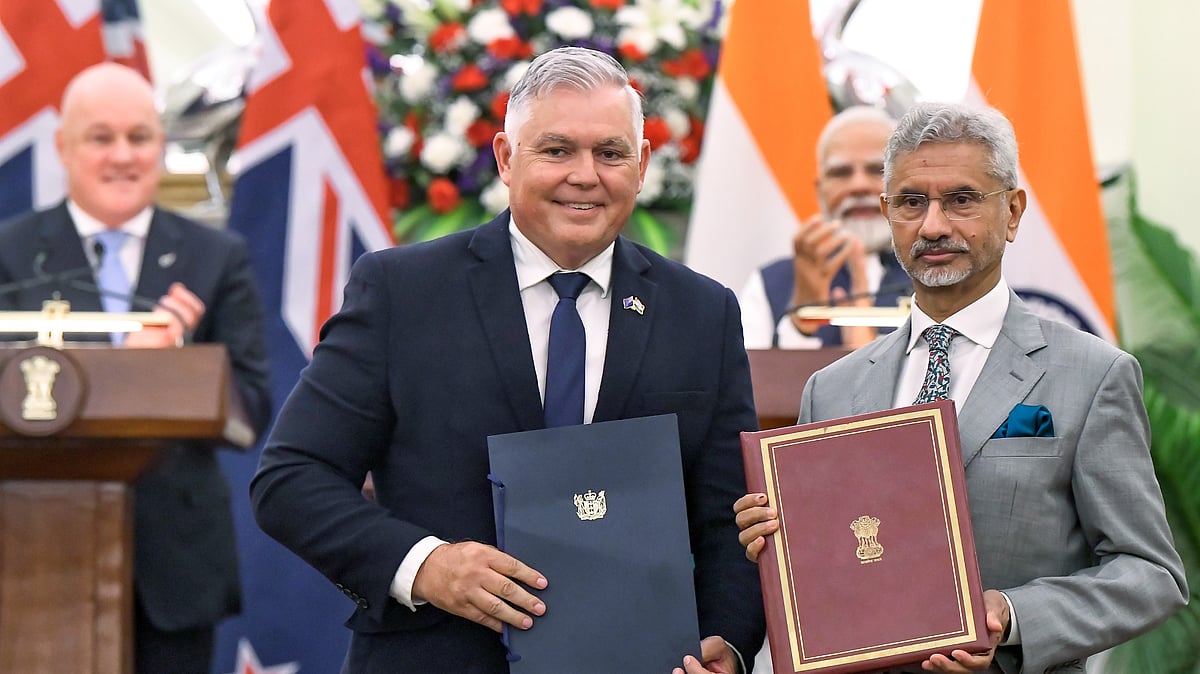
The India-New Zealand Free Trade Agreement, signed early this week, is now being described as “once in a generation”. For an FTA that took just nine months to piece together, it can only be seen in a different light. Complex FTAs take years for a reason, and they require granular negotiation. This bypassed all that. When you strip away the ceremony, a number of fundamental issues arise that neither side’s press releases mention.
MSMEs and past FTA concerns
India’s FTAs have always wrought a systemic problem that nearly no one in the Indian policy conversation tackles aggressively: Indian exporters, particularly the MSMEs. India’s FTAs with ASEAN, South Korea, and Japan all generated significant controversy precisely because import penetration into India rose sharply while Indian exporters—lacking the documentation sophistication, rules-of-origin compliance capacity, and market access support—failed to capture the reciprocal gains.
New Zealand exporters, in contrast, function in a well-resourced, trade-savvy environment with government-supported infrastructure. For example, zero tariffs on NZ forestry are a blow to the Indian industry. Tariffs on forestry exports—a major export to India—will see more than 95 per cent enter tariff-free, with tariffs on almost all existing trade phased out over seven years.
Agriculture access and domestic impact
New Zealand has also won vital new quota access for kiwifruit and apples, with volumes starting well ahead of recent average trade volumes and growing beyond them. The first nation to enjoy preferential access to the Indian apple market under any Indian FTA is New Zealand. India has handed NZ a historic first. Apple growers in Himachal Pradesh and Jammu & Kashmir—politically sensitive and economically fragile hill communities—will struggle to challenge preferentially priced New Zealand apples in an environment which they have historically dominated.
However, to India's credit, it has secured protection for its dairy products. New Zealand offers duty-free access to Indian goods, while dairy exports (30 per cent of New Zealand's total goods exports) are largely excluded.
Political uncertainty in New Zealand
The FTA has been labelled by New Zealand’s Labour Party as “high risk”. New Zealand First leader Winston Peters is calling the agreement "neither free nor fair". The coalition government will require at least one opposition party to support the agreement for it to become effective. Wellington signed an agreement, but it cannot be proven that it will pass at this time.
The Opposition believes that NZ has given far greater access to its labour market than necessary. The deal’s immigration concessions—a Temporary Employment Entry visa pathway with a maximum of 5,000 visas at any time for qualified Indian professionals—will face tough political scrutiny as the ratification process continues.
Lessons from earlier trade deals
India's track record with rushed FTAs is not encouraging. The ASEAN FTA, concluded under political pressure to demonstrate India's openness to trade, inflicted years of industrial pain. This deal has followed a similar path, mistaken for success and signed before the heavy lifting had been completed.
