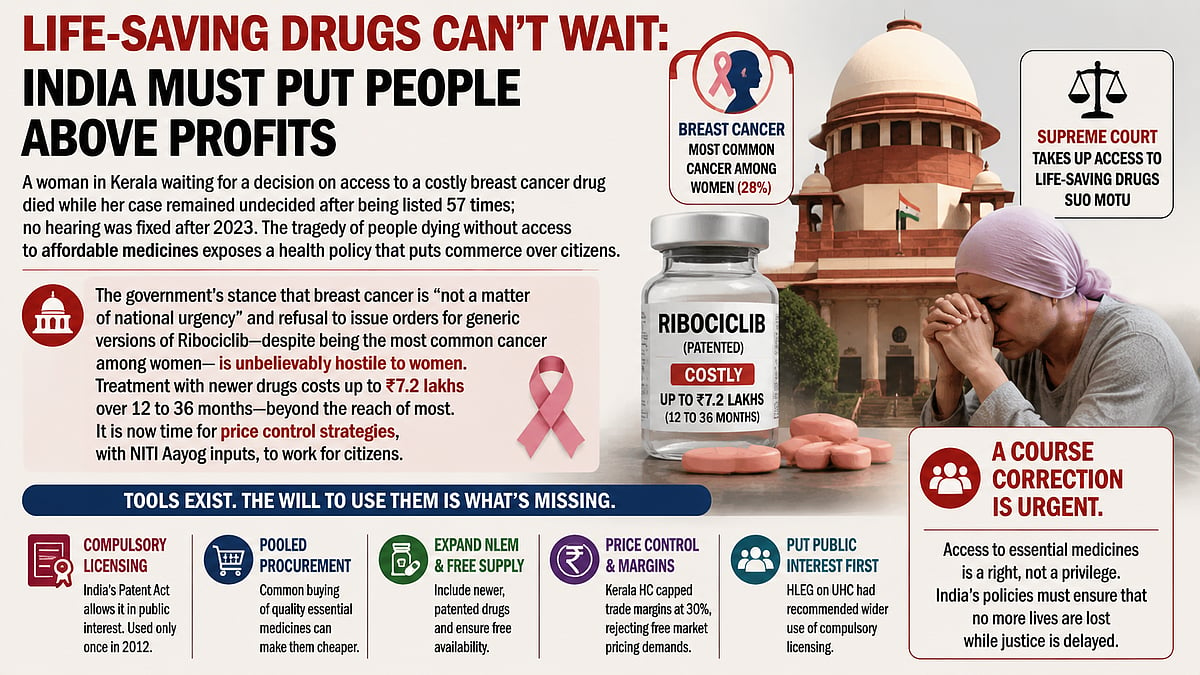
India’s policies on access to life-saving medications under Ayushman Bharat are half-measures at best, and the poor attention to this crucial aspect of healthcare has come under the spotlight after the Supreme Court took up the matter suo motu. A woman waiting for a decision by the Kerala High Court to access a costly breast cancer drug ultimately passed away while the case remained undecided after being listed 57 times; no hearing was fixed after 2023. The neglected issue of access to life-saving drugs has now been taken up by the apex court, while the Kerala HC is also suo motu considering the exorbitant pricing of life-saving patented drugs. The tragedy of people dying in India without access to affordable and efficacious medicines is a shameful commentary on a health policy that ignores the remedial possibilities available under law and places the interests of citizens below those of commerce. The government insults the collective intelligence when it rebuffs demands to issue orders to make generic versions of a life-saving drug, Ribociclib, on the ground that breast cancer is not a matter of national urgency. That the union government took such a position even when the health ministry data describes breast cancer as the most common of cancers among women, accounting for 28%, is unbelievably hostile to women as a whole. Typical treatment with one of the two newer breast cancer drugs, over a 12 to 36 month cycle, costs up to Rs 7.2 lakhs, putting them beyond the reach of the majority. It is now time for price control strategies, which rely on inputs from the NITI Aayog, to actually start working for citizens.
Several tools are available to governments if they genuinely wish to give people access to essential medicines. While many older molecules are part of the national list of essential medicines (NLEM), there is little commitment to bring patented, expensive medicines under its ambit, or even to supply current NLEM drugs free. India’s Patent Act allows compulsory licensing, an argument now before the Supreme Court, to advance public interest. Common pooled procurement of quality essential medicines for public distribution would make them cheaper. Yet, the compulsory licensing provision, which enables cheaper medicines to be made by applicant companies, has been used only once, in 2012, for a kidney cancer drug. Four years ago, in spite of a suggestion from the Kerala HC, the Centre chose to appear powerless in alleviating the suffering of women with breast cancer and refused a compulsory licence. The same court, in a separate matter, ruled against the pharmaceutical sector’s demand for free market prices and capped trade margins at 30%. Ironically, the erstwhile Planning Commission’s High Level Expert Group (HLEG) on universal health coverage had recommended a wider use of compulsory licensing to make drugs affordable. A course correction is urgently needed.

