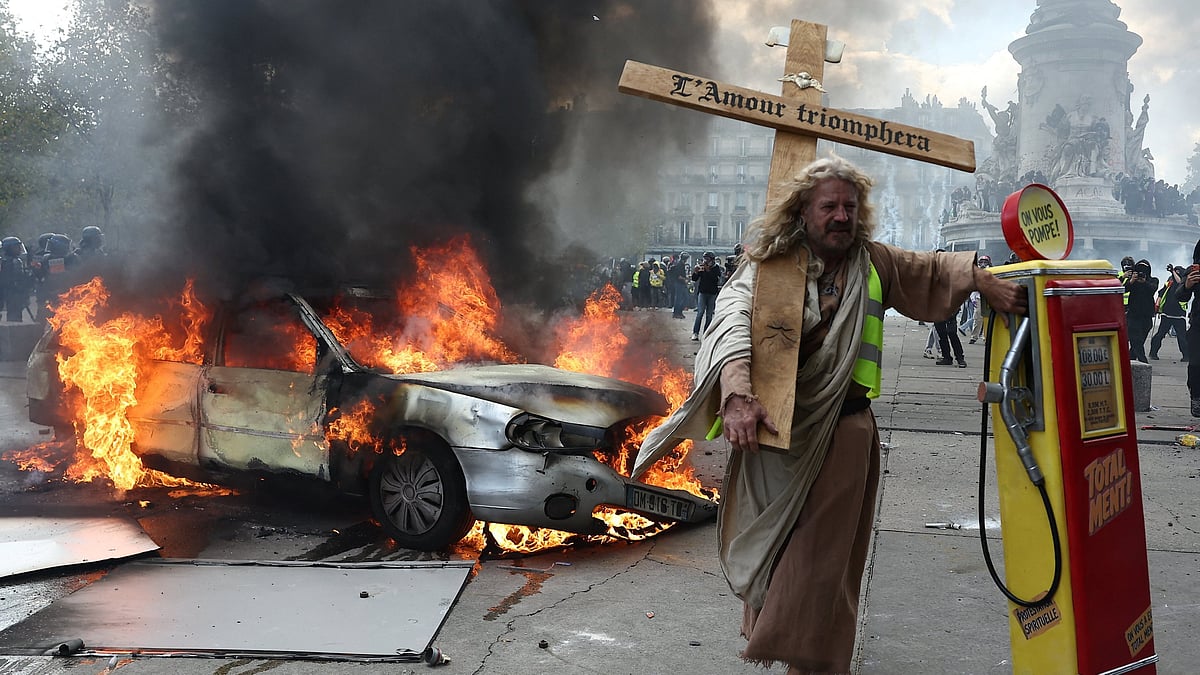
Is the European Union (EU) witnessing the foreboding of a winter of discontent? In France, Belgium and Italy—three of the 27-nation bloc’s historic founding member states—besides Portugal and Spain, peaceful public protests in recent weeks have acquired an explosive edge. Millions of ordinary citizens are making common cause over a wide range of basic concerns, from affordable housing to better education and high fuel prices. Strictly speaking, these are domestic issues that fall within the confines of national jurisdictions. Inevitably, however, the high-voltage protests in various capitals have spilled over into the European Parliament in Strasbourg. The dominant political groups in the 720-member legislature have begun trading hostile exchanges over the handling of the latest crises in different countries.
In France, speculation is rife that the government might declare an emergency in response to large-scale violence, arson and looting that shook the country. Over the weekend, mass protests brought hundreds of thousands onto the streets, with the number of arrests crossing well over 1,000. The upsurge, which began last month with students voicing grievances over decrepit school infrastructure, overcrowded classes and adverse student-teacher ratios, has swiftly morphed into a movement against a cost-of-living crisis.
In Italy, far-right Prime Minister Giorgio Meloni has been scrambling to restore order, and her deputy has assured additional troop deployment in Milan, the city worst hit by the recent violence. The damage to shops in the capital of the Lombard region alone has been estimated at 1 million euros, amid warnings of more protests in the coming days. Moreover, school boycotts by students in Rome and Turin since early October have been spurred by wide-ranging concerns, from dilapidated infrastructure and limits on foreign student enrolments in schools to a ban on the full-face veil. The unrest in France and Italy has particular potency in view of the upcoming general elections.
Housing Crisis Fuels Spanish Protests
When historians revisit Europe’s autumn of unrest in 2026, the narrative will likely commence with the threat of eviction in September of a Spanish octogenarian woman with a disability from the home she had occupied for seven decades. The incident triggered a movement for affordable housing. In the days since, thousands have taken to the streets of Madrid, setting up hundreds of makeshift tent camps to vent their anger over Spain’s spiralling housing costs.
Socialist Prime Minister Pedro Sanchez staked his future by calling a snap election on November 29, after the centre-right opposition voted down legislation to ban evictions until 2030 and regulate the country’s housing market.
Political Extremes See An Opportunity
As unrest in Europe rages on, parties of the extreme left and right, especially those in France and Italy, must be sensing an opportunity, with the next general elections just a few months away.
Next year will also mark 70 years since the EU’s founding in Rome—a poignant moment to reaffirm European solidarity in today’s fragmented world.
To get details on exclusive and budget-friendly property deals in Mumbai & surrounding regions, do visit: https://budgetproperties.in/

