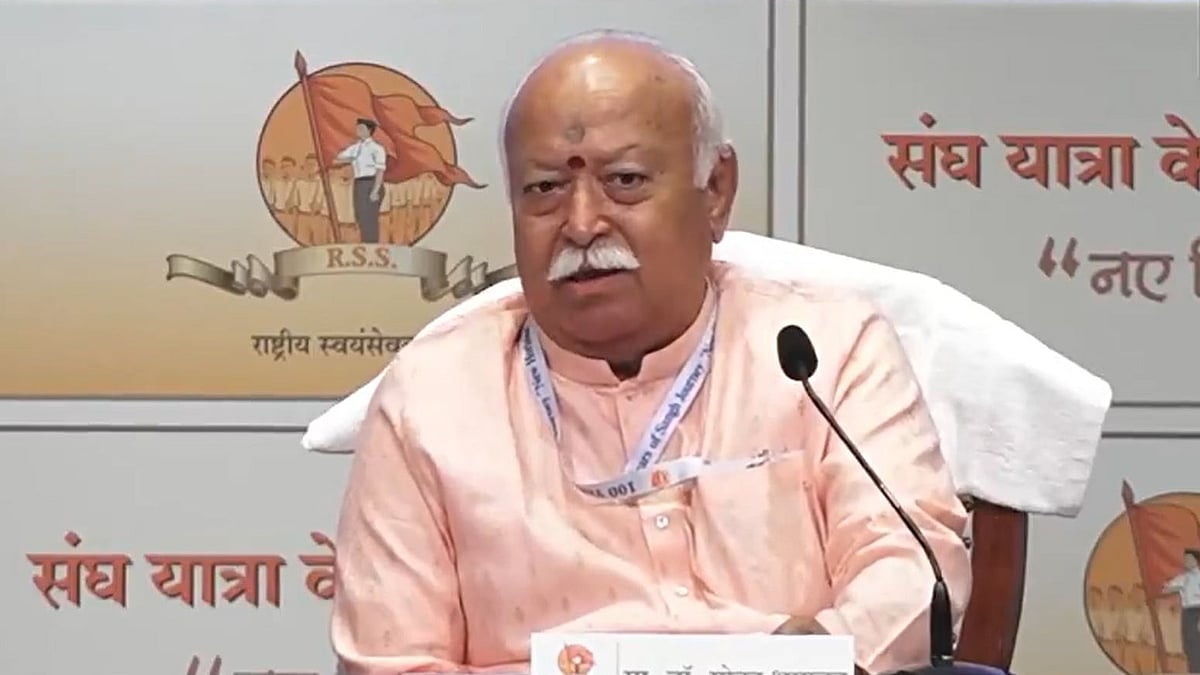
Rashtriya Swayamsevak Sangh (RSS) chief Mohan Bhagwat’s Vijayadashami speech in Nagpur was keenly awaited as it marked the culmination of the organisation’s centenary celebrations. The occasion offered him an opportunity to reflect on developments in India and the world, particularly the protest movement challenging the NDA government.
What emerged, however, was a striking contrast with the position he articulated barely two months earlier. On August 6, addressing nearly 2,000 students from more than 100 cities in Mumbai, he adopted an unusually conciliatory tone. The audience in Nagpur consisted largely of regular RSS members and office bearers.
The difference was reflected unmistakably in his words. In Mumbai, he sought to understand the younger generation; in Nagpur, he sounded a warning against forces allegedly seeking to destabilise India.
The Mumbai interaction was remarkable for its departure from the traditional top-down lecture. Bhagwat embraced dialogue and declared that he would “trust Gen Z blindly”. Young people, he said, deserved a sense of belonging and mutual respect.
More significantly, he insisted that students participating in agitations or questioning authority should not be branded anti-national. Their protests, he argued, could represent legitimate democratic demands for systemic reform.
Perhaps he recalled the Sangh Parivar’s own participation in the Nav Nirman movement in Gujarat, which brought down the Chimanbhai Patel government, and the students’ agitation in Bihar.
Protest movements are not inherently anti-national; their legitimacy depends on their objectives and methods. He also recognised that today’s young people, unlike earlier generations expected to accept authority unquestioningly, demand logical explanations and constructive engagement.
A Different Tone In Nagpur
The Nagpur speech struck a different note. Bhagwat warned of a “storm from the West” threatening traditional cultural and human values. Referring to political upheavals in France, Albania, Bangladesh and Nepal, he alleged that international forces were working to weaken India and declared that attempts at regime change would fail.
While acknowledging that administrative failures could provoke protests, he cautioned against movements that widen social divisions, foster animosity or serve narrow electoral interests. Agitations, he maintained, must respect constitutional limits and pursue solutions rather than conflict.
Which Position Represents The RSS?
Which of these positions represents the RSS’s considered view? Mahatma Gandhi was once asked which of his conflicting opinions should be regarded as his definitive position. His answer was that the one he expressed last should prevail. By that reasoning, Bhagwat’s Nagpur speech must take precedence over his Mumbai assurances.
The message to the protesting youth is consequently less reassuring than it first appeared. The RSS chief, who promised to trust Gen Z, has cast its agitation in a framework of suspicion about external interference and national destabilisation.
The RSS’s centenary has thus exposed a familiar contradiction: an invitation to dialogue when addressing the young, but a warning against dissent when speaking to the faithful.
To get details on exclusive and budget-friendly property deals in Mumbai & surrounding regions, do visit: https://budgetproperties.in/

