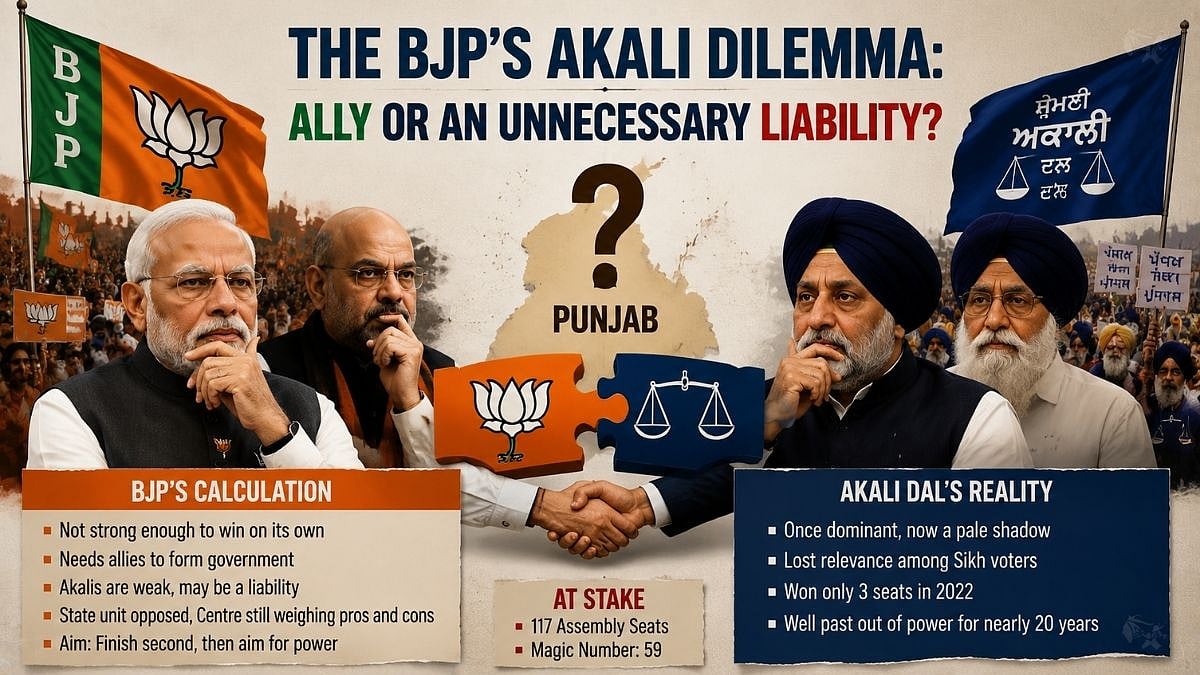
The BJP appears to be divided over the ongoing alliance talks with the Shiromani Akali Dal ahead of the fast-approaching Punjab Assembly elections. While the state unit of the party is opposed to joining hands with the Akalis, the party’s central leadership is weighing the pros and cons of this.
BJP Faces Uphill Battle
The bitter truth remains that the BJP has not yet gained enough strength to think of coming to power in the state on its own. Having contested 73 of the 117 seats at stake and winning just two in 2022, the BJP will need more than a miracle to win the minimum 59 seats required to form the government. While dreaming big, the BJP should ideally aim to finish second, which, if it does, will be a big achievement for it.
With this limitation, the BJP may need pre- or post-poll allies to have a shot at power. The Congress party is struggling in the state with internal disputes and being in total disarray, and the ruling Aam Aadmi Party’s magic is not expected to be as strong as it was in the 2022 elections. The larger question remains whether an alliance with the Akali Dal would benefit it at all.
Akali Dal’s Decline
The Akalis are now a pale shadow of their mighty past, more so since the death of their supreme leader, Parkash Singh Badal, in 2023. The party forced the ageing leader, who was 94, to contest the 2022 election from his traditional seat, Lambi, and he faced the ignominy of suffering his second-ever defeat to his AAP rival by over 11,000 votes. His previous defeat came in 1967, when he had lost by just 57 votes. That signalled the fast decline of the Akali Dal, which ended up winning just three seats, one more than the BJP.
It would be a fallacy to imagine that the Akali Dal has become stronger over the past five years. Hence, the reluctance of the BJP state unit to join hands with it. The BJP, on the other hand, has added some muscle to its body, though it remains to be tested how firm those muscles, acquired through defections and mergers, are. The BJP’s state unit feels the Akali Dal would become a liability for it in the elections, while the party’s central leadership may not be averse to it if the Akalis agree to become its junior partner, which is highly unlikely to happen, though.
A Long-Standing Alliance
The BJP’s ties with the Akali Dal predate the formation of the BJP itself, as its predecessor Jana Sangh was with the Akali Dal when the Akali-led PEPSU (Patiala and East Punjab States Union) government was formed. They shared blow hot, blow cold relations since the Jana Sangh was opposed to the Akali’s demand for a separate Punjabi-speaking state. However, once the Hindi-speaking areas of the state were granted statehood as Haryana and Himachal Pradesh, the obstacles were removed, and the two parties became natural allies. Their alliance lasted for 24 years until the Akali Dal walked out of the BJP-led NDA in September 2020 in protest against the three farm bills brought by the NDA government at the centre.
During those 24 years, they fought 11 elections as allies, including five Assembly elections and six Lok Sabha polls. They formed government thrice together in 1997, 2007, and 2012. Over the past nearly 20 years that the Akali Dal has been out of power, it has become weaker and gotten marginalised since it is no longer the first-choice party of the Punjab Sikhs.
BJP Builds Its Own Base
It took the BJP time to get its footing in Punjab after the Akalis took away the crutches on which it stood in state politics. It reflected in its poor performance in the 2022 elections. However, over the past five years, it has grown in strength. The Punjab Lok Congress of former chief minister Capt. Amarinder Singh has merged with it. A larger number of Congress, Akali, and even AAP leaders have since joined the BJP. Notable among them, besides Amarinder Singh, were Sunil Jakhar, Fateh Jang Bajwa, Raj Kumar Verka, Balbir Singh Sidhu, Gurpreet Singh Kangar, Sunder Shyam Arora, Kewal Dhillon, and Ravneet Singh Bittu, all from Congress; Darshan Singh Kotfatta, Amarpal Bony, Manjeet Singh Manna, Ravi Karan Singh Kahlon, and Harjit Singh Sandhu from the Akali Dal; and Raghav Chadha, Sandeep Pathak, Ashok Kumar Mittal, and Harbhajan Singh, among others, who switched over from the AAP to the BJP earlier this year. A majority of them were either ministers or MLAs in the past.
Notably, by design or accident, the BJP’s alliance trajectory has been in total contrast to the one that the Congress took and sunk in several key states over the past three decades. The BJP used alliances with regional parties to gain strength. It was visible in states like Maharashtra, Bihar, Haryana, Odisha, and several other states. Its regional allies became weak, and the BJP gained strength from their decline and is now ruling in all these states.
Punjab Test For BJP
As for Punjab, the BJP, which was considered a party with limited appeal among the urban and Hindu voters of Punjab, feels its acceptance level among Sikh voters and those in the rural areas must have grown, and it could be worthwhile to test the ground realities, as it has nothing to lose and lots to gain in the state.
Ajay Jha is a senior journalist, author and political commentator.

