Higher education plays a crucial role in bridging the gap between formal education and the labour market in a society. It also plays an important role in an individual’s intellectual growth. Yet, before the All India Survey on Higher Education (AISHE) reports, there was no systematic collection of data covering the entire range of higher education institutions in the country. As the need for a regular flow of comprehensive, timely and quality data on higher education for policy formulation was increasingly felt, the Government of India initiated AISHE in 2013, with comprehensive data collected for the year 2010-11. Since then, the annual AISHE report has become the single source of comprehensive statistics on higher education in the country.
The latest AISHE report pertains to the academic year 2023-24. It was released in July 2026. For teachers’ data, the reference date was December 31, 2023. For examination results, data for students in the academic year 2022-23 were considered. Financial information was collected for the financial year ending March 31, 2023.
It needs to be noted that participation by higher education institutions (HEIs) in the survey is voluntary, and data are submitted by the institutions themselves. Thus, responsibility for the accuracy of the submitted data rests with the HEIs, even though the Department of Higher Education (DoHE) verifies the data to the extent possible.
Based on the data available in this survey, I propose to sum up the present status of higher education institutions in the country in two parts. This article summarises data on the institutional network, while the next will cover the composition of enrolled students, the courses they choose, teaching and non-teaching staff patterns, and the number of foreign students attracted by Indian colleges and universities and their countries of origin.
Universities And Colleges Across India
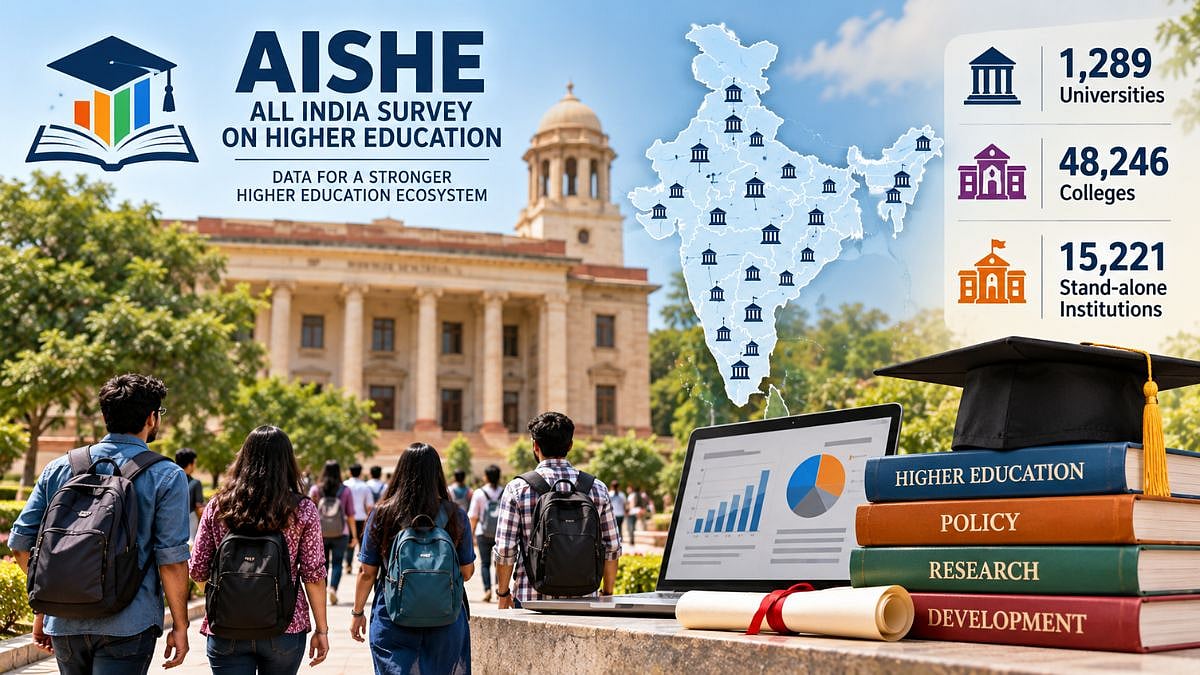
A total of 1,289 universities, 48,246 colleges and 15,221 stand-alone institutions were registered in AISHE 2023-24. Of these, 1,278 universities, 46,468 colleges and 11,787 stand-alone institutions uploaded their data to the AISHE portal.
Of the 1,289 universities, 346 are affiliating central and state public universities, with 48,246 affiliated or constituent colleges. A total of 151 universities have 100 or more affiliated colleges, of which 21 have 500 or more affiliated colleges.
Government And Private Universities
Of the 1,289 registered universities, 733 are government-managed, including 254 central and 479 state universities. There are 55 central universities and 159 institutes of national importance. The country also has 464 state private universities and 115 deemed universities, of which 33 are public and 82 are private.
Of the 1,278 universities that responded, 1,069 have hostel facilities for students, while 122 offer distance education. There are 18 open universities — one central and 17 state — offering distance education.
Gujarat (107), Uttar Pradesh (103), Rajasthan (93), Karnataka (91) and Madhya Pradesh (89) are the five states with the largest numbers of universities. Three Union Territories — Andaman and Nicobar Islands, Dadra and Nagar Haveli and Daman and Diu, and Lakshadweep — have no universities, only colleges.
Disciplinary And Specialised Institutions
Almost 60% of universities are now general or multidisciplinary institutions, while 13.5% are technical, 7.7% are medical and 4.1% are agricultural universities. The remaining universities specialise in other disciplines.
There are 37 universities managed by minorities: 16 by Muslims, 10 by Christians, five by Jains and three by the Sikh minority. There are also 18 universities and 4,787 colleges exclusively for women.
College Distribution Varies Across Districts
There are wide variations in the number of colleges across districts. A total of 10.4% of colleges are registered in just 10 districts, while about 30% are concentrated in the top 50 districts. Bengaluru Urban has the highest number, at 1,148, followed by Jaipur (742), Pune (517) and Hyderabad (465). A total of 154 districts have fewer than 10 colleges each.
The average college density at the all-India level is 32 colleges per lakh of eligible population aged 18-23 years. Karnataka (69), Telangana (56), Andhra Pradesh (51), Himachal Pradesh (51) and Kerala (50) have high college densities, while Bihar (8), Jharkhand (9) and West Bengal (16) lag far behind.
Uttar Pradesh (8,625), Maharashtra (5,380), Karnataka (4,529), Rajasthan (4,324) and Tamil Nadu (2,983) are the five states with the largest numbers of colleges. Of the 46,468 colleges, 15,901 offer postgraduate programmes.
Private Unaided Colleges Dominate
Of the 46,468 colleges, 7,944 (17.1%) are government colleges, 6,011 (12.9%) are private aided colleges, and 32,513 (70%) are private unaided colleges.
Most colleges are small in terms of student enrolment. A total of 37.9% have fewer than 200 students, while about 45% have enrolments between 200 and 1,000. Only 17.2% have more than 1,000 students, and just 4% have enrolments exceeding 3,000.
Stand-Alone Institutions Offer Specialised Courses
Stand-alone institutions are specialised institutions offering diploma courses. These include polytechnics, teacher training institutes, nursing institutes, management institutes, institutes directly under central ministries, paramedical institutes, and hotel and catering institutes.
There are 15,221 registered stand-alone institutions, of which 11,787 uploaded data to the portal. Most offer technical (4,209), teacher training (2,688) and nursing (3,744) courses. A total of 235 institutes offer postgraduate diplomas in management.
Around 22% of these institutions are government-owned and managed, while 8% are private aided and 70% are private unaided. Their numbers vary widely across states.
Higher Education Expansion Remains Uneven
To sum up, the network of higher education institutions in the country is now dominated by undergraduate and small colleges. Most of these colleges are privately owned and managed without financial assistance from the state. Although higher education has expanded significantly in recent years, its distribution and density remain uneven.
Vrijendra taught at a Mumbai college for more than 30 years and has been associated with democratic rights groups in the city.

