The Opposition in India has rarely been short of drama. When Indira Gandhi ruled, Jayaprakash Narayan, the Janata Party, Morarji Desai and Atal Bihari Vajpayee commanded as much public attention as the government itself. Under the United Progressive Alliance, the Bharatiya Janata Party produced opposition figures, from Sushma Swaraj to Lal Krishna Advani to Arun Jaitley, whose parliamentary interventions and street presence became political folklore. People remembered them not merely as critics but as alternative centres of political energy.
That rhythm broke after 2014. Narendra Modi arrived with a majority that grew stronger, a personal popularity that few prime ministers have matched, and a governing style that treated opposition parties as obstacles rather than competitors. The Bharatiya Janata Party’s electoral dominance coincided with the systematic use of central agencies against regional and national rivals. The Shiv Sena split, the Nationalist Congress Party fractured, and the Trinamool Congress faced repeated Enforcement Directorate and Central Bureau of Investigation cases against its leaders. Other parties experienced the same pattern. What looked like ordinary political competition to supporters of the government appeared to those at the receiving end as an effort to hollow out organised opposition before it could consolidate.
Rahul Gandhi’s Bharat Jodo Yatra demonstrated that street mobilisation still mattered. The long march revived the Congress in several states and contributed to its improved performance in the 2024 Lok Sabha election. Yet, the yatra remained an exception. For years, the Opposition’s daily practice had shifted indoors and online, where announcements by the ruling party travelled farther than protests by its critics. The result was a visible void. Anti-incumbency existed on questions of jobs, examination integrity and institutional fairness, but it lacked a sustained, public form that could pressurise the government.
Gen Z Brings Protests Back To The Streets
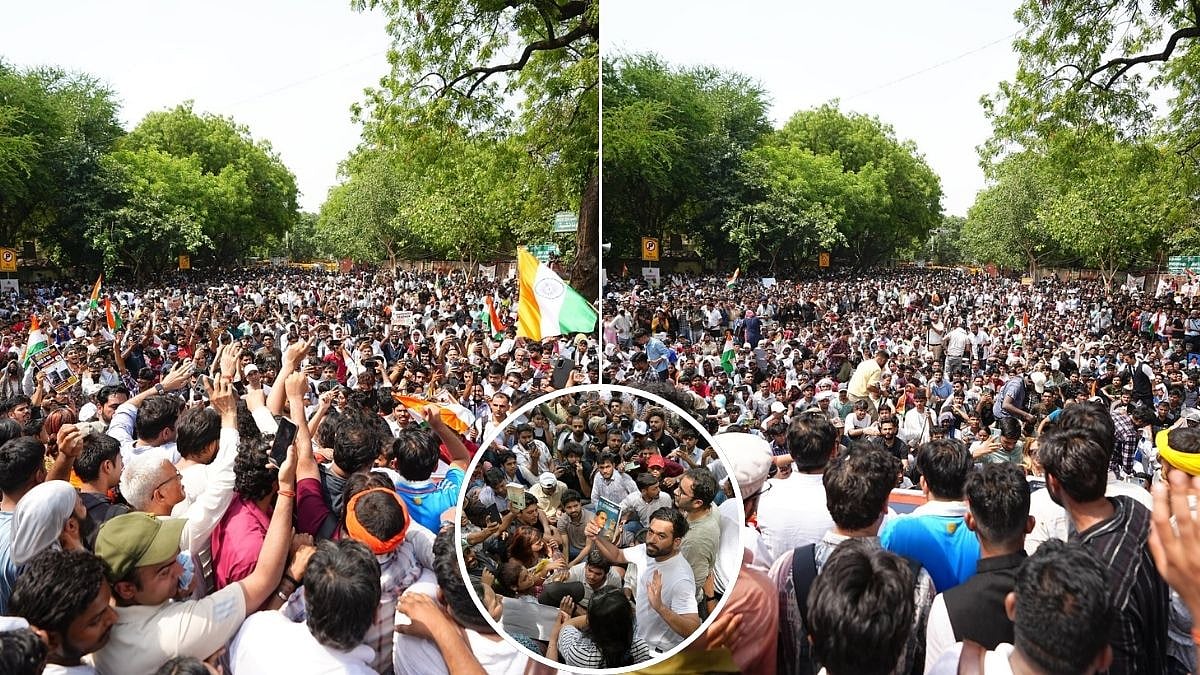
Gen Z supplied that form. The immediate trigger was the May 2026 leak of the National Eligibility cum Entrance Test paper, which forced the cancellation of an examination taken by more than two million medical aspirants and a nationwide retest. Around the same period, a remark by the Chief Justice, comparing certain unemployed youth and online activists to cockroaches, produced a satirical response. Abhijeet Dipke and others launched the Cockroach Janta Party as an online joke that quickly became a real movement. Within weeks, it had millions of followers on Instagram and a physical presence at Jantar Mantar. The protesters combined anger over repeated paper leaks, high youth unemployment and the broader sense that the system treated their futures as disposable. They demanded the resignation of Education Minister Dharmendra Pradhan and refused to disperse.
The government initially resisted. Pradhan’s resignation on July 25, 2026, after more than a month of occupation and a march towards Parliament that met police force, marked one of the rare instances in the Modi years when sustained public pressure produced a ministerial exit. The movement did not end there. By October, the same network had turned its attention to the Special Intensive Revision of electoral rolls and the Chief Election Commissioner, alleging large-scale deletions that favoured the ruling party. Opposition parties, including the Congress and other INDIA bloc constituents, began organising their marches on the same issue, complete with daily street presence, confrontations with police and the visual language of Gen Z protest, including Batman masks that turned an earlier Instagram exchange into a street prop.
How Gen Z Changed The Language Of Protest
What the youth demonstrated was not simply that anti-incumbency exists; they showed how that sentiment becomes politically effective. Messaging had to be short, visual and shareable rather than long speeches or slogans designed for television. Platforms shifted from WhatsApp forwards and evening news to Instagram reels and YouTube explainers that treated politics as both serious and humorous. The audience was no longer assumed to be older party workers or middle-aged viewers. The starting point was the under-thirty generation that constitutes more than half the population and faces the sharpest contradictions between educational effort and employment outcomes. Street occupation replaced press conferences. A single clear demand, rather than a laundry list, kept the pressure focused. Visibility itself became the argument. People could see the protest, film it and decide whether the government looked responsive or rigid.
The Opposition has begun to absorb parts of this lesson. Rahul Gandhi, Priyanka Gandhi and other INDIA bloc leaders now spend more time outside Parliament and on the roads. The Batman masks at the recent Delhi march were not accidental. They signalled an attempt to speak in the register that Gen Z already uses, one that mixes defiance with irony and refuses to treat politics as solemn theatre. The Congress, which once built its identity on mass movements against colonial rule, is rediscovering that street presence is not nostalgia; it is the practical requirement for opposing a government that controls institutions, media ecosystems and a large share of the electorate.
Street Mobilisation Does Not Guarantee Electoral Success
None of this guarantees electoral success. The Bharatiya Janata Party retains organisational strength, welfare delivery and a narrative of national pride that continues to command support. Youth anger over examinations and jobs does not automatically translate into votes for any particular party. The Cockroach Janta Party itself has remained a pressure group rather than an electoral force, and it has already faced internal splits. Yet, the larger point holds. For more than a decade, the Opposition often appeared to negotiate its irrelevance, oscillating between parliamentary walkouts and social media complaints, while the government consolidated power. Gen Z forced a reminder that opposition is not a status but a practice. It begins on the street, uses the language and tools of the people it seeks to represent, and remains visible enough that citizens can judge whether anyone is actually resisting.
The gratitude owed to this generation is, therefore, specific. They did not invent anti-incumbency; they made it impossible to ignore and costly to dismiss. In doing so, they returned to the Opposition the elementary fact that power, however large the majority and however popular the leader, still has to answer when enough people refuse to leave the road.
Sayantan Ghosh is the author of two books, Battleground Bengal and The Aam Aadmi Party, and teaches at St. Xavier’s College (Autonomous), Kolkata.
To get details on exclusive and budget-friendly property deals in Mumbai & surrounding regions, do visit: https://budgetproperties.in/

