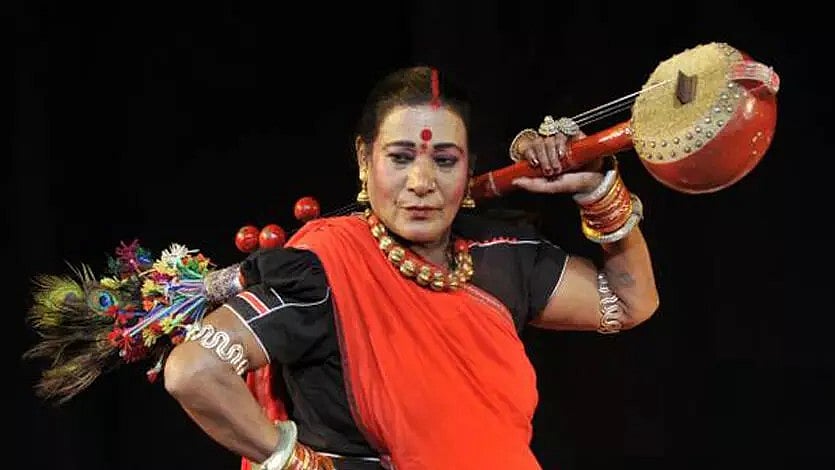
Chhattisgarh is famous for its Dandakaranya forests, its massive mineral wealth, its coveted title as India's rice bowl, and its rich tribal culture. Among its towering personalities, the state has come to be associated with Teejan Bai, the much-acclaimed folk artist adorned with a multitude of awards, including the nation's top honours such as the Padma Shri (1988), Padma Bhushan (2003), and Padma Vibhushan (2019). That voice fell silent yesterday, leaving behind a legacy few can match.
Breaking Social Barriers
It is not easy for a man, let alone a woman coming from a marginalised community, to reach the heights Teejan Bai did. Her introduction to music happened early on when she heard her maternal grandfather recite the Mahabharata in the Kapalik style of Pandavani, written by Sabal Singh Chauhan in Chhattisgarhi. Deeply influenced by the rendition, she started learning the art. However, it was not just her ability to sing that made her the legend she was, but also her ability to break numerous norms imposed on women by society at large.
Unlike other women of her community, who sang devotional songs and narrated the Mahabharata in the Vedamati style, a restrained form of storytelling while sitting cross-legged on the floor, she performed in the Pandavani style, which was a male bastion, standing on the stage and singing in a loud, guttural voice. In true Pandavani style, her renditions were accompanied by dramatic gestures, impromptu dancing, and the enactment of characters from the Mahabharata. She broke the glass ceiling at the tender age of 13 and faced grave consequences, as her year-old marriage broke down and she was expelled by the Pardhi community to which she belonged. But she stood her ground, literally. Alone and penniless, she rebuilt her life and continued singing in Pandavani, creating history.
A Masterful Performer
The most fascinating aspect of her performance was the way she enacted her characters most convincingly using just her expressions, her tenor, and her tambura. When playing Arjun, the tambura in her hands transformed into Gandiva, Arjun's preferred weapon, while playing Bheem, the same tambura appeared as a mace, and while playing Krishna, one could imagine it to be a flute, held ever so gently in her hands.
Teejan Bai's life was as dramatic as her profession. Once, while she was performing, her second husband got onto the stage and, in an aggressive voice, demanded that she stop the act. In reply, she simply picked up her tambura and announced that since he had not only insulted her but her art as well, and she could not forgive him, she was choosing her art over him. And that henceforth he was “a nobody to her”. She ended the marriage there and then, on the stage, in front of the audience.
An Enduring Legacy
Such was the persona of Teejan Bai—an individual who dared to dream, an artist who kept a legacy alive, but above all a woman who broke conventions and lived life on her own terms.

