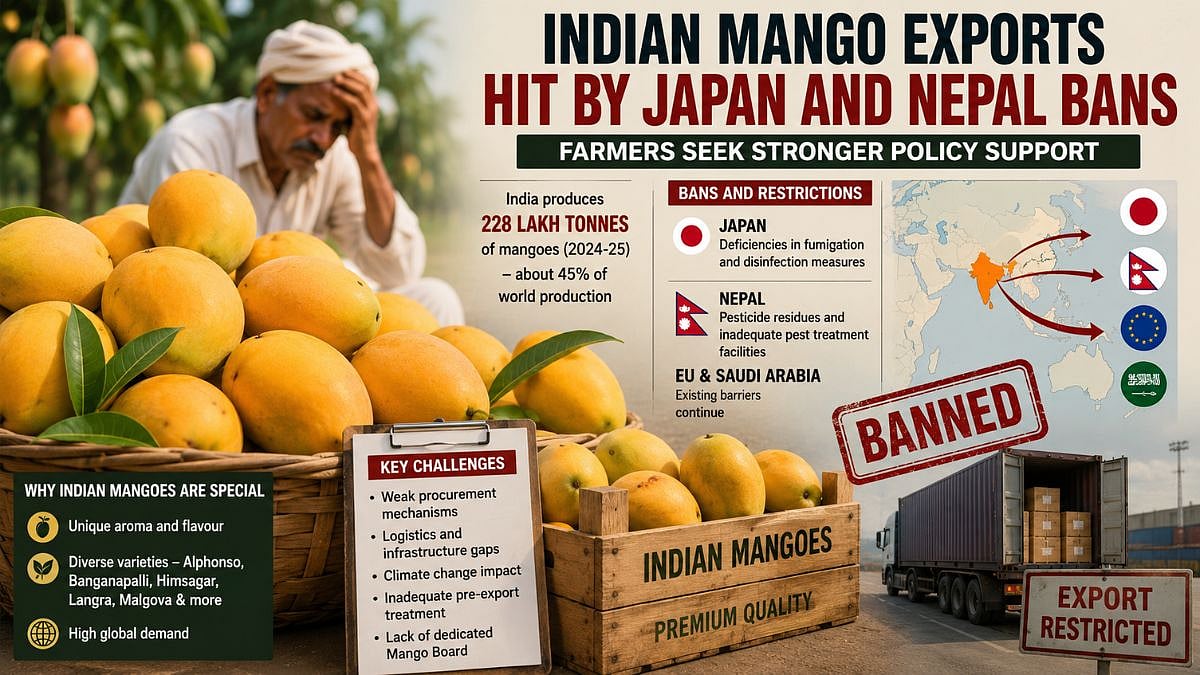
India is the global leader in mango production, with several varieties of the king of fruits commanding a premium in international markets, but this year has witnessed a setback in exports. As a heavy hitter, the country contributed 228 lakh tonnes, or about 45%, of the world’s mangoes during 2024-25. These are made famous by the unique aroma and flavour of Alphonso, Banganapalli, Chinna Rasulu, Malgova, Langra, and others, making this prized crop deserving of high levels of support from the Union and state governments.
Export Setbacks And Bans
But this year’s experience has left many mango farmers bitter, as Japan and then Nepal banned the import of Indian mangoes, adding to barriers imposed by the European Union and Saudi Arabia. Recently, Japanese inspectors found deficiencies in fumigation and disinfection measures, while Nepal, which aligns its standards with the EU, cited pesticide residues and inadequate facilities to treat mangoes against pests.
It is baffling that such concerns are inadequately appreciated at the highest levels of policymaking, at a time when high petroleum expenditures and a weakening rupee have led to calls for austerity from Prime Minister Narendra Modi. Among the suggestions repeatedly made to boost mango production and export is the creation of a Mango Board, which can give undivided attention to emerging challenges.
Union Agriculture Minister Shivraj Singh Chouhan said last year that there was no plan to form such a board, and the government would continue with existing policies, supporting scientific cultivation, marketing, and export. Yet, it is neighbouring Thailand and not India that leads in producing dried mango slices, a delicacy marketed aggressively to international travellers.
Distinctive Indian Mango Identity
Indian mangoes have a distinct presence in world markets because of historical authenticity provided by climatic conditions, mineral-rich soils, local pollinator diversity, and natural growing practices. It would be a monumental folly, therefore, to attempt industrialisation of mango cultivation for yields rather than remove physical bottlenecks, such as weak procurement mechanisms, logistics, and pre-export treatment.
Climate Change And Crop Challenges
Climate change is also casting a dark shadow on mango farming, as this year’s experience with Chhattisgarh’s Mahilabad mango hub and Bengal’s Himsagar variety shows. A significant part of the crop in Bengal has been blighted by the ‘dark spots’ phenomenon attributed to aberrant rainfall followed by high temperatures.
A wider concern is the poor appreciation of traditional fruit production, reflected in the sanction given for a thermal generation unit in Pirpainti in Bihar’s Bhagalpur district, reportedly involving the felling of a large number of mango trees.
Policy Imperatives For Traditional Cultivation
It is imperative that horticulture policy preserve traditional, natural, and chemical-free mango production, which the world waits to buy each year, rather than focus solely on higher yields through chemical interventions. The Union government has its work cut out to help farmers take their mango crop to market, both in India and abroad.
