Modern human civilisation, industrialisation, urbanisation, and rapid economic growth and prosperity are inextricably linked to ever-increasing energy consumption. Animals consume energy in the form of food for survival. Only modern humans consume most energy not for food but for convenience, comfort, and the consumption of various goods and services. We consume about 2,500 kcal of food per day per capita. That is roughly equivalent to 3 kWh of energy.
Every year, a person consumes about 1,000 kWh of energy as food. All humanity (8.3 billion) thus consumes about 8,300 terawatt hours (TWh) of energy per year as food. Considering that global primary energy consumption in all forms by humanity is about 200,000 TWh, we consume about 25 times the energy that we eat as food for survival. In a fundamental sense, our energy consumption distinguishes us from all other animals and has enabled us to enjoy a measure of comfort, convenience, and quality of life unmatched by any other species.
Rise Of Modern Energy Use
Until the 1850s, our energy consumption was limited to firewood for cooking and heating. With the advent of the Industrial Revolution, things changed rapidly. In 1804, Richard Trevithick designed the first steam-powered railway locomotive. From the 1850s, rail transport took off. In India, the first passenger train ran from Bombay to Thane in 1853. In the US, the first transcontinental rail track was completed in 1869. The use of coal kept increasing for railways from 1850 onwards.
With Thomas Edison's invention of the electric bulb in 1879, and with alternating current winning the "War of the Currents" in 1895 as an efficient mode of transmission of power over long distances, the age of electricity dawned. Coal became the fuel of choice for the production of electricity, and coal consumption took off.
With Henry Ford's remarkable success with assembly lines and the mass production of automobiles from 1908, the era of oil began. From the 1950s, natural gas consumption grew dramatically for heating, cooking, and use as industrial fuel and raw material.
Today, humanity is addicted to massive consumption of energy, without which life comes to a standstill and economies collapse. Oil consumption, which constitutes 30% of our primary energy consumption, was 11 million barrels per day (mbd) in 1950 and now stands at 103 mbd. Global coal consumption, mostly for thermal power, stands at 8.8 billion tonnes per year and accounts for about 27% of the global energy supply. Natural gas consumption of 4 trillion cubic metres (bcm) accounts for about 23% of primary energy consumption. Renewable energy—nuclear, hydropower, solar, wind and biofuels—accounts for about 19% of energy, and this segment is growing rapidly.
Climate And Energy Challenge
In the past four decades, climate scientists have concluded that atmospheric carbon dioxide (CO2) levels are rising (280 ppm in the pre-industrial era; about 432 ppm now) and are causing global warming due to the greenhouse effect, and this rise is very likely due to human activities. Since then, there have been serious concerns about the impact of a significant rise in global average temperature. Concerted efforts are being made to reduce CO2 emissions.
But given our critical dependence on energy consumption for economic activity, we are always falling short of our targets. Climate sceptics dismiss the concerns of global warming as alarmist and argue that changes in temperature are part of natural cycles throughout the planet's history and that reducing consumption of fossil fuels (coal, oil and gas) would be painful and unnecessary. Irrespective of which argument is right, prudence and the precautionary principle demand that we reduce CO2 emissions and switch over to alternative, renewable energy sources.
Until about four decades ago, the concern all over the globe was "peak oil/gas/coal production" and the likelihood of depletion of these fuels, posing an existential threat to humanity, as they are finite in quantity and will eventually be exhausted. Estimates indicate that global oil and gas reserves may last about 50 to 55 years and coal reserves about 130 years. Experience has shown us that new deposits may be found through exploration. But as the easily recoverable fossil fuels are exhausted, the cost of extraction from new finds will become increasingly difficult, more expensive and uneconomical. In any case, we may extend supplies by a few more decades, but there is a limit beyond which we will not be able to extract these fossil fuels from Mother Earth.
The Case For Renewables
Decades ago, I attended a brilliant lecture by George Porter (1920–2002), the distinguished Nobel Laureate in Chemistry (1967) and then President of the Royal Society (1985–90). He pointed out that our dependence on fossil fuels is but a short blip in human history. Coal, gas and oil consumption have been with us for only over a century in the long history of the modern human species (Homo sapiens), spanning about 300,000 years. Porter pointed out that conservation and efficient management of fuels would at best prolong their availability by a few decades. The real long-term answer lies in harnessing the ultimate source of energy on planet Earth—the sun. Nature has been harnessing the sun's energy through photosynthesis, which evolved about 3 billion years ago. Now efficient technologies give us the means of harvesting the sun's energy and generating electricity. We can generate solar power and convert biomass into fungible energy through second-generation technologies. We are closer than ever before to fulfilling the dream of abundant, cheap and sustainable energy.
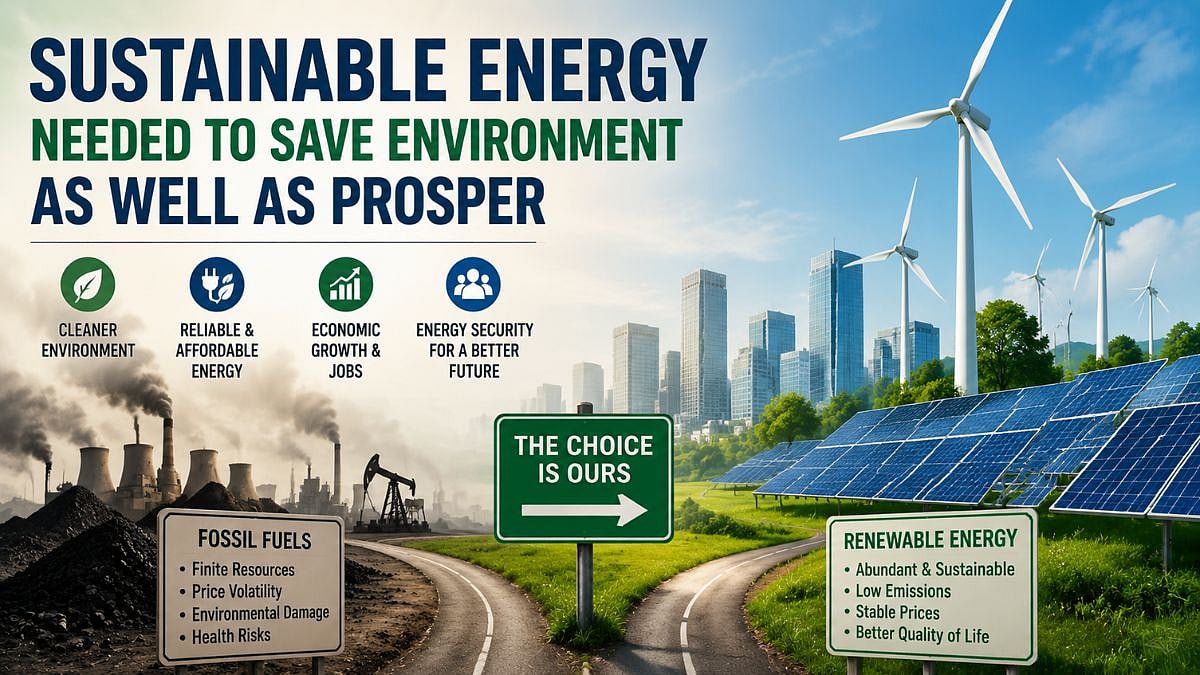
Whether we believe in anthropogenic climate change or are sceptical of global warming claims, modern technology offers us an unprecedented opportunity to sustain economic growth with cheap, reliable energy without fear of depletion of reserves. We are singularly fortunate to live in this glorious age. The Iran war and the perpetual fear of the closure of the Strait of Hormuz and supply chain disruption should spur all humanity, and us in India, into energetic, purposive action.
The recent events leave us in no doubt that Iran considers the Strait of Hormuz its asset, and it will always control shipping in the Persian Gulf. Complacency about the future of energy supplies will be suicidal. We need to act now and drastically reduce our dependence on oil imports within a decade.
The author is the founder of the Lok Satta movement and Foundation for Democratic Reforms. Email: drjploksatta@gmail.com / Twitter: @jp_loksatta.

