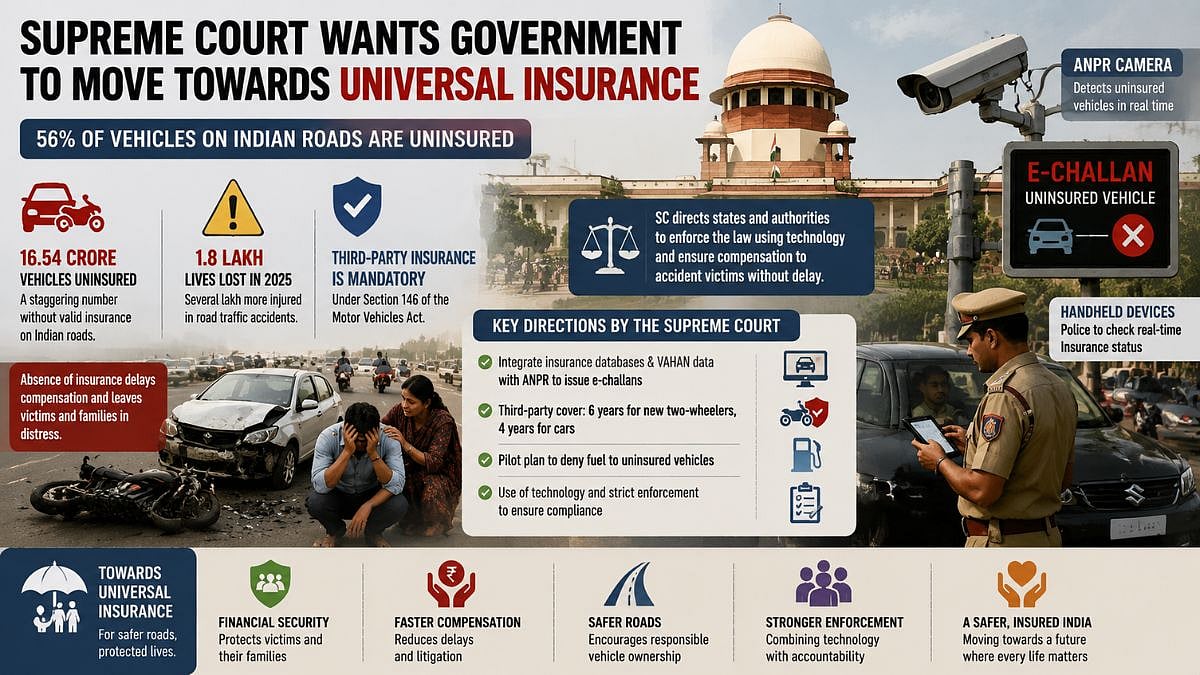
Against the backdrop of an extraordinary burden of fatalities and injuries in road crashes, it is a gross failure of governance that about 56 per cent of vehicles on Indian roads are uninsured. In absolute terms, that is a staggering 16.54 crore vehicles.
Among two-wheelers, which are involved in a large share of accidents, vehicles without valid insurance exceed those with cover. India witnessed 1.8 lakh road traffic accident deaths in 2025, and injuries left several lakh incapacitated.
It is wholly welcome, therefore, that the Supreme Court has taken fresh cognisance of this derelict state of affairs and issued directions to address the crisis.
Absence of third-party insurance, which is mandatory under the Motor Vehicles (MV) Act, paralyses the compensation process for victims in a legal process that is beset by delays even in the normal course. Victims of crashes that occurred before rules were updated in 2022 are worse off.
The SC bench of Justices Sanjay Karol and Prashant Kumar Mishra took note of the problem of uninsured vehicles in connection with a case where the insurance company was ordered to pay compensation to a victim’s family and ruled that a comprehensive insurance policy covers any occupant of the vehicle.
What stands out is the shocking disinterest of state governments in enforcing MV law, which mandates compulsory third-party insurance under Section 146. Now, the SC has fixed responsibility on the administrative machinery to enforce the provisions using appropriate technologies.
Technology-Driven Enforcement
The court’s orders, inter alia, cover integration of insurance industry databases and vehicle data from the VAHAN portal with Automatic Number Plate Recognition (ANPR) technology to issue e-challans to uninsured vehicles and provision of handheld devices to police to check real-time insurance status.
Third-party cover for new two-wheelers is to be increased to six years and for cars to four years. In an innovative approach to bringing about compliance, the court said the Ministry of Road Transport and Highways, in consultation with insurance regulator IRDA, could come up with a pilot plan to deny fuel to uninsured vehicles. These are forward-looking orders and suggestions aimed at eliminating the unconscionable delays in paying MV compensation.
Need For Wider Coverage
It should be emphasised, however, that ANPR technologies can sometimes err, throwing up false positives; a different technology, such as FASTag, has faced disputes from vehicle owners over wrong toll plaza debits.
A two-factor confirmation using matching of the vehicle with the ownership and insurance may be necessary; dispute resolution should be made simple.
It is possible to weed out uninsured vehicles through manual checks carried out intensively in cities and on highways by police and insurance industry agents, using handheld devices.
The IRDA could also enable low-premium, stand-alone personal accident insurance products for individuals who take shared rides, buses, trains, taxis and autorickshaws, covering medical treatment, injury and death in road crashes.

