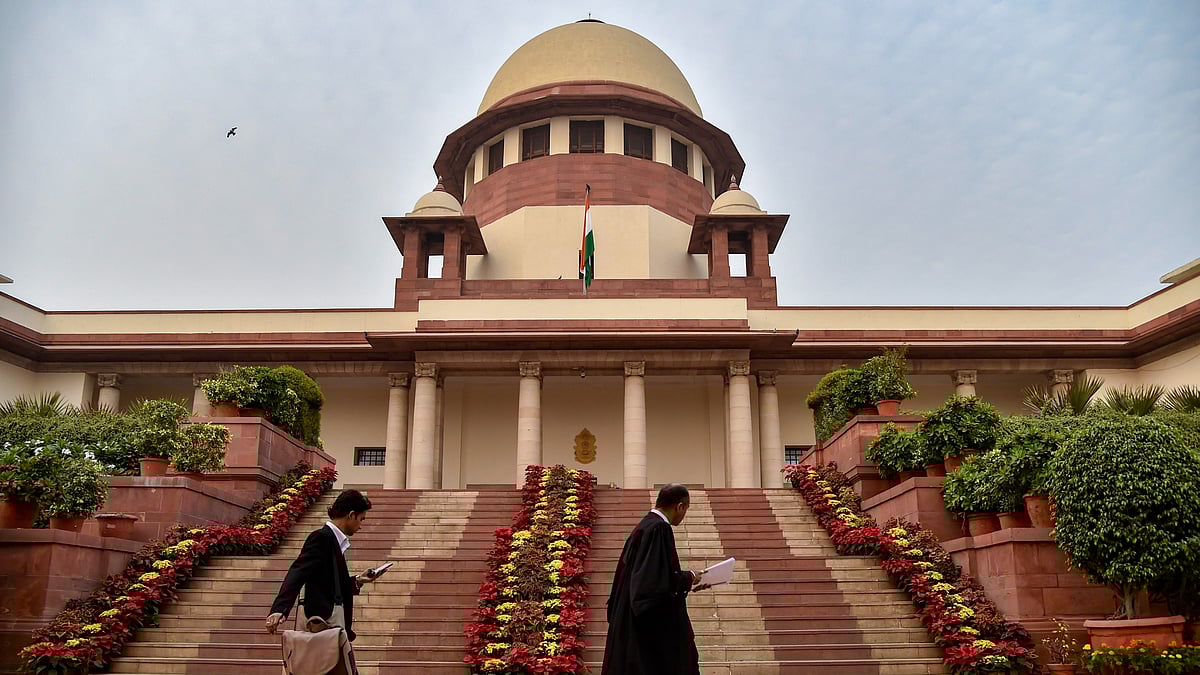
The Supreme Court made several sharp comments on Thursday (Feb 19, 2026) regarding the indiscriminate distribution of largesse to voters undermining the state’s primary responsibility of providing collective goods and services and fulfilling genuine welfare obligations. The Chief Justice wisely refrained from giving a direction, saying the Court did not want to "cross our limitations and comment or decide on the purpose of a welfare scheme or how it should be given".
This restraint and refusal to intervene judicially is constitutionally sound and enhances the Court's credibility. At the same time, the Court gave expression to the anguish and concern most thinking citizens feel about fiscal profligacy and unchecked populism at the cost of core functions of the state and imperatives of investment and economic growth. This gives us an opportunity to examine the issue in a dispassionate and non-partisan manner and arrive at a mature consensus to protect the future.
Unchecked populism and electoral promises
It would be unwise and unproductive to tell political parties what kind of electoral promises they should make. But there is a line that is sometimes crossed. The DMK’s promise of free colour TVs in the run-up to the Tamil Nadu Assembly election in 2006 is one such case. The matter went to the Supreme Court, and in 2013, the Court directed the Election Commission, in the absence of legislation, to frame guidelines regarding electoral promises under Article 324 in consultation with recognised political parties and include them in the Model Code of Conduct. So far, no such action has been taken by the Election Commission.
The nature of the electoral promises apart, it is clear that unchecked populism at the cost of core functions of the state, infrastructure, promotion of growth, and enhancing the incomes of the poor is driving many states into a debt trap and fiscal crisis. This author has made the case for fiscal responsibility in these columns on several occasions.
Constitutional tools and fiscal responsibility
What can be done now? The Constitution makers anticipated this problem and made provisions to address future fiscal challenges. Article 360 expressly states that “if the financial stability or credit of India or of any part thereof is threatened”, the President may make a declaration to that effect by a proclamation. But that is an extreme step after a full-blown crisis develops. The critical issue is that the Union has the responsibility to ensure the ‘financial stability’ and ‘credit of India’.
The Union is endowed with the authority and responsibility to avert a fiscal crisis in states under Article 293. Under Article 293, ‘a state may not without consent of the Government of India raise any loan’ if it owes money to the Union or if any Union guarantee is in place. The Union may impose conditions for granting such consent as it ‘may think fit to impose’. This salutary provision has not been utilised by successive governments for fear of political backlash and out of sheer neglect over time. In a highly polarised political climate, any denial of consent to loans or imposition of conditions will be portrayed as an act of hostility to the state. Worse still, innocent voters may be incited by saying that while the state government, out of the goodness of its heart, wants to extend welfare to the people, the Union is maliciously preventing it from doing so. The Union, just like the states, is governed by a political executive, and every party wants to maximise its vote share in a state and is reluctant to risk the voters’ wrath to promote fiscal discipline.
A constructive way forward
We need a constructive debate in the country to protect the future. Otherwise, several states will enter a debt trap from which recovery will be difficult. The Union has been exhibiting impressive fiscal discipline in recent years. But several states are borrowing heavily for current expenditure without creating durable and productive assets or enhancing the earning capacity of the people. This is robbing children of their future, as they have to repay the debt as future taxpayers without inheriting assets. Such conduct is contrary to the ethos of Indian society and detrimental to our future as a country.
What is the way out? Perhaps we should follow the golden rule: governments should borrow exclusively for investment purposes, not to finance current consumption. Many governments have revenue deficits. But our economy is growing at 7%. Nominal growth will probably be over 10% in the long term, and government revenues will grow at the same rate. All we need to do is either freeze revenue expenditure at current levels until the revenue deficit is nil or at least allow expenditure growth well below, say, 2-3% per annum. In a few years’ time, the debt will be manageable; a road map can be provided for each state, taking into account its specific circumstances, and the condition may be imposed under Article 293(4) to reach a nil revenue deficit in a finite time frame for consenting to any new debt.
Role of the CAG and non-partisan enforcement
How do we enforce such a condition without partisanship? The Comptroller and Auditor General (CAG) is a credible constitutional authority. The task of keeping track of the finances of the states in real time, ensuring transparent public accounts, taking into account off-budget loans and pending bills, etc., may be entrusted to the CAG, and the consent or denial of a loan may be based on the CAG's recommendation, reviewing transparent data and evidence.
Some states are already in an impending crisis. The Constitution gave us the tools. There are practical and relatively painless ways of applying the fiscal rules. The rules can be enforced in a transparent, credible, and non-partisan manner. The task is urgent. The time is ripe. We should act without delay. Any dithering or failure will jeopardise India's growth prospects at a critical juncture in our national life.
The author is the founder of Lok Satta movement and Foundation for Democratic Reforms. Email: drjploksatta@gmail.com / Twitter: @jp_loksatta

