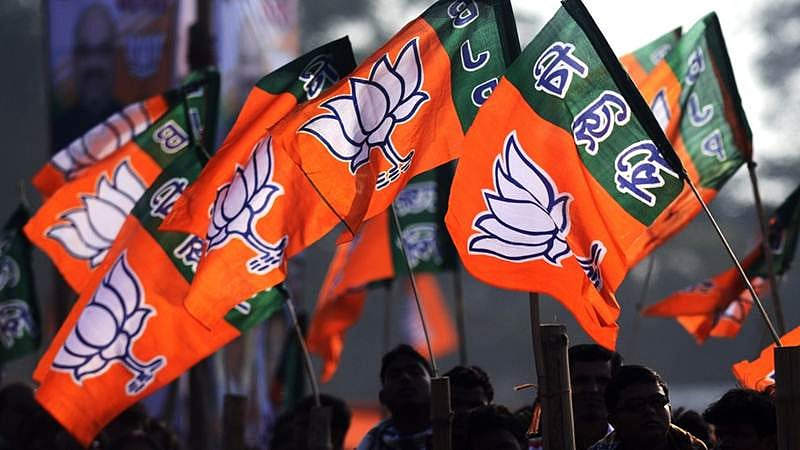
THE return to tradition under the BJP’s auspices could also mean returning to the chaos, corruption and religious strife of the last days of Mughal rule. It could be said that India is returning to its roots. Uttar Pradesh exploded last Saturday in a frenzy of Holi-like celebration because many people felt their birthright had been restored. Simultaneously, Lok Sabha TV screened Kalpana, the one and only film that the great dancer, Uday Shankar, made, reviving the sad suspicion that the birthright is flawed and that our parody of Westminster politics only compounds the confusion of India that is Bharat.
It is tempting for the saffron brigade to argue that the Bharatiya Janata Party will gradually extend its hold over the entire country, and that this will mean some form of Hindu Rashtra. If so, the difference from the past will be mainly of degree. What needs to be remembered is that India has never really been anything else. Even Jawaharlal Nehru’s India rested on a bedrock of orthodoxy that would have lapped up Narendra Modi’s mix of puja and politics. Nehru himself is believed to have told the American diplomat John Kenneth Galbraith that he was “the last Englishman to rule in India”. It has also been said he was English by education, Muslim by culture, and a Hindu only by the accident of birth.
Nehru’s tremendous prestige and what Singapore’s Lee Kuan Yew called “the charisma of the leader” enabled him to dominate the party, push through progressive legislation like the Hindu Code bills, and subordinate Hindu traditions to an enlightened superstructure of Western jurisprudence. His mass appeal helped. As Vallabhbhai Patel himself said of the mammoth crowd at a Congress rally, “They come for Jawahar, not for me.” Lee mused that not more than 40 per cent of listeners understood what Nehru said and stood for. But “they thought to be in his presence was to have been blessed.” Secularism was never a widely accepted national ideal.
While news channels salivated over Modi’s spectacular sweep of the UP polls and sought different ways of repeating that Modi is the new Nehru, I wallowed for an hour and a half in a film that Martin Scorsese, the great American director, called “a great work of hallucinatory, homemade expressionism and ecstatic beauty … whose primary physical vocabulary is dance” when it was shown at the Cannes film festival. It was the second time for me: I saw Kalpana on a rare visit to the cinema (almost an obscene word in my strait-laced family) a year after its release in 1948. I was nearly twelve then and it was a special treat by someone who couldn’t be refused because he had just married into our family.
I remembered bits of the film but not its savage denunciation of social abuses. I thought of Uday Shankar (whom I had met and interviewed in his old age) as an artist, not a social crusader. But from the opening shot of a signboard reading “Box Office is God” to the closing scene of a patriarch urging everyone to abjure slogans and act positively instead, Kalpana is profoundly evangelical. One misses this concern for fundamental values in the factional squabbling that passes for politics in India. Of course it’s also cause for concern that the BJP’s view of India is so obstinately monochromatic that it did not induct a single Muslim candidate although Muslims account for 20 per cent of UP’s population. For that matter, the BJP doesn’t have any Muslims in the Lok Sabha either. But although a token Muslim might have been shrewd tactics in UP, I wasn’t surprised. Mohammed Ali Jinnah’s scathing dismissal of Muslims in the Congress Party applies even more to Muslims who affect to flaunt the BJP’s saffron. As I have recounted before, lunching once with Atal Behari Vajpayee and Sikandar Bakht in Singapore, I asked Bakht why he was in the BJP. “The BJP is the only party for Muslims …” he began when Vajpayee shut him up.
Modi hasn’t yet achieved the state of near divinity Lee attributed to Nehru, despite Amit Shah’s sycophantic attempt to downgrade Nehru by asserting, “Modi has emerged as the most popular leader since independence.” But there’s no denying he is far closer to peasant grassroots. So was Mahatma Gandhi. So was Patel. Standing at a cultural distance from the multitude, Nehru could see the flaws and judge India by a modern yardstick. But his modernity failed him at the end. Although Nehru worried about obscurantism, superstition and astrology, he ignored the corruption, dishonesty, nepotism, money-grabbing, bullying, obsequiousness and other character defects that are portrayed in Kalpana. Most Bengalis of a certain age know the names of the local hoarders who were largely responsible for cornering foodgrain and pushing up prices to create the catastrophic famine of 1942 but some pot-boilers have taken to blaming Churchill for the tragedy.
Nothing exposes the absence of genuine modernity more than parroting fashionable borrowed slogans like “Digital India” while ordinary services like the post and public transport are collapsing. The semi-educated everywhere tend to fasten on smart catchwords and repeat them ad infinitum like the mantras that primitive folk hope will bring them salvation. Marie Stopes, the British campaigner for eugenics and women’s rights, found that Indian women to whom she had given strings of beads to count the safe period as a birth control measure had instead hung them up in their puja rooms. The strings had become talismans. Uday Shankar’s film is a sombre reminder that the evils that assail India are not the prerogative of any party. Being part of the Indian way of life, they might prompt even fewer questions now that tradition has been enthroned politically.
The contours of the India of the future are not especially comforting. Anglo-Indian schools will be less anglo, the English in daily use more Hinglish. British and North American NRIs will be much more extensions of domestic society. Politics will be more pujas, and pujas more political. Recognising that demonetisation served its purpose with the election, people will stop fantasising about preventing fake notes, starving terrorists of funds or cleansing black money. Cow protection vigilantes will continue to attack poor Muslims while rich Hindus continue to guzzle steak in smart restaurants and luxury hotels. Fancy couture and foreign travel will be as commonplace as tilaks, tikkis and saffron.
But hope will not be extinguished so long as India boasts a few individuals like the old man who acts as chorus at the end of Kalpana to demand an end to slogans and positive action instead. Otherwise, the return to tradition under the BJP’s auspices could also mean returning to the chaos, corruption and religious strife of the last days of Mughal rule.
The writer is the author of several books and a regular media columnist.
