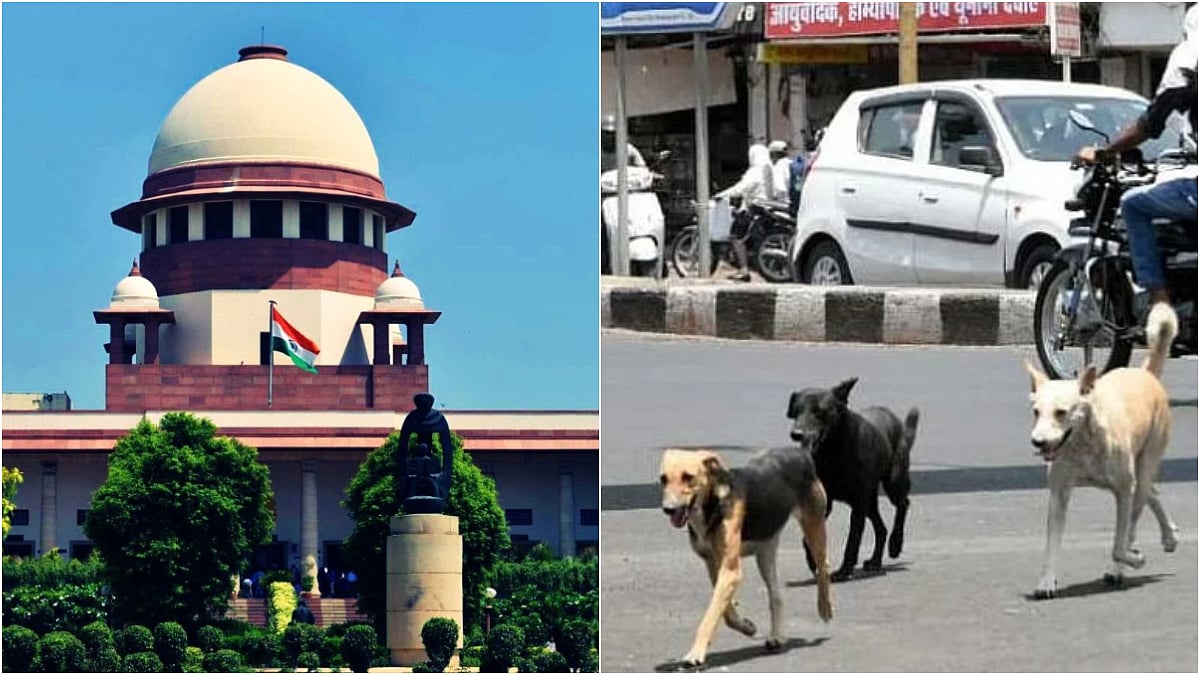
The Supreme Court’s dismissal, on Tuesday, of the challenges filed on the management of stray dogs and its firm refusal to modify previous directives would disappoint dog lovers and animal rights activists, but weighed against the larger complexity of all life and public spaces across the country, it comes across as a balanced and sober one. The judgement eschews absolutism of either side—animal lovers argued for little to no regulation, while victims of dog bites and states had pleaded earlier for euthanasia and mass transportation of dogs to shelters. The bench of Justices Vikram Nath, Sandeep Mehta, and NV Anjaria, while delivering the judgement, said the state cannot remain a “passive spectator” while people faced the constant threat of dog attacks in public spaces, placing the responsibility fair and square on the Chief Secretary of every state to keep certain public spaces free of strays.
While refusing to place absolute animal rights above human safety and mobility in public spaces, the SC cited hundreds of cases just this year of dog attacks and children killed by strays. The SC had taken up this issue suo motu last July after a six-year-old lost her life to dog bites in Delhi. Invoking Article 21 of the Constitution, the court held that it includes the right to move freely in public spaces without fear of such attacks. “The Constitution does not envisage a society where children and elderly citizens are left to survive at the mercy of physical strength or chance,” the judges stated. Animal rights activists have steadfastly refused to engage with the threat of attacks and loss of lives; a few have, in a tone-deaf way, gone so far as to suggest that the attacks could be provoked or are few and far between for a large stray dog population.
The judgement matters because India has a staggering population of 60-62 million strays. An alarming 3.7 million dog bites are recorded every year; the World Health Organisation estimates around 20,000 deaths across India from stray dog bites and rabies, while Lancet puts it at 5,726. Even one death is one too many. Medical researchers term this a public health crisis that India has consistently ignored. It is undoubtedly the outcome of the failure of urban and rural local bodies to implement the Animal Birth Control framework (2021) and the ABC Rules of 2023 to build infrastructure to support the expanding population of stray dogs, their sterilisation, and vaccination. The institutional failure has been compounded by the inability of dog lovers to take responsibility for the behaviour of stray dogs they care for. They can continue to feed the strays, but at designated spaces. Enforcing institutional responsibility can make all the difference both to public safety and the lives of stray dogs.
