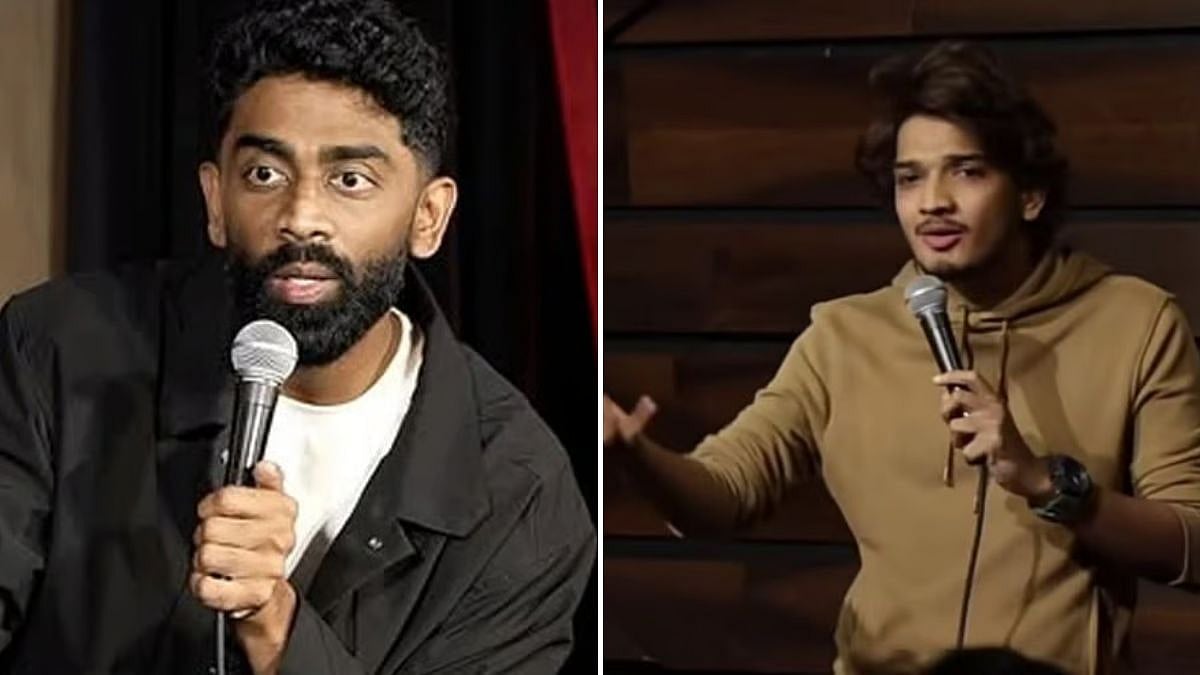
In our patriarchal society, one often hears misogynistic and sexist comments at regular intervals about women from music composers and young stand-up comedians. After a young man’s controversial “Rs 370 biryani” remark at Pranit More’s show set social media ablaze, a 2024 rape “joke” by young stand-up comedian Madhur Virli has resurfaced and gone viral. What is striking, however, is that the video took nearly two years to attract widespread scrutiny. The clip has predictably triggered massive social media blowback. Just think back to early 2025, when stand-up comedian, YouTuber, and podcaster Ranveer Allahbadia triggered a nationwide controversy after making explicit and widely condemned remarks on the YouTube comedy panel show India’s Got Latent.
Much contemporary stand-up seeks a reflexive reaction through shock and profanity. In the rape “joke’’ clip, Virli claims that in nine out of ten rape cases, the crime involves only sexual assault, while in one case the victim is murdered afterwards. He then goes on to suggest that if a victim were to ask the perpetrator about “cuddling” after the assault, it could provoke him into stabbing her. Such remarks strike at the very core of our collective moral and emotional sensibilities. Did Virli make these comments believing they would reinforce his standing as a comedian of consequence? Or did he calculate that shock value and vulgar provocation would guarantee him a few moments of publicity in the relentless virality cycle of social media? Cultural tolerance of sexism, such as laughing at degrading jokes, is a disturbing social phenomenon.
It would not be incorrect to argue that our constitutional right to freedom of expression is increasingly being stretched beyond reasonable limits, blurring the boundary between liberty and restraint.
Were things really this bad even two decades ago, in the absence of social media? Not quite. The content of observational stand-up comedians such as Raju Srivastava, Sunil Pal, and Jaspal Bhatti, to name just a few, was never misogynistic or sexist in nature. These comedians could make audiences roar with laughter through sheer Pythonesque twittishness—an affectionate lampooning of human eccentricities. Raju Srivastav’s comedy touched upon diverse themes—the daily ordeal of commuters travelling in Mumbai’s local trains, the anxieties surrounding the marriage of a girl in a middle-class family, or the amusing spectacle of guests piling their plates high with food at weddings.
Jaspal Bhatti, through his iconic show Flop Show, brought alive with understated brilliance the bureaucratic red tape of government offices, the common man’s struggle against rising prices, and the obsession of officials with endless meetings. His inimitable comic style neither offended nor left a bad taste in the mouth, yet it drove home the point with remarkable effectiveness. These shows contained no crude insinuations or offensive remarks about women. These were shows that entire families could watch together without discomfort or embarrassment.
Comedians have a responsibility towards society in these fraught times. Comedy should not merely entertain; it should also educate and enlighten through satire, leaving audiences with something meaningful to reflect upon.
Given that many of today’s stand-up comedians—in their late twenties and thirties and followed by lakhs on social media—enjoy considerable fame and popularity, it becomes all the more important for them not to make sexist jokes and remarks the backbone of their comedy. There is no dearth of subjects in our country that can be treated in a satirical vein while still conveying a meaningful message. The misplaced assumption that audiences appreciate only cheap and crude humour is prompting many young stand-up comedians to dish out content that reflects a deeply gendered mindset, treating women as objects of commodification. The pursuit of fame through likes and virality is understandable, but it should never come at the expense of gender sensitivity. Let us not forget that the normalisation of sexist jokes is a blatant negation of the values of gender equality and justice.
Since humour is serious business, young stand-up comedians can address issues such as growing joblessness, patriarchy, the scourge of dowry, and foeticide in an understated yet creative manner. In the words of Leo Rosten, American writer and humourist, “Humour is the affectionate communication of insight.” It enables difficult truths to be conveyed with a light touch, making audiences laugh even as they pause to reflect on society's deeper maladies.
Comedy should not be a mere pastime, reduced to cheap amusement or crude sensationalism. At its best, humour can provoke thought, challenge social prejudices and inspire meaningful reflection. If women continue to be the fodder for such regressive comedy, then there is something seriously wrong with our society.
The writer is a Delhi-based journalist.

