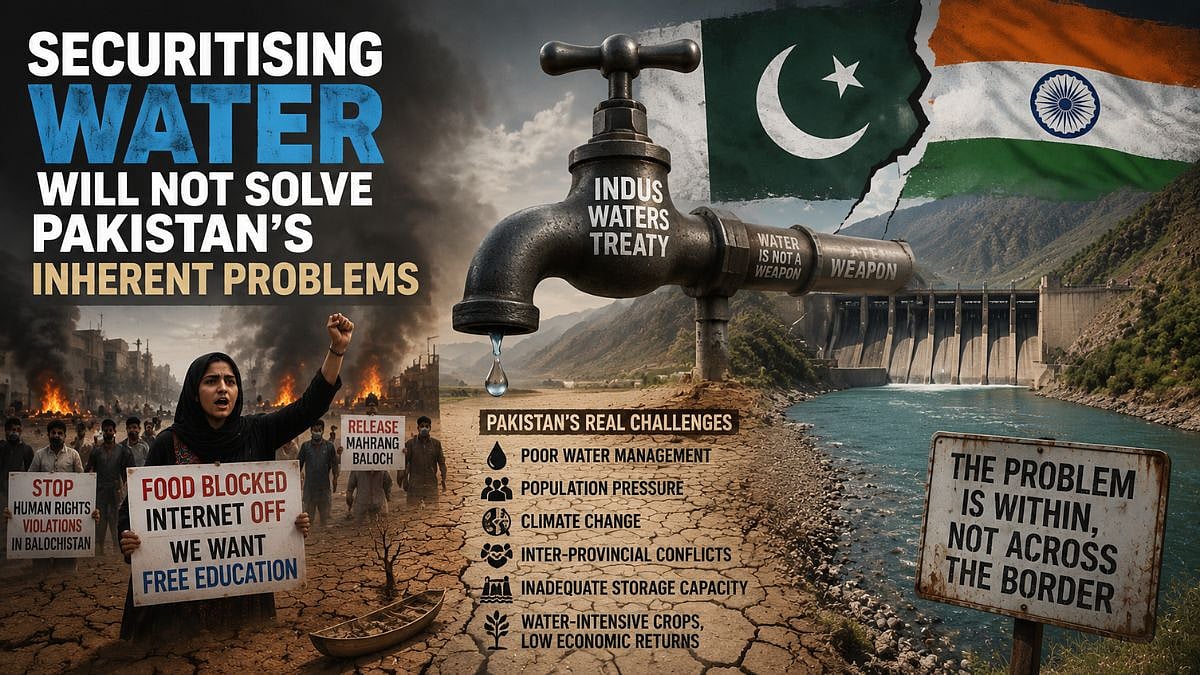
The narrative of Pakistan’s diplomatic coup in brokering the US-Iran deal has been undermined by increasing civil unrest within its borders, further aggravated by the sentencing of human rights activist Dr Mahrang Baloch to life imprisonment earlier this week. Pakistan has accordingly pivoted to crying foul over the Indus Waters Treaty, securitising water as it does all its problems.
Growing Domestic Challenges
Pakistan has historically been adept at shaping anti-India narratives, casting the blame for the shortfalls of its government on India. The limitations of that strategy are now glaringly obvious. Pakistan is finding it hard to spin the violent suppression of protestors in Balochistan and ‘Azad’ Jammu and Kashmir (PoK). In the latter province, some 50 people were killed in separate incidents of police firing earlier this month. The ongoing sit-in by tens of thousands at Rawalkot has yielded impactful images of children holding up placards saying, “Food blocked, internet off” and “We want free education”. A showdown is imminent, with protestors planning a massive march on the provincial headquarters in Muzaffarabad.
In Balochistan, a month of violence followed by public protests and a province-wide shutdown stood in stark contrast to the peaceful environs of Lake Lucerne, where the US-Iran talks were held. The Western media’s championing of Dr Baloch, who has protested extrajudicial killings, covert trials, abductions and human rights violations in her province, has dented Pakistan’s image. To make matters worse, Bollywood’s contribution to the victimised Balochistan narrative, Dhurandhar, made the top 10 highest-grossing films globally. The overall impact was felt when the US, France and the UK blocked a move to institute UN terror sanctions against the separatist Balochistan Liberation Army earlier this month.
Pakistan’s threats of deploying hard power and attempts at building soft power can also be linked to the after-effects of Operation Sindoor, both civil and military. Insofar as Pakistan’s war cries vis-à-vis India’s alleged assault on its water security by suspending the Indus Waters Treaty are concerned, analysts believe the beleaguered country is unlikely to walk the talk. It has never, in its 80-year history, won a war. And rattling the nuclear sabre has become a time-worn strategy.
Water Crisis Of Its Own Making
Nor can Pakistan successfully attribute its ongoing water crisis to India. As water resources expert and former Indus Commissioner P.K. Saxena has observed, Pakistan’s water scarcity is of its own making. Research studies have cited reckless water management, climate change and a burgeoning population as the main factors behind plummeting per capita availability of water. A 2022 study by a public sector university in Islamabad—long before the Indus Waters Treaty was suspended—stated that Pakistan’s poor water management results in the wastage of a third of its available water (as much as India’s share under the Indus Waters Treaty). Acknowledging that 80 per cent of Pakistan’s population faces water shortages for at least a month each year, it attributed the crisis to overuse of groundwater, contamination of water sources, lack of a monitoring mechanism for channelling available water, rampant water theft and inter-provincial conflicts (Punjab vs Sindh).
In addition, Pakistan’s water storage capacity is woefully inadequate, a 2024 study in the journal of the World Water Council notes. Even that is being rapidly depleted by sediment build-up in dams. As a result of virtually no public investment in storage, the current capacity is adequate only for 30 days, far short of the standard 1,000 days. Saxena points out that around 97 per cent of Pakistan’s fresh water is used for farming, with water-intensive crops such as rice, wheat, sugarcane and cotton consuming 80 per cent of the precious resource while contributing only 5 per cent of the GDP.
Security And Strategic Implications
Although water is traditionally not considered a security threat, Pakistan has a tendency to frame any public problem in those terms. If Pakistan feels that its dependence on the upper riparian countries of Afghanistan and India for fresh water is an existential threat, why has it vitiated relations with both by launching cross-border attacks? Pakistan's recent air raids on Tehrik-i-Taliban Pakistan (TTP) bases across the Durand Line have provoked Afghanistan’s counterstrikes against ISIL-Khorasan hideouts. On its eastern border, the post-Operation Sindoor ceasefire still holds, but, in a tit-for-tat move, India has linked the Indus Waters Treaty to national security.
India’s suspension of the treaty may well be justified by Pakistan’s violation of peremptory norms of international law, or the principle of rebus sic stantibus, which allows termination of a treaty owing to a substantial change in circumstances. As India does not recognise the authority of the International Court of Justice in disputes with other Commonwealth nations, that avenue of protest is closed to Pakistan. Significantly, Pakistan’s closest ally, China, follows the Harmon Doctrine, which gives it absolute control over water resources in its territory, regardless of the impact on lower riparian states. India taking a leaf out of China’s book would be Pakistan’s worst nightmare.
Lessons From History
As part of its soft power push, Pakistan has, of late, been trumpeting the Indus Valley sites of Mohenjodaro and Harappa as its civilisational heritage. Interestingly, in the present context, the collapse of that civilisation is attributed largely to water scarcity.
Bhavdeep Kang is a senior journalist with 35 years of experience working with major newspapers and magazines. She is now an independent writer and author.

