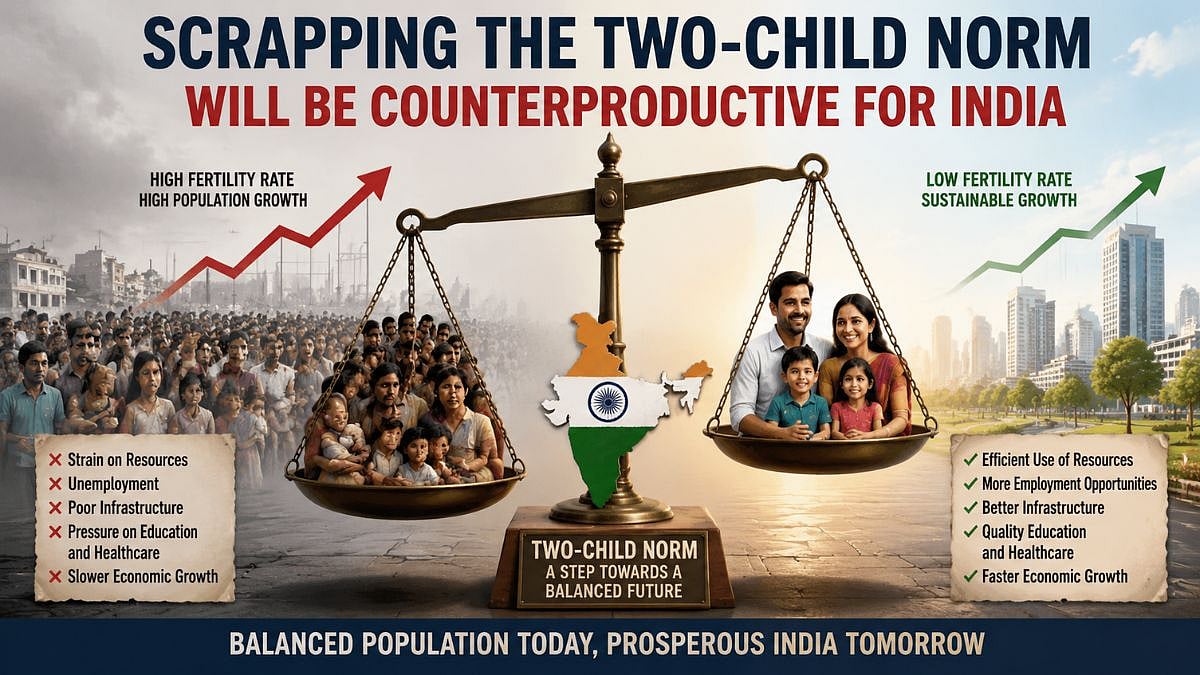
Population stabilisation measures in states with high growth rates are taking a hit. The Madhya Pradesh government last month rolled back the two-child criterion for government service. Earlier, the Rajasthan government scrapped the two-child rule for contesting local body elections. The Uttar Pradesh government, meanwhile, has shelved the population law it had mooted in 2021. All three BJP-ruled states have population growth rates far in excess of the national average and well above the replacement rate. Why the back-peddling on policy measures aimed at limiting growth rates?
Counter-intuitively, high-growth-rate states seem disinterested in promoting small families, while low-growth-rate states are doing so. Back in the 1990s, the BJP viewed India's runaway population growth with concern: “Expected to hit the one billion mark by the year 2001, India's population is set to overtake that of China unless the growth rate is checked and then reversed.” It went so far as to advocate special incentives for a one-child norm. Now, the party needs to come up with a policy to address the serious population imbalances caused by the disparity in growth rates between states.
Policy Reversals Raise Questions
RSS Sarsanghchalak Mohan Rao Bhagwat's repeated calls for a ‘three-child norm’—never mind that India's population has outstripped China's—may have been a motivating factor for the Chief Ministers concerned, although their governments are at pains to deny it. But none of them has been able to present a rational explanation for the rollback of population stabilisation measures.
Rajasthan minister Jogaram Patel claimed the two-child norm for contesting panchayat elections was outdated because the state's fertility rate had dropped to “nearly 2.0”. Perhaps Patel had not bothered to check the latest SRS 2024 figures, which put Rajasthan's total fertility rate (TFR) at 2.3, and that of rural areas at 2.4. Madhya Pradesh Chief Minister Mohan Yadav barely bothered to justify his decision, merely saying it would benefit job aspirants.
In contrast to these poorly performing states, the two-child norm remains in place in states which have not only achieved population stabilisation but are also well below the national average of 1.9. Maharashtra, which has a two-child norm for both government service and local body elections, has a total fertility rate (TFR) of just 1.4—meaning the number of children a woman is likely to have in her lifetime. Gujarat and Odisha, which bar those with more than two children from local body elections, have TFRs of 1.7 and 1.6, respectively. Given that a TFR of 2.1 is regarded as the replacement rate, the population of these states is shrinking, while that of the outliers is increasing.
Regional Population Imbalance
“Population explosion is more dangerous than the hydrogen bomb,” the Odisha High Court observed while dismissing a plea against a violation of the two-child norm this week. A similar observation was made earlier this year while upholding the disqualification of a panchayat member on the same grounds. The court might have added that unbalanced population growth is as great a danger. Odisha has a TFR of just 1.6, while in neighbouring Jharkhand it is 2.2.
This is not to argue that disincentives alone can limit population growth. South Indian states have historically been good performers, thanks to superior human development parameters, which have obviated the need for policy measures. Tamil Nadu (1.3), Kerala (1.3), and Karnataka (1.5) have been far ahead of the North in population stabilisation, as have Andhra (1.4) and Telangana (1.5). The latter two states have accordingly removed the two-child norm, but for high-growth-rate states like Uttar Pradesh (2.6), Madhya Pradesh (2.4), and Rajasthan (2.3), not having such measures in place is mystifying.
Bihar, the country's worst performer with the highest TFR of 2.9, restricts its two-child norm to urban local body elections. Assam, on the other hand, has the most stringent population stabilisation measures and has brought its TFR down from 2.4 in 2014 to 1.9 in 2024. Other than demographically vulnerable communities, Assam applies the two-child norm to government jobs, welfare schemes, and local body elections. It is also pushing to bring legislators under this policy.
Women's Rights And Population Policy
A favourite claim is that population stabilisation measures are anti-women and a denial of their reproductive rights. The concern for women does not extend to coercive pregnancies, which, in fact, strip them of their reproductive autonomy and subject them to severe physical and mental trauma. Reproductive Coercion and Abuse (RCA) is a recognised tool of male domination, with a high incidence in India. A 2019 study by US and Indian researchers found that 12 per cent of women of reproductive age in Uttar Pradesh experienced this form of gender violence at the hands of their husbands and in-laws. Not surprisingly, underage and illiterate women were found to be more vulnerable.
Male policymakers are typically unconcerned with childbirth and child-rearing and rarely take the impact on women's physical health, mental well-being, and the denial of economic opportunities into account. A 2016 study, focused mainly on Bihar and partly on Uttar Pradesh, found that 20 per cent of married adolescent girls experienced pressure to have a child immediately after marriage. To claim that the two-child norm strips women of a reproductive autonomy that millions of them do not enjoy is counterproductive.
Need For Regional Strategy
Earlier this year, BJP MP Praveen Khandelwal called for a region-specific National Population Management Policy to sustain India's developmental trajectory. As Khandelwal pointed out, India stands at a “pivotal demographic juncture”, with population growth straining natural resources beyond their limits and causing rampant unemployment in some states. The National Capital Region is estimated to have a population of 78 million (larger than that of the entire UK), about a third of which comprises immigrants from Bihar and Uttar Pradesh. While the government's concern with addressing demographic changes due to immigration is laudable, checking the demographic momentum in states with a high population base is equally necessary.
Bhavdeep Kang is a senior journalist with 35 years of experience working with major newspapers and magazines. She is now an independent writer and author.

