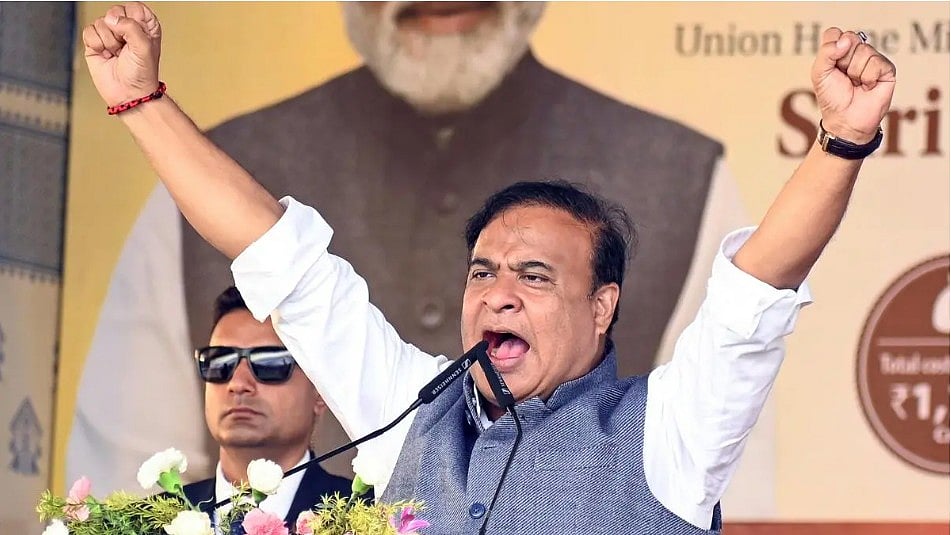
The Assam government, led by Chief Minister Himanta Biswa Sarma, is moving to heavily regulate or completely ban live-in relationships between unmarried couples as part of a proposed Uniform Civil Code (UCC) Bill set to be introduced in the newly formed Assembly on May 26.
Concerns over personal liberty
This proposal has sparked significant concern and upset young, urban Assamese residents, particularly in Guwahati, who view it as an infringement on their personal liberty.
There is no doubt that the Northeast is undergoing a profound transformation. It enjoyed a unique egalitarian culture with less rigid social hierarchies than what is prevalent across North India. This identity has been altered by the rise of the BJP, resulting in its rapid political integration into the more right-wing, neoliberal capitalist governance model, forcing it to move away from a more liberal, left-wing mould.
The UCC has already been passed by the states of Uttarakhand and Gujarat. A prototype of this Bill was prepared by Justice Ranjana Desai (retd) and a five-member team for the state of Uttarakhand, which was the first state to pass it on February 7, 2024. Gujarat followed suit on March 25, 2026.
Registration clause sparks opposition
While the overall objective of this controversial Bill is clearly political, as it deprives minorities of their personal laws and replaces these with a common set of laws governing marriage, divorce, and succession, the clause that has young people most alarmed is the one about live-in relationships.
The Bill mandates that all residents of the state, whether living within the state or outside, must register their relationship with a registrar to be appointed by the state. The registrar is expected to verify the antecedents of the couple to ensure that neither partner has already been married or has been in a prior live-in relationship or is a minor. The registrar must also ensure that the partners are not related by blood or marriage.
Once these details have been clarified, the couple will be given a registration certificate, which can be forwarded to the police station under whose jurisdiction they are residing.
“If this truly happens, it will be a terribly regressive move for a state that has been largely and comparatively liberal and less constricting. A setback to the very ethos of the state and indeed to the entire idea of individual choice. People voted for ‘unnayan’ and ‘subidha’ (development and welfare benefits). This is neither,” Ruhi Tewari posted on X.
Young people across Assam are aghast at the forced imposition of a registration clause for live-in relationships among consenting adults. This, they believe, reflects a medieval mindset completely at odds with the prevailing ethos.
Young couples voice objections
The views of several young Assamese people reflect their antipathy to the Bill. Several young adults claim they chose to live together as they did not want to enter into a formal relationship through an arranged marriage which would saddle them with several responsibilities that they were ill-prepared for. “They did not want to start negotiating relationships with each other’s families before they were sure they had a future together,” said one young man who works as a warden in a college.
Another young executive, who is in a relationship with a young teacher, pointed out, “Living together was like doing a reality check on each other, since we wanted to find out whether we would be able to make a go of our relationship.” After four years together, they have decided they would like to marry and plan to do so by the end of this year.
The UCC Bill has failed to spell out what timeframe it is looking at when it alludes to the issue of maintenance in case a live-in relationship falls apart.
“To expect a man to give maintenance to a woman after they have lived together for one year is totally unrealistic. A couple needs to be together for at least a period of three years before any claim for maintenance is made,” said one young woman who holds a secretarial post in a company. However, the Bill does not spell out any such details. Even in the West, maintenance is given only for long-term relationships.
Criticism over criminalisation provisions
The Bill also states that if partners decide to terminate the relationship, they need to go back to the registrar and inform him of the same. Having to go public on their private lives is something that the majority of young people in the state feel is an “extremely regressive” and “intrusive” step. Young women believe that if they apply for registration, it could well open them to blackmail by neighbours or vigilantes.
One of the worst clauses of the Bill is the criminalisation of such relationships. Couples that do not apply for registration within a 30-day period will face imprisonment of up to three months or a fine of Rs 10,000 or both. In case of false information being given to the registrar while filing the application, the couple can face imprisonment of up to three months and a fine of up to Rs 25,000.
The clause referring to the compulsory registration of couples seems to have been drafted keeping interfaith couples in mind. Uttarakhand has had a handful of cases where young Muslim men have been accused of wooing Hindu women in order to “forcibly convert” them to their religion. In most cases, subsequent investigation proved the accusation to be false, but by then the damage had been done.
Compulsory registration of live-in couples reflects a patriarchal and puritanical mindset, with moral policing not being restricted just to this state but also to all state citizens living outside the state. The good news is that not many couples are taking it seriously. In Uttarakhand, in the last two years, only 68 couples have applied for registration.
Debate over UCC implementation
The question asked repeatedly in political circles is why Uttarakhand was chosen to launch the UCC. The answer is obvious. Uttarakhand has been positioned as a “Hindutva laboratory” to be used by the RSS to spread their ideology across the north. Assam is their next launchpad to spread Hindutva across the Northeast.
Rashme Sehgal is an author and an independent journalist.

