
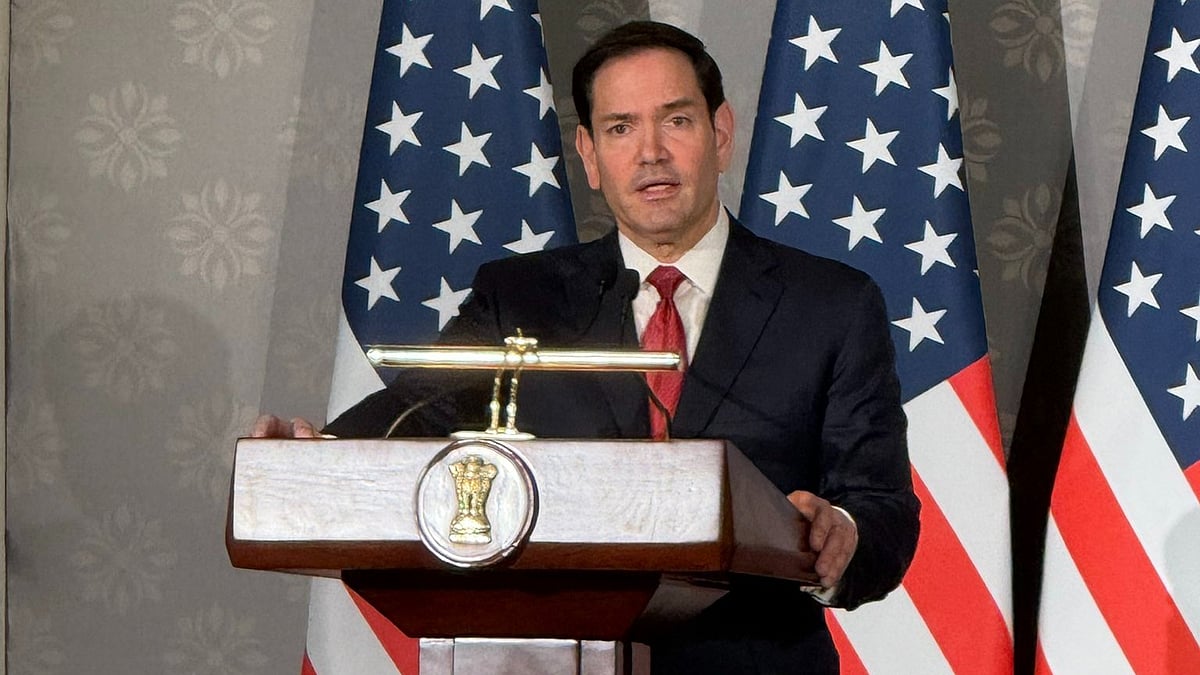
At a time when unease and uncertainty have crept into India-America relations, U.S. Secretary of State, Marco Rubio arrived in New Delhi on a mission that was as much about reassurance as diplomacy. The visit has been officially projected as part of Washington’s continuing commitment to the Indo-Pacific and the Quad framework, but the deeper purpose was unmistakable: repairing strategic trust that has weakened in recent months under President, Donald Trump’s second administration.
Challenges Before Both Nations
Despite the warmth displayed during Rubio’s visit, several structural challenges continue to complicate India-U.S. ties.
The first is trade. Protectionist tendencies in Trump’s economic policy remain a major irritant. India wants greater market access, stable tariff policies and protection from abrupt trade penalties. The United States, meanwhile, seeks wider entry for American agriculture, technology and manufacturing exports. Without a comprehensive trade settlement, economic distrust may continue overshadowing strategic convergence.
The second challenge is Russia. India’s continued purchase of Russian oil remains a sensitive issue in Washington. Although the United States has temporarily softened its position because of global energy disruptions, pressure could return once conditions stabilise. India, however, sees Russia as essential for energy security and defence supplies.
Third, immigration and visa policies continue troubling Indian professionals and students. Stricter American green card and H1B regulations create resentment among India’s skilled workforce, which has traditionally been one of the strongest bridges between the two democracies.
The fourth challenge is strategic autonomy. India does not want to become part of any rigid anti-China military bloc. It seeks partnerships without alliance obligations. Washington often expects clearer strategic alignment, while India insists on maintaining policy independence.
Fallout for China and Pakistan
Rubio’s India visit also carried unmistakable geopolitical messaging for both China and Pakistan.
For China, the visit reaffirmed that despite temporary fluctuations, Washington still intends to strengthen India’s strategic role in the Indo-Pacific. Rubio’s repeated emphasis on India’s “cornerstone” status was aimed partly at Beijing. Closer India-U.S. cooperation in supply chains, emerging technologies and maritime security directly affects China’s regional ambitions.
Yet Beijing may also interpret recent American behaviour differently. Trump’s outreach to China suggests that Washington may still pursue selective accommodation with Beijing when it suits American economic interests. China could therefore conclude that the U.S.-India partnership remains tactical rather than treaty-based.
Pakistan, meanwhile, faces a more complicated picture. Washington’s recent engagement with Islamabad during the Iran crisis undoubtedly revived Pakistan’s strategic relevance. But Rubio’s India visit signalled that America does not want Pakistan’s re-emergence to come at the cost of alienating New Delhi.
The strains had accumulated steadily. Trump’s aggressive tariff regime against Indian exports, Washington’s renewed diplomatic engagement with Pakistan, uncertainty over America’s China strategy, and differing approaches to the Iran crisis had generated growing unease in New Delhi. Rubio’s four-day India visit, therefore, became less a ceremonial diplomatic engagement and more an exercise in reassurance diplomacy before the upcoming Quad foreign ministers’ meeting.
Rubio’s meeting with Prime Minister, Narendra Modi focused heavily on trade, energy security, supply chains and emerging technologies. Yet behind these formal themes lay a larger geopolitical objective: preventing India from concluding that Washington’s strategic priorities are shifting elsewhere.
America’s Attempt to Rebuild Confidence
One of Rubio’s central tasks was to restore confidence in India that the United States still considers New Delhi indispensable to its Indo-Pacific strategy. His repeated assertion that “India is at the cornerstone of how the United States approaches the Indo-Pacific” was clearly designed to counter growing Indian anxieties.
Those anxieties are not imaginary. Trump’s recent Beijing outreach created concern within Indian strategic circles that Washington may be seeking a tactical accommodation with China while expecting India to continue carrying the burden of balancing Beijing in Asia. Simultaneously, America’s engagement with Pakistan during the Iran crisis revived old Indian fears about Washington reverting to its traditional South Asia hyphenation policy.
Rubio therefore tried to send multiple symbolic signals. He highlighted that his first official engagement as Secretary of State earlier this year had been a Quad meeting. He repeatedly praised India’s role in the Indo-Pacific. He extended Trump’s invitation to Modi for a White House visit. The message was clear: despite recent tensions, the United States still views India as central to its Asian strategy.
The visit also attempted to stabilise economic ties damaged by tariff disputes. Trump’s earlier decision to impose steep tariffs on Indian goods had created one of the sharpest trade tensions between the two countries in recent years. Though an interim arrangement reduced tariff levels, a comprehensive trade agreement remains elusive. Rubio’s emphasis on expanding energy trade was therefore not merely about commerce but also about reducing friction in the broader relationship.
Energy Diplomacy at the Core
Energy security emerged as the most substantive dimension of Rubio’s discussions with Modi. The timing was significant. India faces severe energy vulnerability amid disruptions in West Asia and instability around the Strait of Hormuz. More than 80 percent of India’s energy requirements are imported, making global disruptions directly linked to domestic inflation and economic pressures.
Rubio used this crisis to push American energy exports aggressively. He argued that U.S. energy supplies could help diversify India’s imports and reduce overdependence on unstable regions. Washington also sees energy exports as a way to narrow its large trade deficit with India.
Equally significant was Rubio’s sharp statement that the United States would not allow Iran to “hold the global energy market hostage.” This remark reflected America’s broader strategic positioning in West Asia, but it also carried implications for India. New Delhi has traditionally maintained balanced relations with Iran because of energy needs and connectivity interests, particularly the Chabahar project. India therefore faces the difficult challenge of balancing its strategic partnership with Washington while preserving room for independent engagement with Tehran.
The irony, however, is difficult to ignore. The current energy crisis affecting India was itself intensified by escalating U.S.-Israeli confrontation with Iran. While Washington offers energy alternatives, American policies have simultaneously contributed to the instability disrupting Asian energy flows.
The Quad and Strategic Signalling
Rubio’s visit has gained additional importance because it has preceded the Quad foreign ministers’ meeting in New Delhi. The Quad — involving India, the United States, Japan and Australia — has become the central pillar of Indo-Pacific balancing against China.
However, the grouping has recently shown signs of losing momentum. The absence of leader-level summits and the postponement of Trump’s expected India visit created perceptions of an “unofficial downgrade” of the Quad. Rubio’s presence in New Delhi was therefore partly intended to prevent such perceptions from hardening.
For India, the Quad remains useful but not sufficient. New Delhi seeks a durable American commitment to regional stability, technology partnerships and defence cooperation. Yet Trump’s transactional foreign policy style often creates unpredictability. India worries that Washington’s strategic focus could shift abruptly depending on domestic political calculations or evolving relations with China.
Rubio attempted to counter these doubts by emphasising continuity in Indo-Pacific policy. But symbolism alone may not fully reassure India unless accompanied by concrete economic and strategic commitments.
India-US relations will come out much stronger: Marco Rubio after meeting S Jaishankar.
After high-level talks with External Affairs Minister S. Jaishankar in New Delhi, U.S. Secretary of State Marco Rubio asserted that India-U.S. ties had “not lost momentum” and would emerge “much stronger in the coming years.” Rubio expressed hope that the long-pending bilateral trade agreement would be concluded soon, noting that both countries remained “strategically aligned” on most major global issues. The discussions covered the conflicts in West Asia, the Indian subcontinent and East Asia, with Jaishankar reiterating India’s support for “unimpeded” maritime commerce amid regional tensions. The two leaders also reviewed cooperation in civil nuclear energy and welcomed growing collaboration in the energy sector, underlining the expanding strategic and economic dimensions of the partnership.
Rubio’s Kolkata Stop Revives Debate Over FCRA and Civil Society Space
U.S. Secretary of State Marco Rubio’s visit to the headquarters of the Missionaries of Charity in Kolkata has unexpectedly pushed India’s Foreign Contribution Regulation Act (FCRA) back into the international spotlight. What appeared outwardly as a symbolic cultural and humanitarian stop during Rubio’s India tour quickly acquired larger political significance amid growing scrutiny in Washington over the Modi government’s regulation of foreign-funded charities and religious organisations. Rubio later praised Mother Teresa on social media, describing her work as a powerful example of faith in action, further amplifying the diplomatic messaging around the visit.
The timing of the visit became especially significant because it came days after U.S. Congressman Chris Smith publicly urged the State Department to raise concerns over proposed amendments to India’s FCRA law. Smith warned that the proposed changes could give the government sweeping powers to seize properties, schools and hospitals run by foreign-funded NGOs if their licences lapse or are not renewed. He specifically referred to the Missionaries of Charity’s 2021 licensing crisis, when the Union Home Ministry refused to renew the organisation’s FCRA licence citing “adverse inputs”, resulting in the freezing of its foreign funding accounts. The decision had triggered sharp international criticism before the government restored the licence in January 2022.
Rubio’s Kolkata visit is therefore being interpreted in diplomatic circles as a subtle but visible signal on issues of religious freedom, civil society space and the functioning of humanitarian organisations in India. Critics in Washington argue that the FCRA framework is increasingly being used as an instrument of bureaucratic pressure over international charities and advocacy groups, while the Modi government maintains that the law is essential to protect national security and prevent foreign funding from being misused against India’s interests. The episode once again underlines how questions relating to civil society and regulatory control are steadily becoming part of the broader India-U.S. strategic conversation.
India nevertheless remains wary. Historically, Washington has repeatedly deepened ties with Pakistan during regional crises, only to later reaffirm commitment to India. That legacy continues shaping Indian strategic thinking.
Ultimately, Rubio’s visit may succeed in slowing a visible drift in India-U.S. relations, but it did not eliminate the underlying contradictions. The relationship today is driven less by emotional strategic convergence and more by mutual necessity. America needs India to balance China in Asia, while India needs American technology, investments and geopolitical support. The challenge for both nations is whether they can transform this transactional convergence into long-term strategic trust in an increasingly unstable world order.
In summary, Rubio’s visit marks a pragmatic reset in U.S.-India relations, leveraging shared interests in trade, energy, and security to mend fences. While outcomes provide momentum ahead of the Quad, enduring challenges demand careful navigation. Success would benefit both nations through enhanced economic resilience and a more stable Indo-Pacific order, with ripple effects constraining rivals’ manoeuvrability. The coming months will test whether this repair evolves into a durable, high-trust partnership.
(Writer is strategic affairs columnist and senior political analyst based in Shimla)

