
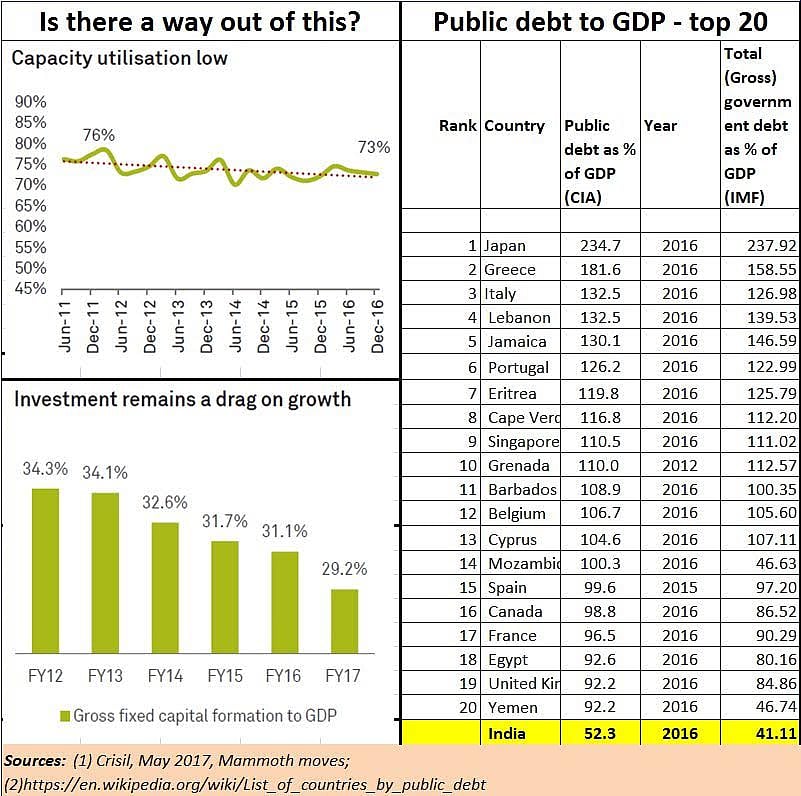
The government is caught between a rock and a hard place. It wants to create jobs through massive spending on infrastructure. But for that it will have to spend money that it does not have (and FDI into infrastructure hasn’t taken off). This, in turn, means that it will have to go in for borrowing or raising resources through PSU disinvestment.
But debt is problematic. It is already a mill-stone weighing down public finances. It also prevents the government from getting a better credit rating. A poor rating prevents the government from gaining access to cheap international funds. There is the additional problem of the government having to service debt through interest payments. The higher the amount paid each year as interest charges, the greater is the probability of revenues being squeezed out, leaving little for developmental expenses.
Actually, India’s debt is not large compared to many other countries (see chart). But when debt has the company of low investment, and low productivity, then problems multiply. Can money be freed for development purposes?
According to some, the way to do this is by taking a fresh look at valuing public sector units (PSUs). It is similar to the valuation exercise that was done during the nineties. It is similar to what has been recommended for banks. The PSUs are put through an exercise where they revalue and realise the full value of their assets by transferring them to respective subsidiaries. The revaluation of land is done transparently by using the ready reckoner rates put out by the income tax department.
As Pradip R. Shroff, a leading merchant banker explains, “In the present scenario, PSU disinvestment is popularly known as Reduction in Percentage of Equity Holding of Government of India (GOI) in PSUs including nationalised banks. Through the process of disinvestments, GOI gets one of the Sources of Funds for budgetary proposals/appropriations. The issue of additional equity shares by PSUs is another mode of Reduction in % of Holding of GOI in PSUs. In the latter case, the additional funds can only be used by the PSUs and do not go to the government .”
As most economists also explain, the ultimate Concept of PSU disinvestment results in raising Long Term Resources of Funds, which neither carries any repayment burden nor any interest burden. This is what the government did when it began the PSU disinvestment programme during 1991-1992 and continued with this strategy thereafter.
Investment bankers, like Shroff, believe that there is a need to take a re-look at PSU disinvestments from a different angle. And this is what they propose:
billion).
That could leave the government with additional funds to invest on infrastructure, to create jobs and to kickstart the economy.
But all this is a mere accounting exercise. To make this work, the government needs to focus on governance, credible judicial processes, and sensible economic policies. Otherwise, corruption will erode benefits, and a sense of well-being could tempt the government to more profligacy. Remember how political compulsions compelled even the present ruling party to allow for loan waivers in Uttar Pradesh? It has now to re-educate the rest of India why loan waivers are bad in principle. Simultaneously, there is the urgent need to stanch losses from unproductive PSUs.
There is also the critical need to penalise legislators and bureaucrats who sometimes allow PSUs to become sick, so that they could be allowed to be taken over by private interests (Air India fits this bill).
Respect for corporate governance is therefore the key. If the government wants to save India, this is what needs to be focused on first.
The author is consulting editor with FPJ.
