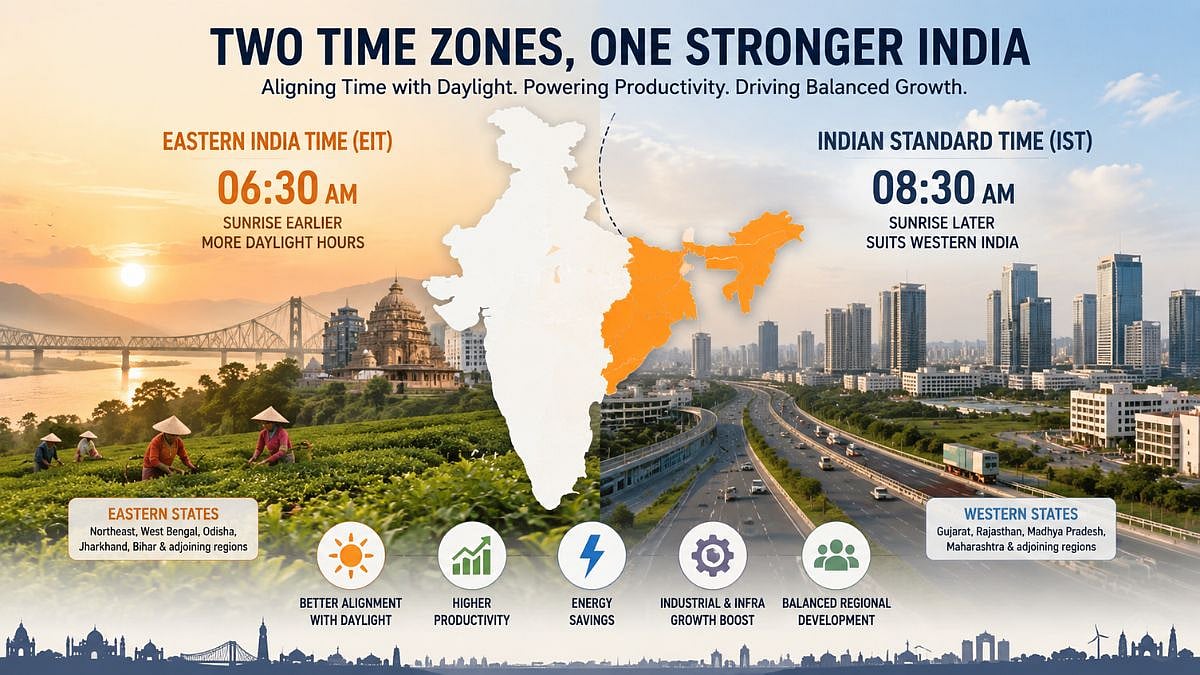
India’s remarkable diversity is reflected not only in its languages, cultures and geographies, but also in the way daylight is distributed across the country. From Arunachal Pradesh, where the sun rises as early as 4 am in summer, to Gujarat, where sunrise is much later, the gap is nearly two hours. Yet, India continues to operate under a single time zone — Indian Standard Time (IST).
This uniformity, while administratively convenient, masks a deeper inefficiency that disproportionately affects the eastern region of the country. At a time when India is striving for balanced regional development, the case for introducing two time zones is not merely a matter of convenience but also of economic necessity.
Eastern India bears economic burden
Eastern India — comprising the Northeast, West Bengal, Odisha, Jharkhand and Bihar — has historically lagged behind western and southern states in industrialisation, income levels and infrastructure development. While multiple structural factors contribute to this imbalance, the role of time misalignment is an under-appreciated yet significant dimension.
Under IST, large parts of eastern India experience daylight hours that are poorly aligned with official working schedules. Mornings begin much earlier, but institutional activity — schools, offices and markets — does not. As a result, valuable daylight hours are lost. Conversely, the day ends early, leading to a premature sunset that compresses productive hours and increases reliance on artificial lighting.
This misalignment translates into tangible economic costs. Industries, especially those dependent on natural light — such as agriculture, tea plantations, small manufacturing units and construction — operate below optimal efficiency. Early sunset reduces the effective working window, while the unused morning hours represent lost economic opportunities.
Biological impact on productivity
Beyond economics, there is a biological dimension that cannot be ignored. Human productivity is closely linked to circadian rhythms — the body’s internal clock that responds to natural light cycles. When official time is misaligned with sunrise and sunset, it disrupts this rhythm.
In eastern India, workers often begin their day after sunrise and continue working well past sunset. This results in fatigue, reduced alertness and lower overall productivity. Children attending schools in darkness during winter months face similar challenges, affecting learning outcomes and well-being.
A better alignment of time with daylight would allow individuals to work in sync with natural light, improve efficiency, reduce stress and enhance the overall quality of life. Over time, such improvements in human productivity can translate into measurable economic gains.
Energy and infrastructure benefits highlighted
One of the most immediate benefits of introducing a second time zone would be energy savings. With daylight better aligned to working hours, dependence on artificial lighting would decrease, particularly in households, offices and small enterprises. For a region that is still strengthening its power infrastructure, this reduction in peak evening demand can be significant. Lower energy consumption not only reduces costs for consumers but also eases pressure on state electricity boards, allowing resources to be redirected toward expanding and modernising infrastructure.
Additionally, longer effective daylight hours can accelerate infrastructure development. Construction projects, road building and other public works often lose productive time due to early sunsets. A shift in time zone would extend usable daylight, enabling faster project completion and better utilisation of labour and machinery.
Administrative concerns can be managed
Opponents of multiple time zones often cite concerns about confusion in railway schedules, flight timings and administrative coordination. However, these concerns are increasingly outdated. Such resistance stems largely from a preference for administrative simplicity rather than insurmountable challenges. Today, digital systems, automated scheduling and real-time synchronisation have made managing multiple time zones routine across the world. Airlines already operate across global time zones seamlessly, and Indian Railways, with its sophisticated logistics network, is well capable of adapting to dual-time displays.
Moreover, India is already informally adjusting to multiple time systems. In the Northeast, “tea garden time” and early office hours are widely practised, effectively creating a parallel time regime without formal recognition. This indicates that the transition to an official second time zone would be more of a formalisation than a disruption.
Debate over unity and regional needs
Another frequently cited argument against multiple time zones is the symbolism of national unity — one nation, one time. While emotionally resonant, this argument does not hold up to practical scrutiny.
Unity is not derived from uniform clocks but from shared economic progress and inclusive growth. In fact, by ignoring regional realities, a single time zone may inadvertently perpetuate inequality. If eastern states continue to operate under suboptimal conditions, the development gap with western and southern India will widen, undermining the broader goal of national cohesion.
Countries such as the United States, Australia and Russia function effectively across multiple time zones without compromising unity. India’s federal structure is strong enough to accommodate such pragmatic adjustments.
Second time zone seen as growth catalyst
Introducing a second time zone — say, one hour ahead of IST for the eastern region — can act as a low-cost, high-impact reform to boost economic activity. Better alignment with daylight can enhance agricultural productivity, improve efficiency in MSMEs and attract investment by creating more predictable and productive work environments. It can also support tourism by extending daylight hours for visitors and improving the overall experience.
Importantly, such a reform can signal policy intent toward addressing regional disparities. It demonstrates that governance is responsive to local needs and willing to adopt innovative solutions to unlock growth.
Call for phased implementation
A cautious and calibrated approach can address any residual concerns. A pilot implementation in the Northeast for a defined period — say three years — can provide valuable insights. Alternatively, the government could begin by legally recognising flexible working hours in the region, aligning official schedules with daylight without immediately changing the time zone. This would allow stakeholders to adapt gradually.
Simultaneously, public awareness campaigns, dual-time displays in transport systems and digital integration can ensure a smooth transition.
Rethinking time as economic reform
The debate on India’s time zone is ultimately about whether governance can evolve with changing realities. For decades, the status quo has been maintained in the name of convenience. But as India aspires to become a developed nation, such inefficiencies — especially those that hinder already lagging regions — must be addressed.
A two-time-zone system is not merely a technical adjustment; it is an economic reform that can unlock productivity, conserve energy and accelerate development in eastern India. It aligns human activity with nature, enhances infrastructure utilisation and promotes balanced regional growth. India has long prided itself on its ability to adapt and innovate. Reimagining time itself may well be the next step in that journey.
The writer is a businessman and past president and governor of IMC.

