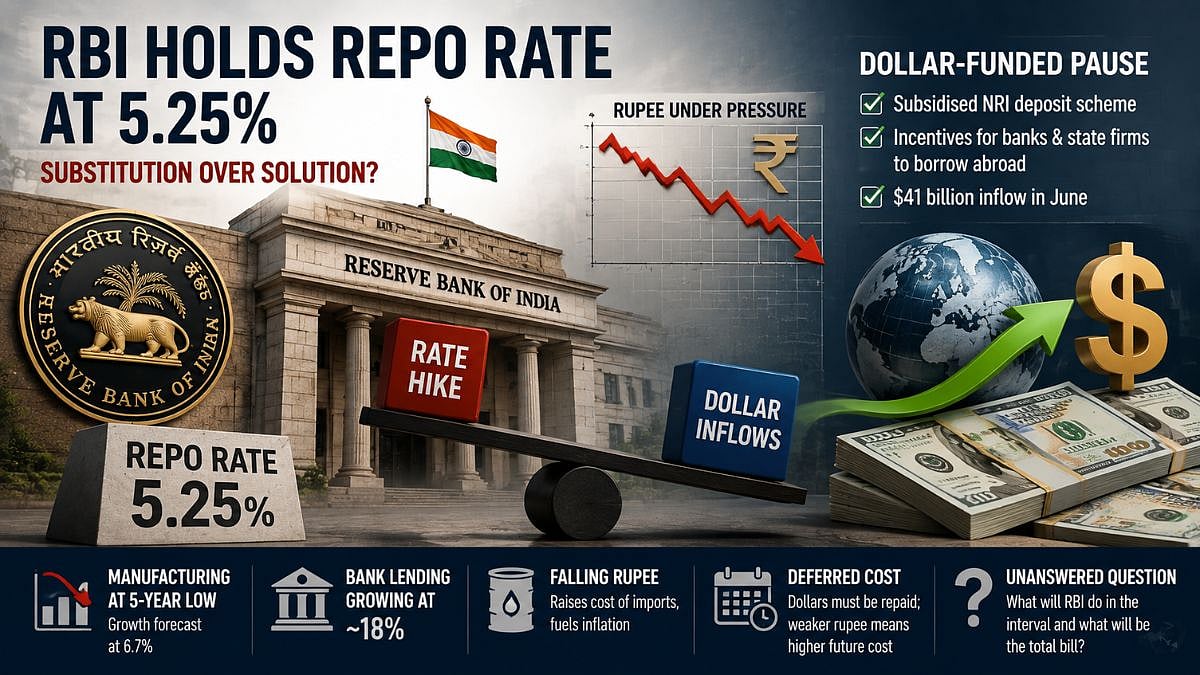
On the surface, the Reserve Bank of India's unanimous decision to hold the repo rate at 5.25 per cent looks like an act of patience. It is closer to a substitution. One must realise that the RBI's mandate is to control inflation, not the exchange rate, and Governor Sanjay Malhotra was careful to repeat that the rupee's level is for markets to decide.
But a falling currency raises the cost of everything India imports, oil above all, and that eventually shows up in prices. A central bank cannot ignore it. What the RBI has done is decline to answer the rupee's slide with the policy rate and answer it with borrowed dollars instead.
Policy Choice Examined
On its own terms, the hold is defensible. Malhotra's framing—headline inflation pushed above target by fuel, underlying pressures contained—is borne out by the RBI's own revisions. It trimmed average inflation for the year to 5 per cent, cut the core projection more sharply to 4.3 per cent, and nudged growth up to 6.7 per cent.
What creates dissonance is that manufacturing activity has sunk to a five-year low, while bank lending is growing at nearly 18 per cent, even as the RBI has projected growth at 6.7 per cent. Those figures do not fit together.
A central bank facing a sliding currency normally raises rates. Higher rates make rupee assets pay more, which attracts and retains foreign money, supporting the currency. The cost is domestic: expensive credit and slower growth.
The RBI did not want to pay that cost. So, in June, it went after the dollars directly instead—a subsidised deposit scheme aimed at non-resident Indians, plus incentives for banks and state firms to borrow abroad. This resulted in a massive inflow of $41 billion.
Those dollars support the rupee just as a rate hike would, but without affecting domestic borrowing costs. Hence, a "dollar-funded pause": the hold at 5.25 per cent is affordable only because something else is doing the currency's work.
Long-Term Costs
The cost is still there. It has just been shifted to where nobody sees it. The scheme pays NRI depositors more than banks abroad do, and the government picks up the difference. If one raises the repo rate, every borrower in India feels it.
But by not increasing the repo rate, nobody feels anything—for now. However, the dollars have to be repaid, and if the rupee falls further, returning them will obviously cost more. They also mature together, as the date has already been set by the scheme.
One needs to realise that the dollars came for an interest rate the market could not offer. When the scheme lapses, they go—and because they must be repaid in dollars, a weaker rupee means they cost more to return than they did when they were brought in.
Unanswered Questions
What the RBI has not explained is what it will do in the interim, or what the total bill will look like when those deposits come due.

