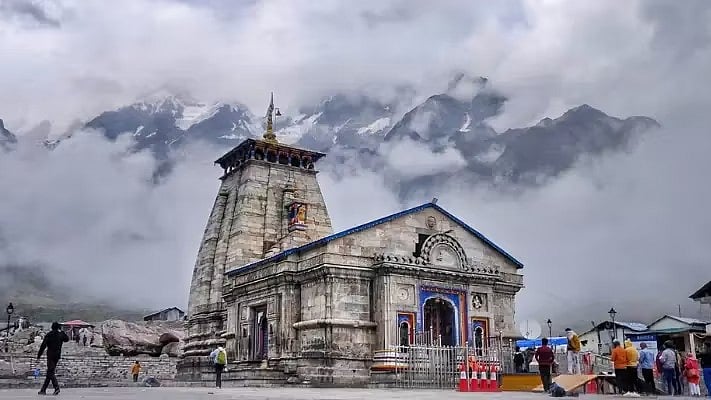
Religious tourism has not only blurred the line between pilgrimage and leisure travel, but it is also taking a heavy toll on the environment. A significant percentage of the tourist traffic that prompted the Supreme Court to recommend ‘tourism carrying capacity’ studies in Himachal Pradesh is directed towards religious sites. The question of whether religious tourism has a spiritual significance comparable to that of a traditional pilgrimage is for anthropologists to consider, but governments in Himalayan states must consider the social costs.
Take the case of Uttarakhand. Nainital (population 58,000) hosted over 1.32 million visitors last year. But neighbouring Kainchi Dham, Neem Karoli Baba’s ashram near tiny Bhowali (population 9,200), has seen a footfall of 2.24 million in the first six months of 2026 alone. To the northwest, in the Garhwal range, the Char Dham yatra has attracted over 60 million visitors this year—four times as many as the Vatican, five times the entire population of Uttarakhand, and seven times the number of visitors 10 years ago.
Environmental Damage At Religious Sites
At Kainchi Dham, the Baba’s devotees leave behind them a blanket of trash—Styrofoam plates and cups, foil wrappers and plastic bottles—and a once-pristine river sullied with sewage and shoals of garbage. At the Char Dham sites, government agencies have collected 800 tonnes of trash so far this year, including ‘religious litter’ like garlands, clothes, plastic wrappers for the prasad, e-waste and bio-hazardous waste. The temple-studded Kangra Valley and the global spiritual hub of Dharamshala in Himachal Pradesh face a similar problem. In 2022, the National Green Tribunal (NGT), acting on a report that the Himalayan region generates 8 million tonnes of trash every year, ordered a study on the environmental cost of tourism.
Given the adverse impact of religious tourism on ecologically sensitive zones, one cannot but wonder whether it confers the same spiritual merit as the ‘teerth yatra’ once did. To quote celebrated author Devdutt Patnaik, “This new form of pilgrimage is a 21st-century phenomenon, transforming the way Hinduism is experienced. Temples are becoming tourist spots. Festivals are becoming experience centres.” The fillip to local economies disguises the social cost, while avaricious priests benefit from credulous tourists and politicians from mediating licences.
Government Policies And Tourism Infrastructure
Governments tend to encourage religious tourism without putting safeguards in place. In 2014, the PRASHAD scheme was launched to develop and upgrade infrastructure around pilgrimage sites. The trouble is that projects are approved in isolation, without considering the cumulative impact of development. Temples themselves make strenuous efforts to attract visitors. Sociologist Janet Kahl observes, “As the number of pilgrim visitors to a shrine increases, the shrine becomes more organised and institutionalised.”
In a paper exploring the relationship between pilgrimage, leisure and tourism, anthropologist Vinay Srivastava says that they are interrelated but distinct concepts. A pilgrimage was traditionally regarded as a strenuous journey, often undertaken on foot if one was in good health. The hardier pilgrims would indulge in displays of extraordinary physical endurance, such as prostrating themselves in the direction of the shrine each step of the way. The journey itself was as important, if not more, as the destination. Thus, the pilgrimage was neither work nor leisure but an intermediate, separate category of travel. It was a serious matter based on rules and rituals but brought with it the joy of being with like-minded people and experiencing a spiritual uplift. Tourism, of course, is all about leisure. Religious tourism seems to fall somewhere in between.
Pilgrimage Versus Leisure Travel
The surge in religious tourism is directly related to the rapid development of road and hospitality infrastructure, which makes remote shrines easily accessible. It can be argued that one reason why temples were built in isolated mountainous regions was to ensure that devotees left worldly distractions behind and undertook a mindful journey over difficult terrain. The sole purpose of a pilgrimage was submission to the deity, for which the devotee endured rigours sustained by faith. But tourism is an end in itself. The modern tourist can comfortably combine temple visits with a vacation. Anthropologist Craig Palmer writes that “pilgrimage is distinguished from tourism by virtue of the fact that a pilgrimage is claimed to be undertaken for reasons involving religious sacrifice”. If ‘sacrifice’ is taken as the key word, then it can be argued that a helicopter hop to Kedarnath doesn’t have the same cache as the 17-km trek from Gaurikund. The fact remains that it no longer makes sense to trek if one can take a bus.
Social Media Drives Religious Tourism
Social media is perhaps the greatest driver of religious tourism. The selfie-at-the-shrine is de rigueur for visitors of all generations, but celebrity posts have a multiplier effect. Until 2022, Kainchi Dham was a quiet and unpretentious place, sitting on the banks of the Shipra River in a valley. The Bhowali-Kainchi stretch saw very little traffic. Then, cricketer Virat Kohli’s much-publicised visit to the ashram transformed it into a must-visit religious hub. The fact that Steve Jobs had been there in 1975 (two years after the Baba’s passing) and founded Apple shortly thereafter, and Mark Zuckerberg had visited in 2015, was reiterated repeatedly. Suddenly, there were chronic gridlocks all along the 20-km route from Bhimtal to Kainchi Dham. Gradually, other problems surfaced—a sharp increase in land value, increased vulnerability to forest fires, and multi-storeyed hotels sucking up scarce groundwater.
The successive climate-related tragedies the Himalayan states have suffered all bear testimony to the unchecked proliferation of tourism infrastructure. Religious tourism should be more, not less, mindful of environmental norms.
Bhavdeep Kang is a senior journalist with 35 years of experience working with major newspapers and magazines. She is now an independent writer and author.
To get details on exclusive and budget-friendly property deals in Mumbai & surrounding regions, do visit: https://budgetproperties.in/

