As India marches toward its ambition of becoming a developed economy, achieving record agricultural yields and expanding complex retail supply chains over the last decade, an unsettling question lingers over millions of households: Is the food reaching our tables actually safe to consume?
Food is the primary necessity of human survival and our first medicine. A society can endure delays in infrastructure projects or temporary slowdowns in industrial output, but it cannot survive the routine contamination of its daily nourishment. When the most basic essentials of air, water and food are compromised, debates about GDP growth, foreign investment and global influence lose their meaning. True national development remains incomplete if citizens cannot trust the food on their plates. Every family, regardless of income, depends on the integrity of the food system several times every day. Safe food is, therefore, not merely a consumer issue; it is a national security issue that directly affects productivity, healthcare costs and the quality of human capital.
A Systemic Crisis
India's food ecosystem has transformed dramatically over the last decade. Consumers enjoy unprecedented variety, quick-commerce delivery and year-round availability of fresh produce. Yet, beneath this abundance lies a serious public health crisis.
Since Independence, food adulteration has evolved from an occasional malpractice into a systemic hazard. Vegetables are frequently ripened with hazardous chemicals or coloured with industrial dyes. Fruits are coated with non-food-grade waxes. Milk is diluted or synthesised using detergents and urea. Edible oils are mixed with cheaper alternatives. Commercial kitchens and restaurants are frequently found using expired ingredients, repeatedly heated cooking oil and unsafe food-handling practices.
Unlike most consumer products, food suffers from severe information asymmetry. A buyer can compare specifications before purchasing a car or an electronic appliance. But no ordinary consumer can visually detect pesticide residue, heavy metal contamination or chemical adulteration in vegetables, fruits, milk or cooked food. The seller possesses the information while the consumer bears the risk.
The consequences extend far beyond food poisoning. Continuous exposure to adulterants contributes to organ damage, neurological disorders, hormonal disorders, weakened immunity and cancer, with children, pregnant women and the elderly facing the greatest risks. The burden eventually shifts to the healthcare system, imposing enormous unseen economic costs on society.
Administrative Heroics Are Not Enough
The ongoing statewide enforcement drive led by Maharashtra FDA Commissioner Tukaram Mundhe demonstrates what determined regulation can achieve. Since assuming office in May 2026, his team has carried out extensive inspections, seized contaminated products, suspended licences and prosecuted repeat offenders.
Such action sends a powerful message that violations carry consequences and also fosters consumer awareness. But no matter how committed an officer may be, inspections alone cannot solve a problem spread across millions of farms, warehouses, wholesalers, restaurants and retail outlets. Raids punish offenders only when they are caught red-handed. They, though laudable, do not meaningfully change the economic incentives that encourage adulteration.
The SEBI Model
SEBI does not examine every individual trade. Instead, it regulates a network of registered intermediaries, such as stock exchanges, brokers, clearing corporations, depositories and custodians, and also deploys the services of qualified auditors. These intermediaries carry statutory responsibilities to ensure compliance throughout the system. Failure attracts severe penalties, licence suspension and loss of market access for these intermediaries.
Compliance, therefore, becomes an essential business function rather than an optional obligation. The regulator oversees the architecture of the market while intermediaries continuously monitor participants operating within their own ecosystems.
Bringing The Model To Food Safety
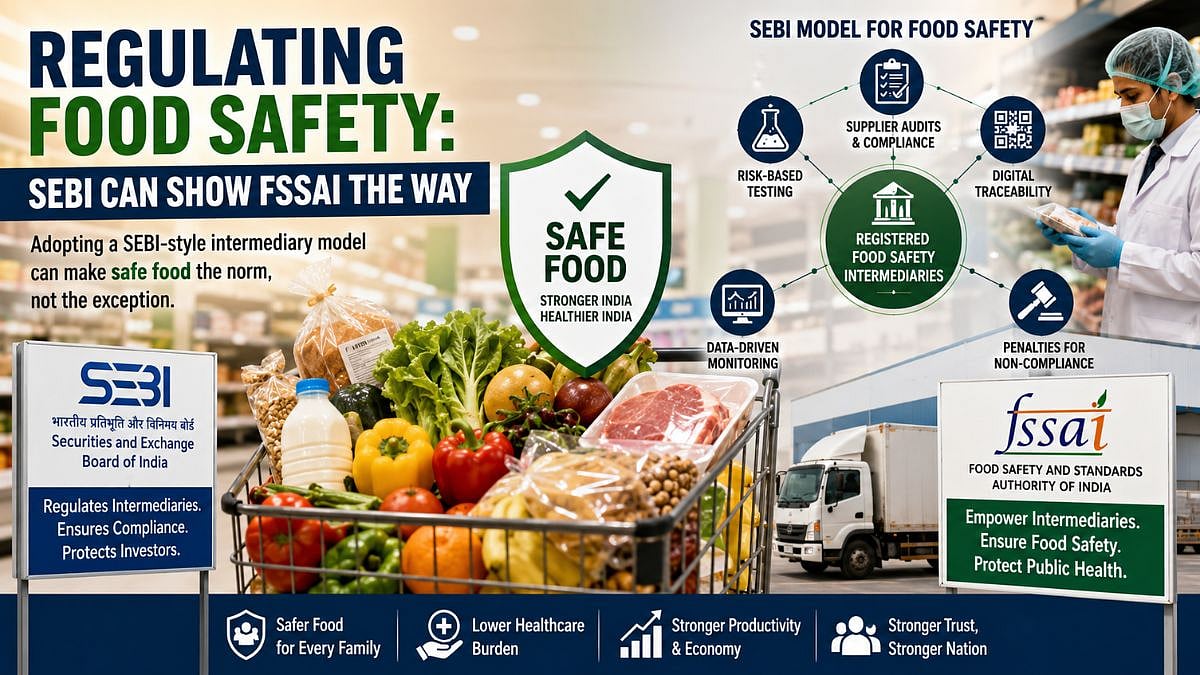
The FSSAI should create a similar framework for the organised food sector. Large supermarket chains, food delivery platforms, quick-commerce companies, restaurant chains and major food processors crossing specified turnover thresholds should be designated as Registered Food Safety Intermediaries.
These entities should become legally responsible for the safety of food moving through their supply chains. They must maintain standardised quality assurance systems, conduct risk-based and random testing through accredited laboratories, ensure digital traceability and periodically audit suppliers.
Changing Market Incentives
This approach changes the economics of adulteration.
Today, dishonest suppliers gamble that regulators will never inspect them. Under an intermediary model, they face a far greater probabilistic risk of being permanently removed from the supply chains of major buyers. Corporate intermediaries themselves would face serious penalties for repeatedly sourcing from non-compliant suppliers.
Technology can strengthen this ecosystem through QR code traceability, integrated testing databases and data-driven risk profiling, allowing regulators to focus inspections where risks are highest while continuously monitoring emerging patterns of violations.
A Practical Path Forward
The unorganised sector still dominates food distribution across India. Small vendors and neighbourhood stores cannot immediately shoulder the same compliance burden as large companies. The FSSAI should, therefore, adopt a phased approach: strict intermediary accountability for organised businesses, supported by government-funded testing facilities, simplified digital reporting and capacity-building for smaller vendors. As SEBI does, the government can fund these measures through the levy of the necessary fees on these intermediaries.
Food safety is not merely another regulatory function; it is the foundation of public health and national productivity. If India truly aspires to become a developed nation, citizens must have confidence that every meal nourishes rather than harms. A SEBI-inspired regulatory framework can move India from episodic enforcement to a system where safe food becomes the norm rather than the exception. India has demonstrated in the financial sector that well-designed regulation can successfully align private incentives with the public interest. There is every reason to believe that the same philosophy can transform food safety and restore public confidence in what reaches every dining table.
The writer is a retired IRS officer and former Chief of Surveillance at SEBI, and an advisor to corporates, market participants and technology entrepreneurs.

