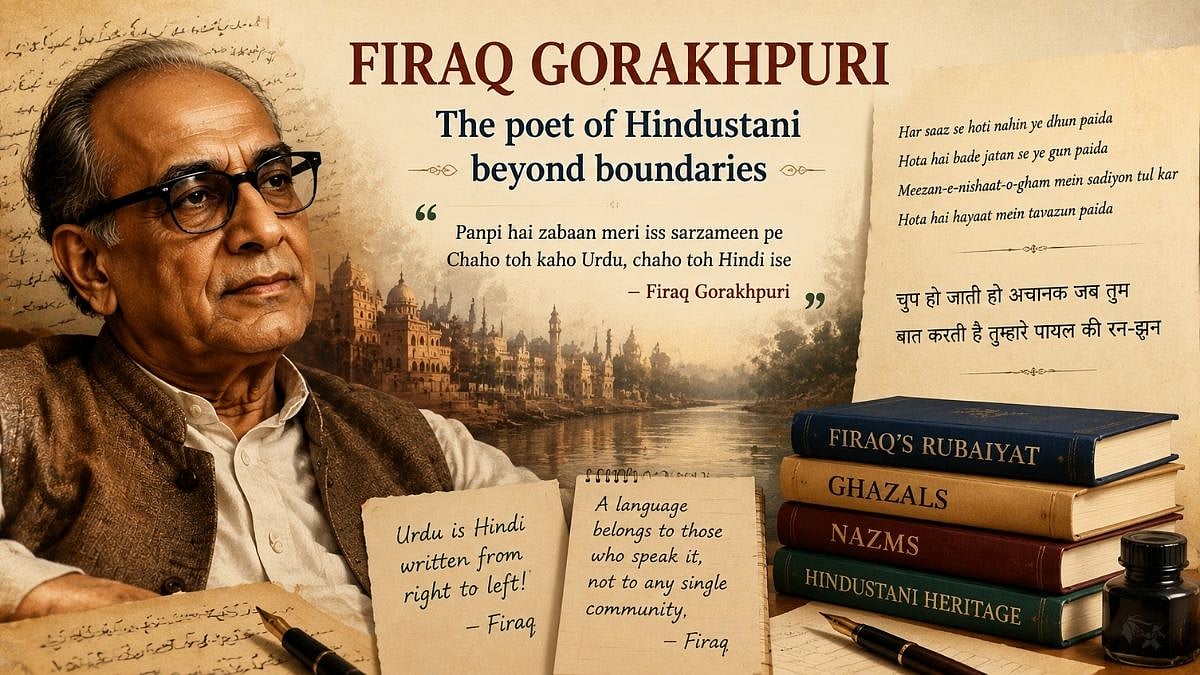
One of the greatest Urdu poets of the last century, Raghpati Sahay ‘Firaq’ Gorakhpuri was born on August 28, 1896. Firaq (meaning 'separation' in Urdu) is bracketed with the three Fs of Urdu poetry of the 20th century: Faiz Ahmad 'Faiz', Ahmad Faraz, and ‘Firaq’. In these polarised times when even languages are being branded on the basis of religion, sects, and provinces, studying the poetry of Firaq is not just important; it's essential to disabuse ourselves of so many linguistic misconceptions that have, of late, eclipsed our spirit, society, sanity, and sensibility. In spite of having an astounding command over Urdu, Firaq never suffered from linguistic chauvinism. He taught English literature at Allahabad University and wrote with equal aplomb in all three languages, viz., Urdu, English, and Hindi. He never insisted on writing his Urdu poetry in chaste and abstruse Persianised Urdu. In his words, "Panpi hai zabaan meri iss sarzameen pe / Chaho toh kaho Urdu, chaho toh Hindi ise" (My language has thrived on this soil / You can jolly well call it Hindi or Urdu).
Firaq's Vision Of Hindustani
If Firaq was against the kind of Urdu laboriously embellished with the recondite and archaic Persian, Arabic, and Turkish words, he was also not in favour of Sanskritised Hindi. He says elsewhere, "Shayari wahi dil mein utarti hai / Zabaan na jab theth Hindi na Urdu hoti hai" (Only when a language is neither pure Urdu nor Hindi does it become intelligible to the readers). It can be safely observed that Firaq Indianised culturally indifferent Persianised Urdu and pared it down to intelligible Hindustani. According to Dr Khawaja Ahmad Farooqi, "If it were not for Firaq, the land of our ghazals would be dull; its ascension would not be more than a carbon copy of Persian masters' ornate ghazals or imitating dead and lifeless Iranian traditions." He adroitly brought in Hindi words like 'salonapan', 'chanchalpan', 'baalpan' and 'aneelapan' (a woman's mystique) and blended them into the predominant structure of an Urdu creation. This created a seamless texture of Urdu-Hindi.
Firaq was of the view that Urdu was Hindi written from right to left! "Rasmul-khat badal deejiye Hindi ka / Pal mein Urdu ban jaayegi Hindi" (Just change the script of Hindi from Devanagari to Persian, Hindi will become Urdu in a jiffy). No language is the preserve and prerogative of a particular community, faith or group of people. He defended the secular, common heritage of Urdu, noting that language belongs to those who speak it rather than to any single community. He believed that Urdu and Hindi must never be labelled. Hindi for Hindus and Urdu for Muslims was a dangerous idea that started taking shape even in the times of Firaq. In other words, this linguistic insistence is not a new phenomenon. It became prevalent when India got freedom in 1947.
Hindi Words In Urdu Poetry
Saddened by this 'development', Firaq started using Hindi words in his Urdu couplets, ghazals, nazms and rubaiyat (quatrains). See the use of the word 'kos' (a unit in distance, used in typical Hindi, metaphorically, a road): "Ye zindagi ke kade kos / Yaad aata hai teri nigah-e-karam ka ghana-ghana saya" (The roads of life are so rough, tough and difficult / I remember the dense shed of your compassion). Or see this famous quote of Firaq: Rate hue lafzon se bada adab nahin bana karta (Memorised words don't make great literature). Firaq says, "Ye zaroori toh nahin ke Urdu faqat Farsi ho / Urdu Hindi bhi toh ban jaati hai kai baar" (It's not essential that Urdu should be so Persianised / Let Urdu remain Hindi at times).
Firaq brought elements from Indian folklore, nature (such as kamal or rivers), and local romantic idioms into the traditional structure of the Urdu ghazal, nazm, and rubai. Rather than merely dropping Hindi words, he organically re-contextualised the language so that native Indian philosophical and emotional hues found a natural home within Urdu expression. His vocabulary remained deeply tied to the composite, everyday stream of Hindustani, making his verses resonate with both refined literary circles and general readers. Two examples from his rubaiyat will make it clear how Firaq re-contextualised Hindi as well as Urdu: Mad mein doobi hui ye raat / Nargis-e-neembaaz ka aalam / Mere naghame ki narm lay mein dekh / Jumbish-e-paaynaaz ka aalam (The night is neck-deep in wine / Like a Nargis, a fabled flower, half open / Look at the tender hue of my song / It's like a beloved coming tip-toeing). The use of typical Hindi words like 'mad' (wine), 'raat' (night), and 'lay' (hue, shade, tune, or rhythm) doesn’t appear to be forced. Firaq always believed in the spontaneity of a language, be it Urdu, Hindi, and even English.
Seamless Hindi-Urdu Expression
Another example is "Har saaz se hoti nahin ye dhun paida / Hota hai bade jatan se ye gun paida / Meezan-e-nishaat-o-gham mein sadiyon tul kar / Hota hai hayaat mein tavazun paida" (Every instrument will not create this tune / This comes only after rigorous practice and perseverance / On the scale of pain and pleasure for centuries / There comes a balance in life). He used 'dhun' (tune), ‘jatan’ (efforts, a word that comes from Sanskrit’s 'yatn'), and ‘gun’ (quality, gun in Sanskrit/Hindi: attribute, trait). Here lies the beauty of the poetry of Firaq. You can see and feel the seamless juxtaposition of Hindi / Sanskrit and Urdu words. Yet another example from the corpus of his 42 thousand couplets will buttress the point: Chup ho jaati ho achanak jab tum / Baat karti hai tumhare paayal ki run-jhun (When you don't say anything, your anklet says something). The entire couplet is completely devoid of Urdu words. Yet, its poetic effect is so emphatic and everlasting. Dushyant Kumar, the doyen of Hindi ghazal, was inspired by the simple, yet effective, poetry of Raghupati Sahay Firaq.
Firaq was as much a thinker as a poet. The search for separation paints a picture of the direction and speed of life and survival and evolution in love. Despite his legendary love for Urdu, Firaq used to say that Urdu literature had not yet given birth to the concept of woman. In the Urdu language, there was no Shakuntala, Savitri, or Sita. One of the great virtues and characteristics of Firaq's poetry is that it reflects the greatness and importance of world experiences as well as cultural values of a composite culture (Ganga-Jamuni Tahzeeb). Firaq's poems affect the heart as well as invite thought, and this is the quality that sets him apart from all other poets. Firaq wholeheartedly admired the great Hindi raconteur Munshi Premchand's simple but powerful language, which he called perfect Hindustani, and would always say, "Premchand's language was Urdu for the Urdu readers and Hindi for the Hindi readers."
Firaq's Relevance Today
Today, when we're foolishly sparring over languages and showing our pettiness at the drop of a hat, delving into Firaq's poetry can humanise and ennoble us.
Sumit Paul is a regular contributor to the world's premier publications and portals in several languages.

