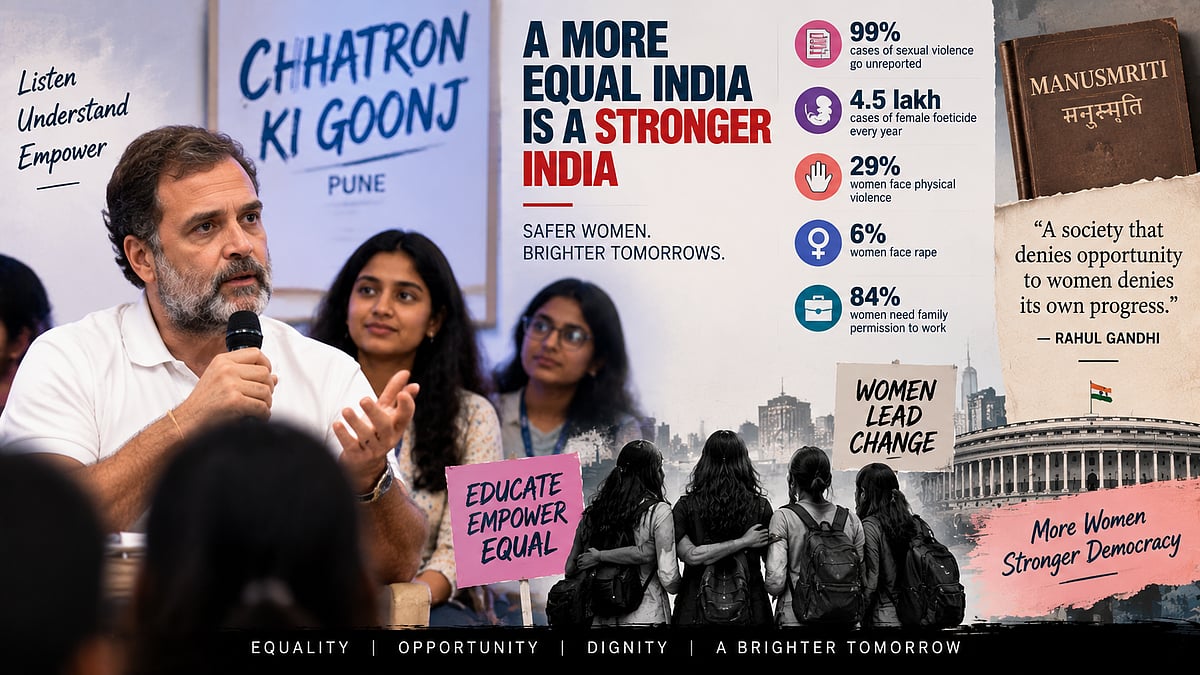
Rahul Gandhi is at his most compelling when his unfiltered candour cuts through the euphemisms of political discourse. At a recent ‘Chhatron Ki Goonj’ interaction with young women in Pune, the Leader of Opposition (LoP), while criticising patriarchy, took aim at the Manusmriti for its regressive portrayal of women as occupying subordinate roles. Rahul spoke about the violence against women but expanded the definition beyond physical violence to include what he called the violence of denied opportunity and the many forms of control women face in their everyday lives. He actually made space for the women on the stage to come and tell their stories.
Calling Indian women India’s biggest asset, Rahul drew attention to the depressing reality that 99% of cases of sexual violence go unreported because of social stigma; that nearly 4.5 lakh cases of female foeticide occur every year; and that 29% of women endure physical violence and 6% face rape. If that were not enough, 84% of women need their families’ permission to take up employment. Rahul wants an enlightened society to be the wind beneath the wings of women waiting for that little push to succeed in their professional lives. According to him, what is required is an attitudinal shift and a moral imagination that give women the necessary social and personal space to live with self-respect and dignity.
There is no denying that politicians often gravitate towards tangible welfare measures rather than confronting abstract and deeply entrenched social issues. Yet, the growing electoral influence of women has made it increasingly difficult to keep questions of patriarchy, women’s safety, and gender equality at the margins of political discourse. Gender has, consequently, emerged as a significant pillar of political strategy in India, prompting a range of legislative and social interventions. These developments are reflected not only in the sharp rise in women’s voter turnout and the broader demographic shifts in electoral participation but also in legislative measures, such as the Prohibition of Child Marriage Act, stronger provisions against dowry, the Protection of Women from Domestic Violence Act, and the criminalisation of instant triple talaq.
The BJP has questioned whether Congress itself practises the gender equality that Rahul Gandhi preaches. Where Rahul deserves sharper scrutiny is in the implementation gap between rhetoric and institutional practice. Women’s representation remains abysmally low across Indian politics. ADR’s 2026 analysis found that women constitute only about 9% of sitting MLAs nationally, with the BJP having 163 women MLAs and the Congress 59. More broadly, 19 state assemblies have fewer than 10% of women legislators.
While going all guns blazing against patriarchy in his criticism of the Manusmriti and conservative Hindu traditions, Rahul Gandhi’s striking silence over the recent regressive remarks by Kerala cleric Kanthapuram A.P. Aboobacker Musliyar—that women should remain confined to their homes and stay away from public platforms—has baffled many.
Patriarchy is not always understood, even by those who live within it, because from childhood many of us grow accustomed to male authority as a natural part of family and social life. The patriarch is often treated as an unquestionable arbiter of what is right and wrong, shaping the cultural and social norms that govern others. Yet, even an otherwise decent man can unconsciously reproduce hierarchies that privilege men and subordinate women.
A newly married woman in our society is culturally freighted with expectations of being an obedient daughter-in-law. At times, her carefully curated outward appearance is merely a spectral charade of happiness. She endures dowry harassment or constant physical and emotional abuse at the hands of her husband simply because she has not borne a son. In such circumstances, all talks of progress and women’s empowerment ring painfully hollow. In her short story, ‘Be a Woman Once, Oh Lord’, Banu Mushtaq talks about the systematic erasure and devaluation of women in a patriarchal world. The narrative highlights how the world has been meticulously constructed “by and for men”. It builds towards an ultimate demand: if the universe is ever to be remade, God must come to earth and live life as a woman. Because God is viewed through a male lens, she feels like a “creation unloved’’ and a mere afterthought.
Rahul’s engagement with students and young women represents a departure from the conventional politics of the podium, where politicians speak and audiences largely listen. His sustained engagement with the younger generation could be seen as cairns on his political trail, offering clues to the direction he intends to take, even if they do not yet establish that he has arrived there.
The writer is a Delhi-based journalist.

