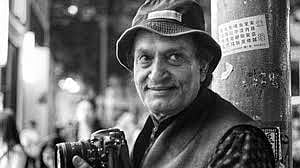
Among the men and women who bore witness to history, sought out personalities and common people with equal respect, treated photography—even news photography—with a meditative deference, and compiled a veritable chronicle of India across five decades, ace photographer Raghu Rai was in a class of his own. Luminous and evocative frames, mostly black and white, in which light played its magic and Rai’s hand-eye coordination captured a moment so complete and perfect that it told the whole story. Rai, 83, passed away on Sunday in Delhi. The floodgates of recollections and admiration have not shut since; those who worked with him spoke of his process and attitude, while those who watched his oeuvre remarked on its amazing versatility and perfect tonality.
Images that defined moments in history
It is futile to compile a list of Rai’s best, but some stand out, both because they are unforgettable photographs and because they define that event or person in India’s history.
His shots of Indira Gandhi and Mother Teresa, both of whom he tailed for years, quietly slipping into crevices to get his right frame; the unmissable shot of a Delhi sweeper gathering up Gandhi’s election poster with his broom after her 1977 election defeat; his shots of Jarnail Singh Bhindranwale before Operation Bluestar; his heart-stopping images of the Bhopal gas tragedy, showcasing the world’s worst industrial disaster; his oeuvre of musicians and artistes from MS Subbulakshmi to Pandit Bhimsen Joshi and Satyajit Ray; his street photography from capturing a young, elfish Arundhati Roy surrounded by men in what quietly screams ‘male gaze’ to the homeless living inside water pipes; his photo-essays of communal amity through the lives of an old Muslim man and a Hindu mentally challenged girl on Delhi’s streets—all together, a compendium of India itself.
A storyteller through the lens
Rai did not merely capture a moment with his cameras; he told an entire story in a frame. A civil engineer by training, he drifted into photography and made it his calling. He worked in newspapers and magazines but carved out his niche. A Raghu Rai photograph rarely needed his byline. That distinctive quality came not only from the camera in his hands but also his grounded approach, meditation about his craft, and his ability to ‘see’ beyond the obvious to capture its meaning. “Common man or Indira Gandhi or any personality, I have to remain me, myself, a sensitive, responsible human being. Over the years, you develop a kind of discipline that your steps are no less and no more, just enough to reach the situation at a distance which has its sanctity,” he once said.
Legacy beyond the age of mobile cameras
Rai embraced mobile photography, but his best was before phone cameras and social media turned photos performative. His work and approach teach that patience, thinking, and risks play a role in great visual story-telling, that memorable photos happen not by chance but by deliberative immersion from a distance. A valuable legacy of photographs and photography, indeed.

