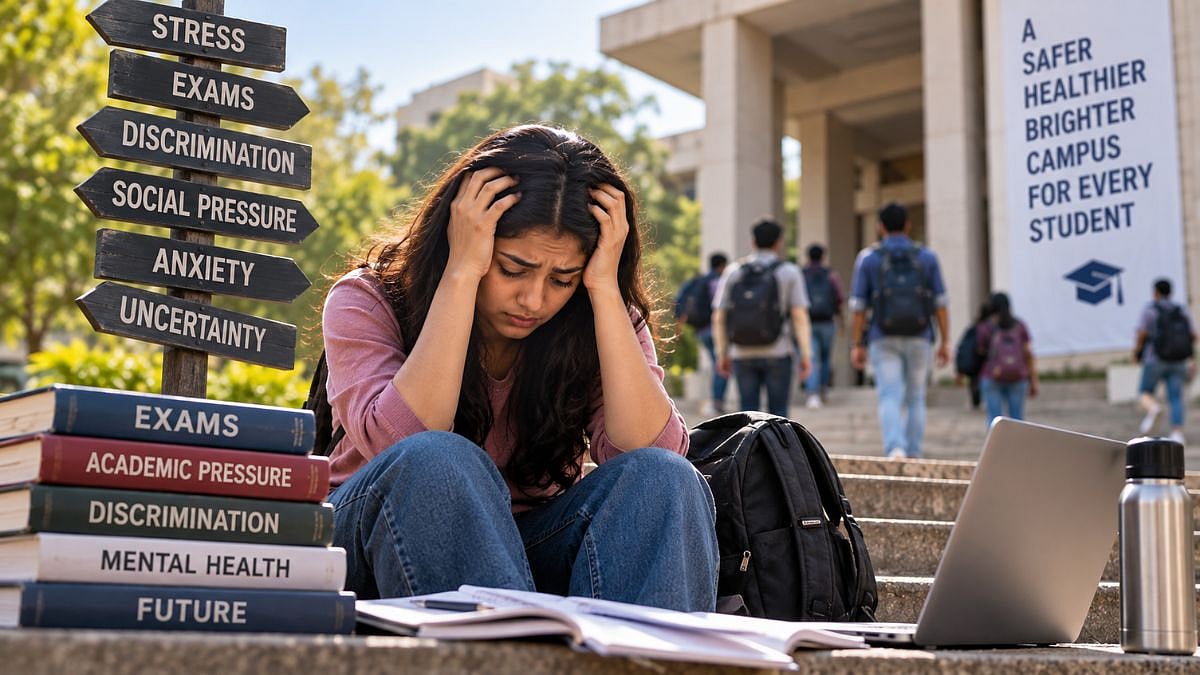
“Education in the true sense,” wrote India’s celebrated philosopher-educator Jiddu Krishnamurti, “is helping the individual to be mature and free, to flower greatly in love and goodness. That is what we should be interested in, and not in shaping the child according to some idealistic pattern.” How far India’s education system has strayed from the noble purposes of education is reflected in the regular reports of students’ suicides from Higher Education Institutions (HEIs)—two in recent weeks from IIT-Delhi and IIT-Bombay—in the lakhs who vie for top scores in competitive examinations, from stories of constant stress and performance anxiety in students, and from discrimination in subtle and not-so-subtle ways that SC/ST/OBC students are subjected to.
Students Face Relentless Pressure
Student life, as the Supreme Court noted, has become “a series of tests” and competitive examinations that “subject students to relentless psychological pressure”. Student suicides, though 8 per cent of total suicides in India, have surged 65 per cent over the past decade, from around 8,400 in 2013 to over 14,000 last year, as registered by the National Crime Records Bureau. The surge points to fundamental and serious issues beyond the mental health vulnerability of individual students. To understand this, the SC appointed a National Task Force (NTF) in March last year, headed by Justice (retired) Ravindra Bhat. Its findings confirm the worst suspicions and flag off a slew of issues that demand immediate and institutional attention.
Survey Reveals Wider Campus Distress
The series of surveys covering a staggering 2.43 lakh students across the country’s HEIs shows that suicides are only the tip of the iceberg. As many as 15 per cent of the students experienced overwhelm or distress in the previous six months, nine per cent reported experiencing suicidal thoughts, and 34 per cent reported feeling like an outsider on campus. The NTF’s interim report last year had flagged off “deep-rooted social discrimination, rampant sexual harassment”, caste-based humiliation, gender discrimination, hostel curfews, moral policing, language gaps, faculty positions not being filled, and delays in scholarship disbursement. Altogether, it is a grim picture, hardly the noble, purposeful, and student-supported education system that was envisioned.
Institutions Must Ensure Accountability
Suicides are individual acts, but they carry the imprint—and the failure—of the entire system. HEIs must be made fully accountable for every act of discrimination, caste- or geography-based humiliation, and suicide. All institutions, public and private, must not only create a responsive and sensitive system of student support but also address the casual discrimination and sexism that happen every day on their campuses. Pending the NTF report, the SC laid down a 15-point guideline for all educational institutions and coaching centres, but there’s no way to know if these are followed. The approach of HEIs is reflected in the fact that barely 3.5 per cent of the nearly 60,383 responded to the NTF survey. This has to change, for higher education is not merely a business.

