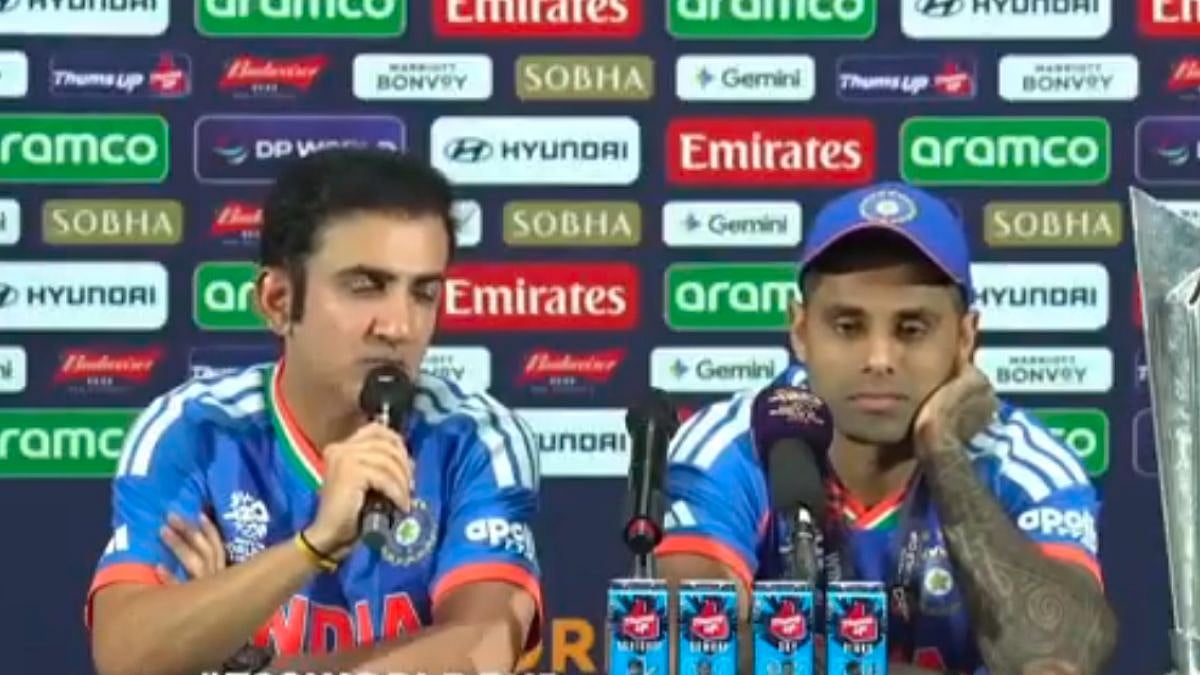
It’s a deadly combination. Gautam Gambhir never smiles. Surya Kumar Yadav is always smiling. Mr Smile and Mr No-Smile together create a kind of deception and depth in their cricket strategy that opponents fail to counter, leaving them to bluster in the field. After a very, very long time and for the first time in Indian history, a team that was rated as the favourite to win the c won the World Cup. And this superlative achievement was achieved without their superstars—Virat Kohli and Rohit Sharma. I rate this victory greater than 1983, when Kapil’s devils massacred the invincible West Indies in the final against all odds. Playing on its own ground, playing without superstars, and playing with the supernatural pressures of the hopes of 140 crore Indians with the added pressure of being the favourite demanded superhuman efforts, and this team did it with lesser mortals and regular cricketers with divine ease.
And this was done when the team was led by Gautam Gambhir and Surya K Yadav, both of whom suffered in their careers from the scourge of super stardom among their teammates. Gautam was a member of a team that included all-time great batsmen, such as Sachin Tendulkar, Rahul Dravid, Virender Sehwag and VVS Laxman, who could walk into any great team. Gautam was a fighter and was a good batsman, but he was never rated at par with the greats of his team. He was gritty and survived in that team. Surya is a late bloomer. He got his opportunity at the ripe age of 30 and, despite being the captain of the T20 World Cup-winning team, he failed to become a regular in either the Test or the one-day team. He is extremely innovative. In the Indian context, he is a revolutionary T20 batsman who has redefined stroke-making with a magnetic touch and audacity, but he will always be considered a one-dimensional player who, despite his immense talent, could not cement his place in the other two formats. That way, Mr Smile and Mr No Smile share the anguish and pain of being underachievers who were made to look inferior vis-à-vis their contemporary greatest batsmen.
No wonder when the Indian team was handed over to Gautam after Rahul Dravid, his psychological attire decided to prove to the world that there exists another world outside the realms of superstars and celebrity cricketers. He fumbled to begin with. He struggled with Virat Kohli and Rohit Sharma. He was never comfortable in their presence; he is still trying to create a team of his own in Test and one-day formats, but he succeeded in T20 because he shared the same pain and understanding with Surya, and both chose players who might not have phenomenal run average and wicket-taking abilities but who fit into their cricket philosophy and play to their worldview. In a one-on-one comparison, this team might not compete with the greatest teams of Clive Lloyd, who won two consecutive World Cups before Kapil demolished them at Lord's in 1983, or the Australian teams that won two back-to-back World Cups in 1999 and 2003, led by great Steve Waugh and Ricky Ponting. Both the West Indian and Australian teams had a few all-time great players. Lloyd and Waugh and Ponting’s teams were considered to be the greatest teams ever in world cricket history, but the same can’t be said about Surya’s team.
The above-mentioned teams had nothing to prove to the world, but in Surya’s team, except Bumrah, everyone has a burning desire to showcase their worth and talent. In this team, every member was dispensable except Surya, the captain, and Bumrah, the bowler. Alternatives were easily available. Abhishek Sharma almost lost his place in the team. Sanju Samson, the man of the tournament, was benched in the beginning. Ishan Kishan was not the team’s first choice at number three. Tilak Verma, the original number three batter, who was highly rated by the team management, finally had to concede his place to Ishan. Surya had a mediocre World Cup as a batsman. Among bowlers, except for Bumrah, everyone else struggled. Varun Chakravarty, who was supposed to be the trump card, was on the verge of being dropped on the eve of the final. But this was the team's greatest strength. Not being the team of a few superstars, their absence in the dressing room was a blessing in disguise. The team was not dependent on one or two players to win matches. There was no one in the room to intimidate them with their phenomenal talent; there was no God to rescue them. This created space for every player to prove their mettle and emerge as a winner.
Sanju Samson is a great example. He played three back-to-back innings, which can make any great player proud. Every time he was interviewed, he spoke about his vulnerabilities and about his mental fragility due to earlier failures, despite being a great talent. He redeemed himself when he was on the verge of being written off from the Indian team. He did not thank his talent; he thanked the Almighty God. Akshar Patel, the vice-captain, was earlier dropped from the team, but when he returned, he took two gravity-defying catches in the semi-final. Varun Chakravarty was clobbered so badly by the South African batsmen that it was surprising that he was not benched for the next team.
So, Gautam and Surya were in the best position to understand the vulnerabilities and mindsets of such cricketers, who are not phenomenal but regular guys with average successes; they knew that such players needed support and belief. And as they were confident in the coach's and captain's support, they tried to give more than 100 per cent. The team, which was not the greatest in terms of individual talent, was unbeatable together. Gautam and Surya transplanted their inner resilience, their survival instincts, and their never-say-die attitudes to the team as a whole and to each member in particular. That is why Gautam and Surya together were such a deadly combination. Thanks for winning the World Cup, Team India.
The writer is Co-Founder, SatyaHindi.com, and author of Hindu Rashtra. He tweets at @ashutosh83B

