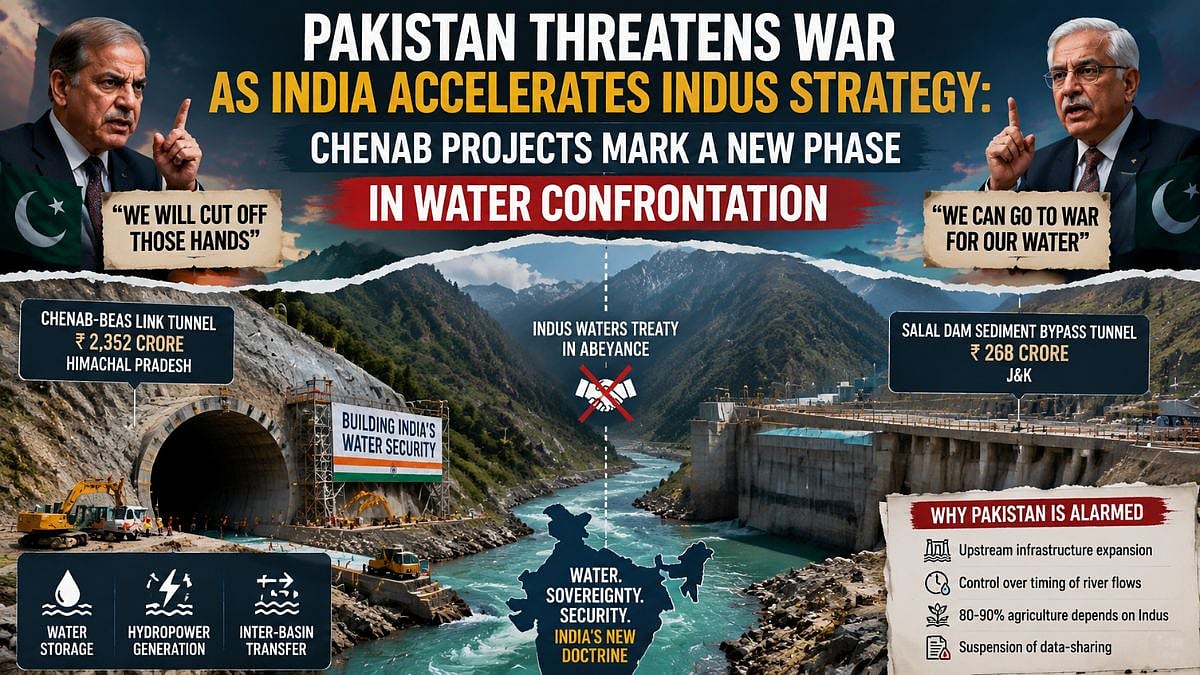
Tensions between India and Pakistan over the six-decade-old Indus Waters Treaty (IWT) have entered their most dangerous phase since New Delhi placed the agreement in abeyance following the 2025 Pahalgam terror attack. The latest flashpoint came with Pakistan's Climate Change Minister Musadik Malik's warning that Islamabad would "cut off those hands" seeking to claim Pakistan's share of the Indus waters. Combined with Pakistan Defence Minister Khawaja Asif's declaration that Islamabad could "go to war" if its water security were threatened, the rhetoric has transformed what was once a technical water-sharing arrangement into an overt national security confrontation.
The escalation comes as India moves beyond diplomatic signalling and begins translating political intent into infrastructure action. The launch of two major Chenab-linked projects worth nearly Rs 2,600 crore—the Rs 2,352 crore Chenab-Beas Link Tunnel in Himachal Pradesh and the Rs 268 crore sediment bypass tunnel at the Salal Dam in Jammu and Kashmir—signals that New Delhi is entering a new phase of hydro-strategic planning. Water, which survived multiple wars as a relatively insulated area of cooperation, is increasingly becoming another arena of geopolitical competition between the two nuclear-armed neighbours.
Islamabad has simultaneously intensified efforts to internationalise the dispute by portraying India's actions as the "weaponisation of water" and invoking climate change, humanitarian concerns and downstream vulnerability to win international sympathy. This strategy is hardly new. From Zafrullah Khan raising the canal water dispute before the United Nations in the early 1950s to Asif Ali Zardari's 2009 warning that Pakistan's water crisis could fuel extremism, successive Pakistani governments have attempted to frame the issue as an international rather than a bilateral treaty matter.
However, Pakistan's legal argument is considerably weaker than its political rhetoric suggests. The Indus Waters Treaty grants Pakistan treaty-based rights to utilise specified waters; it does not confer sovereign ownership over the rivers themselves. Since the Indus, Jhelum and Chenab originate in Indian territory, the treaty preserved India's territorial sovereignty while regulating utilisation of river waters between two sovereign states. This distinction is central to India's evolving position that greater utilisation of its legitimate share cannot automatically be portrayed as depriving Pakistan of its sovereign rights.
From Diplomacy To Doctrine
The suspension of the Indus Waters Treaty is no longer confined to diplomatic symbolism or retaliatory signalling. More than a year after Pahalgam, India has begun converting policy into infrastructure on the ground. What initially appeared to be a temporary coercive measure is steadily evolving into a broader doctrine of hydro-strategic leverage. The latest projects indicate that India's approach has entered a more operational phase. The message is unmistakable: New Delhi intends to maximise utilisation of waters that historically flowed downstream with only limited domestic exploitation.
End Of Strategic Restraint
The significance of this shift extends well beyond engineering. For decades, successive Indian governments argued that restrictive treaty provisions, coupled with inadequate infrastructure, prevented the country from fully utilising its legitimate share of the Indus Basin waters. The current political and security environment has fundamentally altered that calculation. India's decision to keep the treaty in abeyance rests on the argument that the agreement was built on an assumption of peaceful coexistence and mutual restraint—an assumption repeatedly undermined by decades of Pakistan-sponsored cross-border terrorism, culminating in the Pahalgam attack.
Chenab Projects Signal Shift
Within India, the Chenab-Beas tunnel is being projected as a developmental project that would benefit Himachal Pradesh, Punjab, Haryana, Delhi and Rajasthan by improving water availability while generating nearly 4,000 MW of additional hydropower. Strategically, however, its significance extends far beyond regional development. The project reflects New Delhi's determination to optimise utilisation of the western rivers through storage, hydropower, flood management and inter-basin transfers rather than allowing vast quantities of water to flow downstream without adequate domestic use.
Pakistan's Growing Concerns
Pakistan's growing anxiety stems not from any immediate prospect of India "turning off the tap" but from the long-term implications of expanding upstream infrastructure. Islamabad understands that India currently lacks the storage capacity to drastically alter annual river flows overnight. Most existing Indian projects remain run-of-the-river schemes with limited storage. Yet, as barrages, tunnels, sediment-management systems and inter-basin transfer projects gradually expand, India will acquire greater flexibility to regulate the timing and management of flows within the framework of its legitimate rights. In highly seasonal river systems, even modest control over timing can assume considerable strategic significance.
Pakistan's dependence on the Indus system further magnifies these concerns. Nearly 80 to 90 per cent of its agriculture relies directly or indirectly on the basin, while the suspension of hydrological data sharing has introduced additional uncertainty for reservoir operations, irrigation planning and flood forecasting. Consequently, Islamabad's increasingly aggressive rhetoric reflects not only present realities but also apprehensions about India's future hydro-management capabilities.
India's Strategic Balance
India, however, must also calibrate its strategy carefully. As an upper riparian vis-à-vis Pakistan and Bangladesh but a lower riparian in relation to China on the Brahmaputra and Sutlej, New Delhi cannot afford to create precedents that may weaken its own position in future water disputes. It must, therefore, continue presenting its policy as an exercise of legitimate sovereign and treaty rights rather than an attempt to deprive Pakistan of water.
Water As Strategic Frontier
Ultimately, the real significance of India's emerging hydro strategy lies not in abruptly choking Pakistan's water supply—something geography and existing infrastructure do not presently permit—but in ending decades of self-imposed restraint that limited India's utilisation of the western rivers. The Indus Waters Treaty was once regarded as one of the world's most durable water-sharing agreements because both sides respected its underlying spirit. Today, that foundation has been eroded by persistent cross-border terrorism and deepening strategic mistrust. With India accelerating infrastructure projects and Pakistan openly speaking the language of war, the Indus Basin is no longer merely a water-sharing arrangement. It has become a critical arena where engineering, diplomacy, sovereignty, national security and geopolitical power increasingly intersect, making the future of South Asian stability inseparable from the politics of water.
The writer is a senior political analyst based in Shimla.

