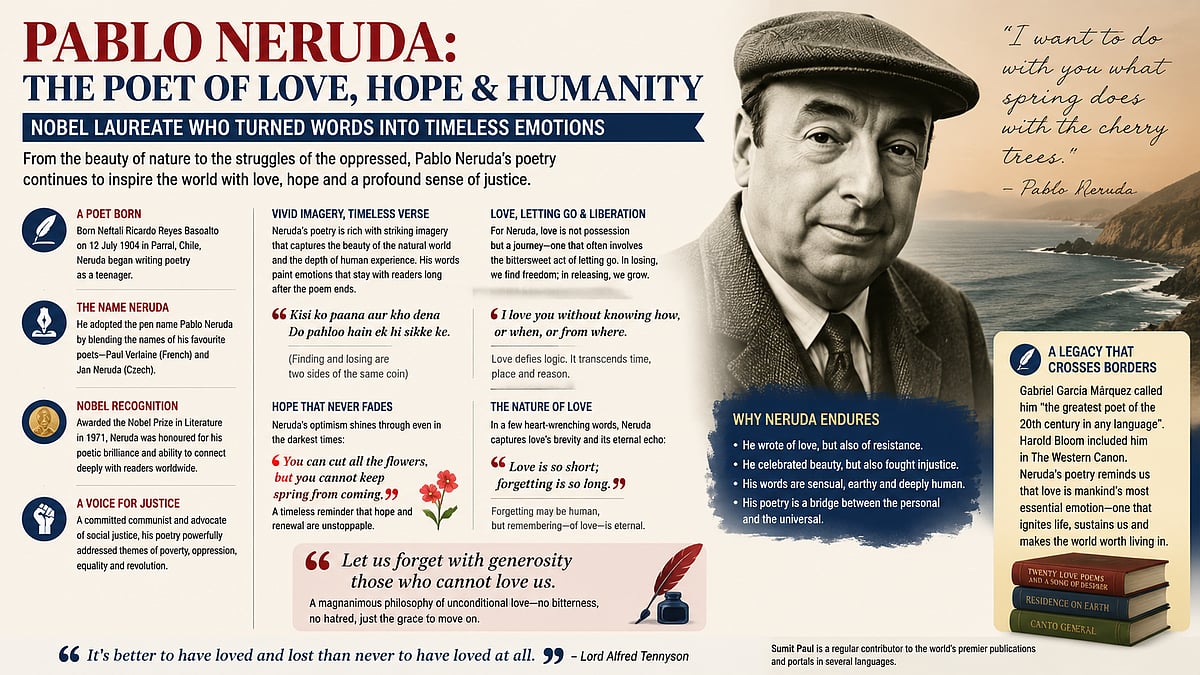
Chilean Nobel laureate Pablo Neruda is considered one of the greatest poets of the 20th century. His work has had a profound impact on the literary world. He was awarded the Nobel Prize in Literature in 1971, recognising his exceptional poetic achievements and his ability to connect with readers on deeply emotional and intellectual levels. Born Neftalí Ricardo Reyes Basoalto in Parral, Chile, on 12 July 1904, Neruda began writing poetry at a young age. He derived the pen name Pablo Neruda, as a teenager, after tweaking the names of two of his favourite poets, Paul Verlaine (French) and Jan Neruda (Czech).
From the early stages of his career, Neruda displayed a remarkable ability to capture the essence of human experience and the beauty of the natural world in his verse. One of the most notable features of Neruda's poetry is his use of vivid and striking imagery. His words paint pictures in the reader's mind, evoking powerful emotions and creating a profound sense of connection with the world around us. Whether he is describing landscapes, people, or abstract concepts, Neruda's imagery is often sensual and earthy, inviting the reader to fully immerse themselves in his poetic universe. Neruda's poetry also reflects his deep political and social convictions. He was a staunch communist and an ardent supporter of social justice, and these themes pervade much of his writing. Through his words, Neruda expressed his concern for the downtrodden and oppressed, advocating for equality and revolution. His poems often tackle issues such as poverty, class struggle, and political repression, offering sharp social commentary and a call to action.
In these turbid and turbulent times, Neruda's poetry comes as a whiff of fresh air. His poetry is a zephyr in the desert of desolation, deprivation, and also depravation. Here it must be made clear that the detractors of Neruda's poetry called him “a poet of depravation” or moral degeneration. Sorry, his poetry cannot be called depraved or decadent. Love wasn't just sensuality or sexuality for Neruda; neither was it a possession or an object. To Neruda, love often intertwines with the bittersweet act of letting go, be it a person, a memory, or a moment. Neruda suggests that both love and letting go can evoke similar emotions and sensations, ultimately leading to a sense of liberation and growth. In the end, the act of loving and releasing becomes a transformative and harmonious journey in which we learn to cherish the beauty of impermanence and embrace the ever-changing nature of our lives.
"Kisi ko paana aur kho dena/ Do pahloo hain ek hi sikke ke" (Finding and losing are two sides of the same coin). The pragmatism of (human, not essentially lovers) relationships is the key to Neruda's delectable poetry. In fine, Neruda knows only love, not caring about its ramifications and consequences. He loves for the sake of love. "I love you without knowing how, or when, or from where." It speaks to the inexplicable nature of love, how it surpasses rationality and defies logic. Love, in its most genuine form, cannot be quantified or defined by its origins or the circumstances surrounding it. It is a force that transcends boundaries, defying time and place. This quote of Neruda celebrates the magical and unconditional nature of love, suggesting that the power of affection lies in its ability to exist beyond the confines of reason, sparking connections that are beyond comprehension.
Hope is an indispensable element that always remains with Neruda, whether it's his poetry, life or love: "You can cut all the flowers, but you cannot keep spring from coming." Here, he beautifully captures the essence of life's unstoppable cycle. By using flowers as a metaphor for joy, growth, and rejuvenation, Neruda signifies the unstoppable force of nature's renewal. It reminds us that even during times of struggle or hardship, the arrival of spring can never be halted. Just as the flowers continue to bloom, bringing colour and beauty to the world, so, too, does the promise of hope and new beginnings persist. Like the resilience of nature, this quote serves as a reminder that no matter the challenges we face, there is always a glimmer of optimism waiting to awaken within us. Having read Neruda's profoundly optimistic aphorism, the discerning readers are invariably reminded of PB Shelley's immortal line, ‘If winter comes, can spring be far behind?’ (Ode to the West Wind). Patjhad aaya toh aaya, vasant ko kaun rok paaya?
Who can forget his immortal line from Tonight I Can Write, ‘Love is so short; forgetting is so long?’ Pablo Neruda encapsulates the intricacies of love and its enduring impact on the human heart through the profound statement. With these simple yet evocative words, he reveals the fleeting nature of love, highlighting its transitory and fragile essence. The brevity of love's existence contrasts starkly with the seemingly eternal process of forgetting, emphasising the profound effect that love can have on one's memory and emotional landscape. Neruda's introspective contemplation serves as a poignant reminder of the lasting imprint that love leaves behind, even long after its flames have extinguished. Neruda knows that forgetting is not a human trait; remembering is.
And the finest and arguably the most magnanimous line in the entire history of world literature ensued from the magical quill of the Chilean genius ‘Let us forget with generosity those who cannot love us’. It's the problem of a majority of people not being able to love me or a select few. I harbour no hatred, no bitterness and no rancour. I just forget those unloving souls without hard feelings. Here, Neruda is not bothered about people's perceptions of love. He's focused only on his unconditional love. To quote Rais Munawwar, "Bas mein mere bas itna hi toh hai/ Mashaal muhabbat ki kabhi bujhne na doon" (This is all I can do/ Not to let the torch of love get extinguished).
In its simplest form, love serves as a fire that ignites our existence, providing warmth, nourishment, and a sense of purpose. The love (even if it's not so intense) we receive from those we hold dear becomes an essential source of energy, sustaining us through the ups and downs of life and fuelling our desires, dreams, and aspirations. It is through these connections that we find fulfilment and meaning, for it is the love that truly breathes life into our souls. Wish the world could imbibe Neruda's lofty philosophy. Interpersonal relationships would have been so positively different, and the whole world would have been a much better place to live in.
It's not for nothing that the Colombian novelist Gabriel García Márquez once called Pablo Neruda "the greatest poet of the 20th century in any language", and the critic Harold Bloom included Neruda as one of the writers central to the Western tradition in his book The Western Canon. The so-called eroticism in Neruda's poetry is perceived eroticism. It's the readers' intentional fallacy that finds extreme sensuality in Neruda's works; just like his Indian contemporary Raghupati Sahay 'Firaq' Gorakhpuri's poetry appears to exude elements of anti-puritanism to the callow readers. Poetry needs to be cracked on the surface to get into its crux. Neruda reminds all of us that love is mankind's essential emotional and universal behaviour. Whether you lose it is inconsequential. "It's better to have loved and lost than never to have loved at all" (Lord Alfred Tennyson).
Sumit Paul is a regular contributor to the world’s premier publications and portals in several languages.

